

TL;DR:
- Active ingredients deliver measurable skin benefits, while base ingredients mainly serve as carriers or preservatives.
- Reading ingredient lists from top to bottom helps assess whether key actives are present in effective concentrations for visible results.
You’ve stared at an ingredient list that looks more like a chemistry exam than a product label. We get it. Understanding ingredient benefits in skincare is one of the most searched topics in beauty for good reason. What you put on your skin every day actually matters, and the difference between glowing skin and wasted money often comes down to knowing which ingredients do what. This guide cuts through the noise, looks at the science, and gives you a clear picture of which actives are worth your attention and how to use them effectively.
Table of Contents
- Key takeaways
- Ingredient benefits in skincare: what actives actually are
- Popular active ingredients and their proven skin benefits
- What ingredient marketing often gets wrong
- How to apply ingredient knowledge to your routine
- A quick reference guide to ingredient categories
- My honest take on skincare ingredients
- Simple, effective formulations from Smplskin
- FAQ
Key takeaways
| Point | Details |
|---|---|
| Actives drive real results | Active ingredients are the working components that deliver measurable skin benefits, not fillers or bases. |
| Concentration matters | An ingredient needs to be present at an effective percentage to produce visible results in your skin. |
| Antioxidants and hydrators are foundational | Vitamin C, hyaluronic acid, niacinamide, and ceramides have the strongest clinical evidence behind them. |
| Consistency beats miracle products | A simple routine used consistently outperforms chasing trendy single ingredients without evidence. |
| Read labels critically | Ingredient lists follow descending concentration order, so a hero ingredient listed last is likely underdosed. |
Ingredient benefits in skincare: what actives actually are
Not every ingredient in your moisturiser is doing the same job. Products are made up of several layers: the base or vehicle (water, oils, silicones), sensory ingredients (fragrances, texturisers), preservatives, and then the actives. Active ingredients are the ones with a documented physiological effect on the skin. They are the reason you buy the product.
Understanding this distinction matters because marketing often blurs the line. A product can contain a brilliant active at a concentration too low to be effective, and you would never know unless you understood how to read the label.
Here is how the main ingredient categories break down:
- Active ingredients: Scientifically proven to change skin structure or function (e.g., retinol, vitamin C, AHAs)
- Base/carrier ingredients: Deliver actives to the skin and form product texture (e.g., water, glycerin, oils)
- Preservatives: Extend shelf life and prevent contamination (e.g., phenoxyethanol)
- Sensory additives: Affect how a product feels or smells without contributing skin benefits
Ingredient lists follow INCI conventions, which means all cosmetic products must list ingredients in descending concentration order. Actives frequently appear lower on labels than their marketing position suggests. When you see an ingredient buried near the end of a long list, its concentration is likely below the threshold needed to do anything meaningful.
It is also worth knowing the difference between cosmetic and drug actives. Sunscreen actives like zinc oxide are regulated as drugs in many countries because they change skin function. Most other skincare actives fall under cosmetic regulation, meaning claims are more loosely governed.
Pro Tip: When assessing a new product, find the key active ingredient on the label and check whether it appears in the first half of the list. If it is sitting after the preservatives, it may not be concentrated enough to deliver the promised benefit.
Popular active ingredients and their proven skin benefits
This is where the evidence gets interesting. Not all actives are created equal. Some have decades of clinical data. Others are riding a wave of social media hype. Here is a breakdown of the ingredient categories with the strongest scientific backing.
Antioxidants
Topical vitamin C at 10 to 20% concentrations and an acidic pH is one of the most validated active ingredients for addressing photodamage and hyperpigmentation. It neutralises free radicals generated by UV exposure and stimulates collagen synthesis. Vitamin E works synergistically with vitamin C, enhancing stability and protective effects. These are among the top antioxidant ingredients with genuine clinical weight behind them.

Exfoliants
AHAs exfoliate surface layers, making skin more receptive to other actives. BHAs like salicylic acid penetrate the pore lining, making them highly effective for acne and congested skin. Glycolic acid (an AHA) has the smallest molecule size in its category, giving it better penetration and faster results on skin texture. Lactic acid is a gentler option that also offers mild hydrating properties.
Hydrators and barrier support
Niacinamide at 5% has clinical data showing visible improvements in skin texture and tone over 8 to 12 weeks, and it starts reducing water loss within just 2 to 4 weeks by improving barrier lipids. It is genuinely one of the most versatile actives available. The skincare benefits of hyaluronic acid are real but often misunderstood. It draws moisture from the environment into the skin, providing short-term plumping. Ceramides support barrier function and can improve skin hydration, smoothness, and firmness, particularly when used consistently.
Retinoids
Retinoids promote cell turnover and collagen production, reducing fine lines and improving skin texture over time. They range in potency from prescription tretinoin down to over-the-counter retinol and retinaldehyde. Starting with a lower concentration and introducing retinoids gradually avoids the irritation that puts many people off this otherwise highly effective category.
| Ingredient | Primary benefit | Evidence level |
|---|---|---|
| Vitamin C (L-ascorbic acid) | Antioxidant, brightening, collagen support | Strong clinical evidence |
| Niacinamide | Barrier repair, texture, pigmentation | Strong clinical evidence |
| Hyaluronic acid | Hydration, plumping | Moderate, temporary effects |
| Retinol/retinoids | Cell turnover, anti-aging, acne | Strong clinical evidence |
| Ceramides | Barrier function, moisture retention | Strong clinical evidence |
| Glycolic acid (AHA) | Exfoliation, texture, tone | Strong clinical evidence |
| Salicylic acid (BHA) | Pore clearing, acne | Strong clinical evidence |
Pro Tip: The benefits of vitamins in skincare are real, but stability matters. Vitamin C degrades quickly when exposed to light and air. Look for formulations in opaque or airtight packaging and check the colour of the product. A darkened serum has likely oxidised.
What ingredient marketing often gets wrong
Here is the uncomfortable truth. Many ingredients with bold claims on the front of the packaging have very limited evidence behind them. Many popular ingredients like hyaluronic acid offer genuine but temporary hydration. The error is in expecting them to permanently transform skin on their own.
Peptides often fail to penetrate the skin effectively due to their molecular size and formulation instability, meaning their celebrated collagen-stimulating claims may not translate into real results without very specific delivery systems. That does not make them useless. It means you should not pay a premium for a peptide-heavy product expecting miracles.
“Successful anti-aging skincare relies on combinations of sun protection, retinoids, and antioxidants rather than single miracle ingredients.” (Source: Selflondon)
Formulation also matters as much as the ingredient itself. A water-based formula carries water-soluble actives differently than an oil-based one. Delivery vehicles like liposomes, encapsulation, and emulsification technology affect whether an active even reaches the target layer of skin. This is why ingredient effectiveness in skincare is inseparable from how the product is made, not just what it contains.
Some other common pitfalls to watch for:
- Ingredients listed on marketing materials that do not appear at effective concentrations in the actual formula
- Essential oils in skincare benefits are real for some functions, but they can also be sensitising for reactive skin types
- Natural ingredient advantages are sometimes overstated when the synthetic version of the same compound performs identically or better
- Claims like “clinically tested” mean very little without access to the actual study data
The most important shift you can make is from product chasing to routine building. A consistent routine with three or four proven ingredients will outperform a cabinet full of “miracle” serums used inconsistently.
How to apply ingredient knowledge to your routine
Knowing what ingredients do is only useful if you know how to use them. Here is a practical approach to putting it all together.
-
Identify your skin concerns. Are you dealing with dehydration, pigmentation, texture, acne, or sensitivity? Different concerns call for different actives. Matching the ingredient to the concern is the starting point.
-
Check the 1% rule in skincare. Ingredients listed below the 1% threshold (roughly the point at which preservatives appear on a label) may not be present in meaningful amounts. This helps you assess whether a hero ingredient is actually doing any work.
-
Layer correctly. Apply actives from thinnest to thickest texture. Water-based serums go on before oils and creams. Avoid applying AHAs or BHAs directly before retinoids on the same evening. Layering actives correctly prevents irritation and maximises each ingredient’s effectiveness.
-
Protect with SPF daily. Vitamin C, retinoids, and AHAs all increase photosensitivity or are degraded by UV exposure. Using them without daily sun protection undermines the results. SPF is not optional when using actives. It is what makes them work over time.
-
Avoid known incompatible combinations. Do not mix AHAs or BHAs with retinoids in the same application. Avoid layering niacinamide directly with high-concentration vitamin C (10%+) without a buffer, as it can cause flushing. Check for ingredients to avoid together before adding something new to your routine.
Pro Tip: When adding a new active ingredient, introduce it every third day for the first two weeks. This gives your skin time to adjust without triggering sensitivity or compromising your existing routine.
A quick reference guide to ingredient categories
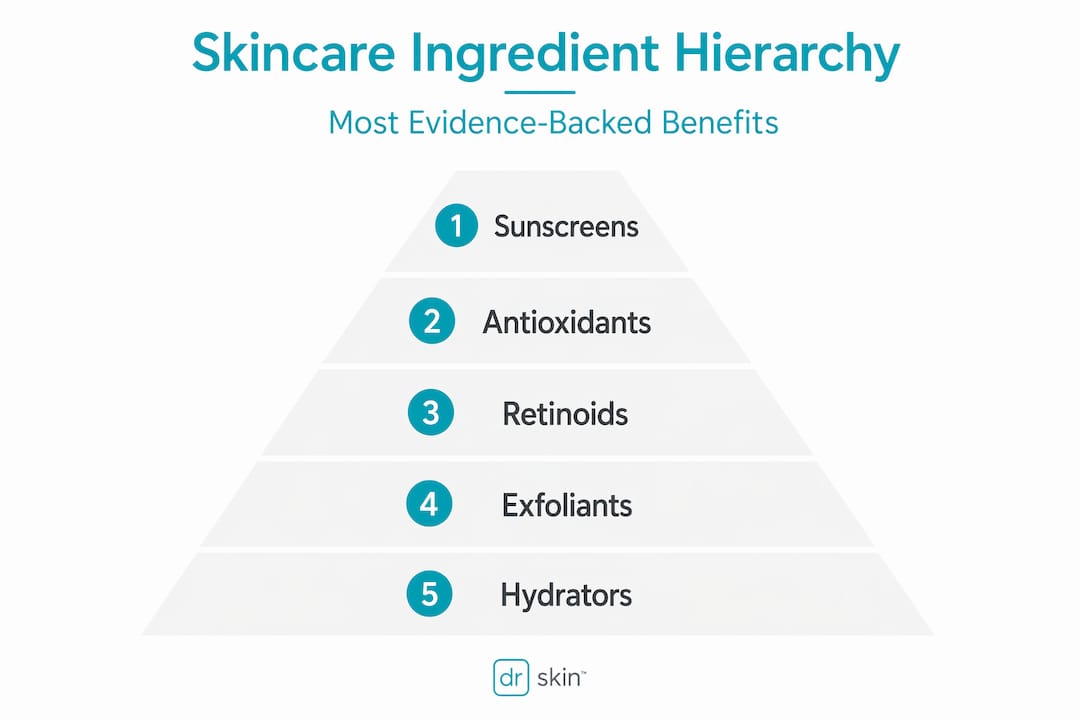
This table gives you a practical reference for assessing any ingredient you come across. Global expert consensus recommends ceramides, hyaluronic acid, niacinamide, and peptides for barrier support and skin health, making them safe foundational choices for most skin types.
| Category | Key ingredients | Core benefit | Works best when |
|---|---|---|---|
| Antioxidants | Vitamin C, Vitamin E, CoQ10 | UV protection, brightening, anti-aging | Used in the morning with SPF |
| Exfoliants | Glycolic acid, lactic acid, salicylic acid | Texture, tone, pore clearing | Used 2 to 3x per week, not with retinoids |
| Hydrators | Hyaluronic acid, glycerin | Moisture attraction and retention | Applied to damp skin before moisturiser |
| Barrier repair | Ceramides, niacinamide | Reduces water loss, calms irritation | Used daily, morning and evening |
| Cell renewal | Retinol, retinaldehyde | Collagen, cell turnover, anti-aging | Used at night, with gradual introduction |
The goal is a short list of evidence-backed ingredients used consistently, not a long list of trending actives used occasionally. Simple, targeted routines built on proven basics will always outperform complexity.
My honest take on skincare ingredients
I have spent years looking at the evidence behind skincare ingredients, and the single biggest problem I see is not ignorance. It is overwhelm. Consumers are bombarded with new ingredients every season, and the marketing machine is extraordinarily good at making everything sound essential.
What I have learned is that the fundamentals almost never change. Sunscreen, a reliable antioxidant, a gentle exfoliant, and a solid barrier repairing moisturiser will handle 80% of what most people need. Everything else is nuance.
I am also genuinely cautious about the natural ingredient advantages narrative. “Natural” does not automatically mean effective or safe. Some of the most irritating ingredients in skincare come from plants. Some of the most effective actives are synthesised in labs. The question is always: what does the evidence say?
The brands I trust are the ones that list their concentrations, reference actual clinical data, and do not promise results they cannot back up. Transparency is not just a marketing word. It is how you know a brand actually believes in what they are formulating.
My practical advice: build your routine around three to five proven actives, be patient enough to give them 8 to 12 weeks to show results, and stop adding new products before the current ones have had a chance to work.
— Werner
Simple, effective formulations from Smplskin
At Smplskin, we built our product range around exactly the ingredients discussed in this article. No unnecessary fillers. No inflated claims. Just formulations anchored in clinically supported actives designed for everyday use. Our gentle cleanser and SPF 15 moisturiser duo gives you the foundational protection and hydration your skin needs, combining barrier-friendly ingredients with daily sun protection in a simple two-step format. If you are ready to stop guessing and start seeing real results, our products are a practical starting point. We are transparent about what goes into every formula because we believe you deserve to know exactly what you are putting on your skin.
FAQ
What are active ingredients in skincare?
Active ingredients are the components in a skincare product that have a proven, measurable effect on the skin, such as reducing wrinkles, clearing acne, or improving hydration. They are distinct from base or carrier ingredients that simply deliver the formula.
How do I know if an ingredient is present at an effective concentration?
Check its position on the ingredient list. Ingredients are listed in descending order of concentration, so actives near the bottom of a long list are likely underdosed. The 1% rule is a useful guide: ingredients listed after common preservatives are probably below 1%.
What are the most evidence-backed skincare ingredients?
Vitamin C, niacinamide, retinoids, ceramides, and AHAs like glycolic acid have the strongest clinical evidence. They address a wide range of concerns from pigmentation and aging to barrier repair and acne.
Can I use multiple active ingredients together?
Yes, but with care. Some combinations reduce each other’s effectiveness or cause irritation. Avoid using AHAs and retinoids at the same time, and introduce new actives gradually to allow your skin to adapt without reacting.
Is hyaluronic acid really as effective as claimed?
Hyaluronic acid is a genuinely useful hydrator that attracts moisture to the skin. Its effects are real but temporary. It works best as part of a broader routine that addresses the skin barrier, not as a standalone treatment.
Recommended
- Skin formulations explained: what actually works – SMPL SKIN South Africa
- Skin health explained: simple science for better results – SMPL SKIN South Africa
- Postbiotic skincare: 5 key benefits for healthy skin – SMPL SKIN South Africa
- Skincare ingredients to avoid for healthier skin – SMPL SKIN South Africa