

TL;DR:
- Skincare sets streamline routines by providing compatible products and proper layering, reducing irritation and confusion. They are designed around essential products like cleansers, moisturisers, and sunscreens, with advanced sets targeting specific concerns through targeted actives. Using sets consistently and layering correctly enhances results, while patch testing and choosing the right set for your skin type prevent adverse reactions and wasted money.
You walk into a pharmacy and face a wall of serums, toners, cleansers, and creams. Each promises results. None tells you which goes with which. This is exactly where the role of skincare sets becomes clear. A well-designed set removes the guesswork. It gives you compatible products, a logical order, and a routine that actually sticks. Whether you are new to skincare or just exhausted by the options, sets offer something valuable: a starting point that makes sense.
Table of Contents
- Key takeaways
- What skincare sets are actually made of
- How to layer your skincare set correctly
- Why skincare sets outperform random product collections
- Introducing new products without stressing your skin
- How to choose the right skincare set for your skin
- My honest take on skincare sets and why they work
- Start simple with Smplskin’s duo set
- FAQ
Key takeaways
| Point | Details |
|---|---|
| Sets reduce product confusion | Curated sets match ingredients and pH levels, lowering irritation risk compared to mixing random products. |
| Layering order matters | Applying products from thinnest to thickest consistency unlocks their full absorption potential. |
| Patch testing is non-negotiable | Introduce new actives one at a time and patch test first, even when products come in a set. |
| Consistency drives results | Simplified routines from sets improve adherence, which is more important than product complexity. |
| Skin type guides your choice | Identifying your skin type and primary concern before buying a set prevents wasted money and skin stress. |
What skincare sets are actually made of
Most people assume skincare sets are just a marketing bundle. The reality is more useful than that. A good set is designed around a complete routine, with each product filling a specific role in the sequence.
The core three products you will find in most basic sets are a cleanser, a moisturiser, and a sunscreen. These cover the non-negotiables: removing impurities, restoring hydration, and protecting against UV damage. If a set only contains these three, it is still a functional daily routine.
More advanced sets add products that target specific concerns:
- Toners rebalance skin pH after cleansing and prep the skin to absorb what comes next.
- Serums deliver concentrated actives like vitamin C, niacinamide, or hyaluronic acid to address concerns like brightness, pigmentation, or dehydration.
- Exfoliants (chemical or physical) remove dead skin cells to improve texture and allow better product penetration.
- Eye creams address the thinner, more delicate skin around the eyes where fine lines and puffiness tend to appear first.
Here is a quick comparison to help you decide which type of set fits your current needs:
| Set type | Best for | Typical products included |
|---|---|---|
| Routine set | Beginners or those simplifying | Cleanser, moisturiser, SPF |
| Targeted solution set | Specific concerns (acne, ageing) | Cleanser, toner, active serum, moisturiser |
| Professional at-home set | Advanced users wanting results | Serum, firming treatment, targeted moisturiser |
Understanding what is in your set, and why each product is there, makes you a more confident user. Check out the everyday skincare essentials guide from Smplskin for a deeper breakdown of what each product type does.
How to layer your skincare set correctly
This is where most people lose the benefits they paid for. The order in which you apply products is not arbitrary. It follows a simple logic: thinnest to thickest consistency, so each layer absorbs properly without being blocked by a heavier formula.
Here is the standard layering order for a morning routine:
- Cleanser – Start with a clean canvas. Removes overnight sebum, sweat, and residue.
- Toner – Apply while skin is still slightly damp. Rebalances pH and preps for absorption.
- Serum – The most concentrated step. Apply to targeted areas and press in gently.
- Eye cream – Pat around the orbital bone. Never drag or rub the skin here.
- Moisturiser – Seals in hydration and the layers beneath it.
- Sunscreen – The final AM step, always. No exceptions.
For evening routines, the sequence stays the same but sunscreen is replaced by a heavier night moisturiser or treatment product. Smplskin’s guide on layering skincare products covers both morning and evening sequences in detail.
Timing matters more than most people realise. Dermatologists recommend waiting 30 to 60 seconds between lighter layers like toner and serum, and up to 3 minutes after heavier products before applying the next step. This gives each formula time to absorb rather than sitting on top of the previous one and diluting it.
Pro Tip: If you are applying a vitamin C serum in the morning, do not combine it with benzoyl peroxide. These two actives cancel each other out and can cause irritation. Use vitamin C in the morning and benzoyl peroxide in the evening if both are needed.
One often-overlooked benefit of using a set is that the products are already formulated to work in sequence. You are not guessing whether your toner’s pH will undermine your serum’s active ingredients. That compatibility is built in, which is why understanding the role of skincare sets goes beyond convenience.
Why skincare sets outperform random product collections
Here is the honest case for sets over picking individual products from different brands and hoping they work together.
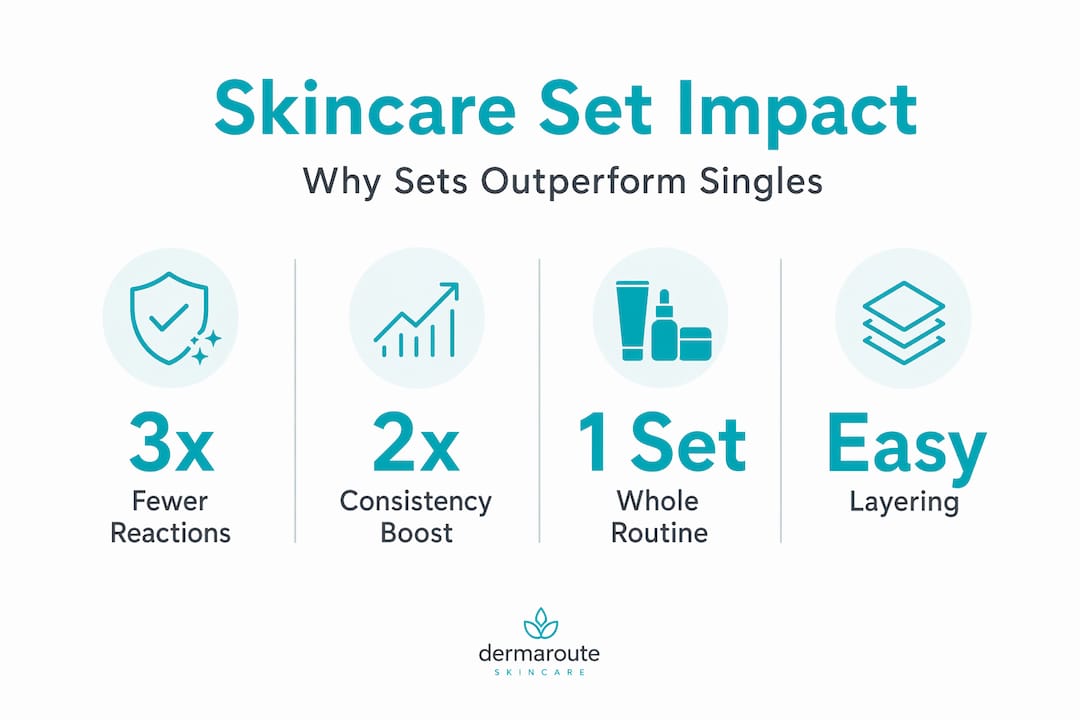
Complete skincare sets are designed with matched pH levels and complementary actives, which directly reduces the risk of irritation and product conflict. When you mix products from different brands, you are combining formulas that were never tested together. That creates unpredictable interactions between actives, preservatives, and pH levels.
The benefits of adopting a set are real and measurable:
- Less irritation. Compatible formulations reduce the chance of redness, breakouts, or barrier disruption.
- Better results. Products designed to work in sequence support each other’s efficacy rather than competing.
- Improved consistency. A defined AM and PM routine is easier to follow than a loosely assembled collection of products.
- Cost efficiency. Sets are often priced more competitively than buying each product separately.
- Lower decision fatigue. You stop spending 20 minutes in a shop reading ingredient labels and just get on with it.
Market data supports this too. Trial sets see 20 to 30% higher repeat purchase rates than single products, which reflects how much easier sets make the experience of building a sustainable routine.
“Skincare sets simplify adoption and reduce trial friction, which behaviorally supports better routine adherence and outcomes.” — IndexBox, Face Sets Market Report
Consistency is where skin health is actually built. A simple routine you follow every day beats a sophisticated one you use three times a week. Sets make that consistency easier to achieve.
Introducing new products without stressing your skin
Even when products come in a set designed to work together, your skin still needs time to adjust. Jumping into a full new routine overnight is one of the most common mistakes people make.
The smarter approach is staggered introduction:
- Start with the gentlest products first: cleanser and moisturiser for the first week.
- Add the toner in week two and observe how your skin responds.
- Introduce the serum or any active ingredient in week three.
- If you are using exfoliants, add them last and limit use to two or three times per week initially.
Patch testing is the step most people skip because it feels unnecessary. It is not. Apply a small amount of each new product to your inner forearm or behind your ear and wait 24 to 48 hours. If there is no redness, itching, or swelling, you are clear to use it on your face.
Pro Tip: Keep a simple skin diary for the first month of a new set. Note the date you introduced each product, any changes in your skin, and how it feels morning and evening. This makes it easy to identify which product caused a reaction if one appears.
Applying multiple actives simultaneously disrupts your skin’s pH and barrier. Dermatologists recommend using one active ingredient per routine and staggering strong ingredients like retinol, AHAs, BHAs, and vitamin C across different sessions. Even if your set includes several actives, you may need to rotate them between morning and evening rather than stacking them all at once.
If your skin is highly sensitive or reactive, a dermatologist consultation before starting a new set is worth the time.
How to choose the right skincare set for your skin
Knowing what to look for before you buy saves you from wasting money on a set that was never right for your skin. Use this checklist:
- Know your skin type. Oily, dry, combination, sensitive, and normal skin all need different formulations. A set built for oily skin will strip a dry skin type. Get this right first.
- Identify your primary concern. Anti-ageing, acne control, brightening, and calming are all valid goals. Look for sets specifically designed around that concern rather than general sets.
- Read the ingredient list. Look for actives that target your concern and avoid ingredients you know cause reactions. If niacinamide worked for you before, look for it.
- Check for clear usage instructions. A good set comes with guidance on order of application and timing. If the brand does not tell you how to use their products together, that is a red flag.
- Choose a reputable brand. Look for transparency around formulation, ingredient sourcing, and skin testing. Smplskin’s guide on choosing skincare products walks you through this process with practical clarity.
For those interested in understanding what professional skincare at home actually means, it comes down to formulation quality and targeted actives. Professional grade sets use higher concentrations of proven ingredients and are designed for consistent, measurable results rather than general maintenance.
My honest take on skincare sets and why they work
Over the years, I have seen the same pattern repeat with skincare. People start with good intentions, buy six different products from six different brands, layer them all on day one, and then wonder why their skin reacts badly. The set concept solves this almost entirely, but only if you respect the process.
What I have learned is that consistency is the actual active ingredient in any skincare routine. A basic set used every single day will outperform an elaborate, inconsistently used routine every time. Sets make consistency easier because the decisions are already made for you.
The layering discipline is something I feel strongly about. Skipping the waiting time between layers or applying products in the wrong order genuinely undermines what you paid for. It takes 90 extra seconds to do it right. That is worth it.
Patch testing is the most underrated step in skincare and the one people regret skipping most. I have seen people abandon entire routines because of a reaction that could have been caught with a simple forearm test.
Skincare sets reduce choice paralysis and that is not a minor benefit. When you stop second-guessing every product interaction, you actually start using your routine. And that is when results happen.
— Werner
Start simple with Smplskin’s duo set
If you have been looking for a clean entry point into a consistent skincare routine, Smplskin has made that decision easy.
The Gentle Cleanser and SPF 15 Moisturiser Duo is exactly what it sounds like: a two-step morning routine that covers cleansing and daily sun protection in one straightforward package. It is formulated with German Chamomile and Cucumber Extract to keep things calm, hydrated, and effective without unnecessary complexity. For those who want to go further, Smplskin also offers individual products like the SPF 15 Daily Moisturiser to build out a more complete routine at your own pace. Simple, effective, and made to actually use every day.
FAQ
What is the role of skincare sets in a daily routine?
Skincare sets provide a curated selection of compatible products designed to be used in sequence, making it easier to build a consistent routine without worrying about ingredient conflicts or product order.
How do you layer products from a skincare set?
Apply products from thinnest to thickest consistency: cleanser, toner, serum, eye cream, moisturiser, and sunscreen last in the morning. Waiting 30 to 60 seconds between lighter layers improves absorption.
Are skincare sets better than buying individual products?
For most people, yes. Sets use matched formulations that reduce irritation risk and work synergistically, while also simplifying the routine enough to support long-term consistency.
Do you still need to patch test products from a skincare set?
Yes. Even products in a set should be patch tested individually, especially if you have sensitive or reactive skin. Introduce one new product at a time to identify any reactions clearly.
How do I choose a skincare set for my skin type?
Identify your skin type and primary concern first, then look for a set specifically formulated for those needs. Read the ingredient list and prioritise brands that provide clear application guidance.
Recommended
- Everyday skincare essentials list for simple, healthy routines – SMPL SKIN South Africa
- Skincare routine tips: 4 steps to a daily glow – SMPL SKIN South Africa
- How to choose skincare products for a simple routine – SMPL SKIN South Africa
- How to achieve healthy skin with a simple routine – SMPL SKIN South Africa