

TL;DR:
- A minimalist skincare routine with five key products outperforms complex routines, reducing irritation.
- Daily sunscreen is essential; other actives like Vitamin C and retinoids are optional but beneficial.
- Consistency and lifestyle habits are crucial for long-term skin health and visible improvements.
Glowing, resilient skin does not require a bathroom shelf overflowing with products. Yet most of us have been there: standing in a pharmacy aisle, paralysed by serums, toners, essences, and exfoliants, each promising transformation. The truth is simpler and more empowering. Research consistently shows that a focused, five-product routine outperforms a chaotic ten-step one, reducing irritation and actually delivering results. In this guide, we walk you through exactly what products to use, when to use them, and how to adapt the routine to your skin’s unique needs so you can stop guessing and start seeing real change.
Table of Contents
- What you need for healthy, minimalist skincare
- The step-by-step routine: morning and evening
- Customizing for your skin type: sensitive and acne-prone skin
- Maximizing results: lifestyle habits and routine consistency
- What most people get wrong about achieving healthy skin
- Streamline your routine with professional-grade essentials
- Frequently asked questions
Key Takeaways
| Point | Details |
|---|---|
| Minimal products, maximum results | Sticking to cleanser, moisturizer, sunscreen, and one or two targeted actives is proven most effective for healthy skin. |
| Consistency is key | Daily routines using high-quality ingredients yield measurable improvements in weeks to months. |
| Personalize for your skin | Adapt your regimen for sensitive, acne-prone, or special situations to avoid irritation and strengthen your skin barrier. |
| Lifestyle matters | Good sleep, healthy diet, and avoiding smoke or excess sun amplify the benefits of your professional skincare routine. |
What you need for healthy, minimalist skincare
With the challenges of skincare overload in mind, let’s clarify which products actually make a difference according to the latest research.
A core minimalist routine for healthy skin comes down to five categories: a gentle cleanser, a moisturiser, a broad-spectrum SPF 30+ sunscreen, an optional antioxidant like Vitamin C for the morning, and an optional retinoid for the evening. That’s it. Keeping your routine to five products or fewer dramatically reduces the risk of irritation and product interference, and makes consistency far easier to maintain.
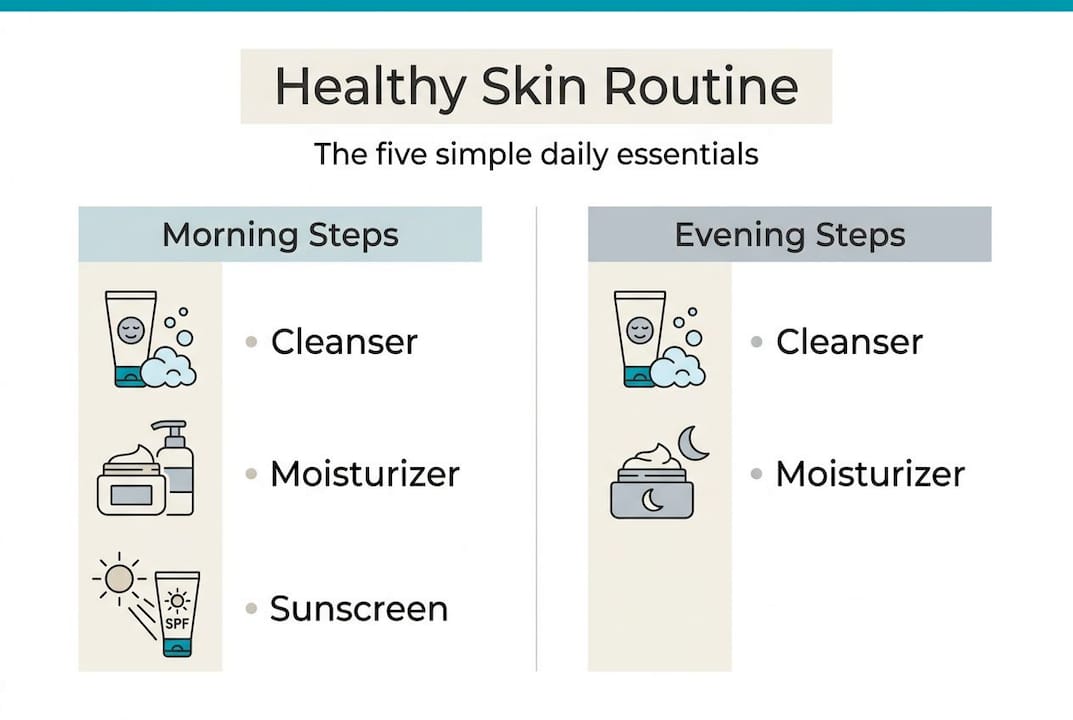
Sunscreen is the one non-negotiable. Full stop. No active ingredient, no serum, and no moisturiser can undo the daily damage caused by unprotected UV exposure. Everything else is secondary. If you want to explore simple routines for hydration as a starting point, that is a great place to begin building your foundation.
Essentials vs. nice-to-haves:
- Essentials: Gentle cleanser, moisturiser, SPF 30+ sunscreen
- High-value add-ons: Vitamin C serum (AM), retinoid (PM)
- Nice-to-haves: Eye cream, toner, facial oil (only if your skin genuinely needs them)
- Skip entirely: Anything with a long list of fragrances or alcohol high on the ingredient list
For more tailored guidance on building your base, these easy routines for hydrated skin offer practical direction. The key skin care tips from dermatologists reinforce this same minimalist thinking.
| Product type | Purpose | When to use |
|---|---|---|
| Gentle cleanser | Removes dirt, oil, and pollutants | AM and PM |
| Moisturiser | Hydrates and supports skin barrier | AM and PM |
| SPF 30+ sunscreen | Prevents UV damage and photoaging | AM (last step) |
| Vitamin C serum | Antioxidant protection, brightening | AM (after cleanser) |
| Retinoid | Cell renewal, anti-aging, acne | PM (after moisturiser or before) |
The step-by-step routine: morning and evening
Now that you know what to buy, here’s the exact process for using each product to maximise results, morning and night.
Morning routine:
- Cleanse with a gentle, pH-balanced cleanser
- Apply Vitamin C serum and allow it to absorb for 30 seconds
- Follow with your moisturiser
- Finish with SPF 30+ sunscreen as your absolute last step
Evening routine:
- Cleanse thoroughly to remove sunscreen, sweat, and pollution
- Apply moisturiser to damp skin for better absorption
- Apply retinoid on top or as directed by the product
- If your skin feels dry, a second layer of moisturiser can be added
Product order matters more than most people realise. Thinner, water-based products go first, followed by thicker creams and oils. This ensures active ingredients actually reach the skin rather than sitting on top of a barrier.
A Delphi consensus among dermatologists found that retinoids rank highest for targeting wrinkles, acne, dark spots, enlarged pores, and oily skin, while Vitamin C leads for brightening and wrinkle reduction, and niacinamide performs best for redness and dark spots. Knowing this helps you choose add-ons with purpose rather than guesswork.
Pro Tip: Apply sunscreen every single morning, even if you work indoors or it’s overcast outside. UV light penetrates clouds and windows. Skipping it even occasionally adds up to measurable photoaging over time.
For a deeper look at how to build a healthy skin regimen step by step, we cover the layering logic in detail. You can also explore postbiotic skincare benefits if you want to support your skin’s natural microbiome alongside your routine. Check what dermatologist-recommended ingredients look like in practice to guide your choices.
| Ingredient | Primary benefit | Best time to use |
|---|---|---|
| Vitamin C | Brightening, antioxidant | Morning |
| Retinoid | Anti-aging, renewal, acne | Evening |
| Niacinamide | Redness, dark spots, barrier | AM or PM |
| Mineral SPF | UV protection, anti-aging | Morning (last step) |
Customizing for your skin type: sensitive and acne-prone skin
Even the best simple routine should be tailored. Here’s how to tweak the process for your unique skin challenges.
Not every skin type responds the same way to actives. If you have sensitive skin, the smartest move is to skip Vitamin C and retinoids entirely at first. Focus on ceramide-rich moisturisers and fragrance-free cleansers. Introduce one new product at a time, waiting two weeks before adding another.
For acne-prone skin, consider adding salicylic acid (a beta-hydroxy acid that clears pores) or benzoyl peroxide (which kills acne-causing bacteria) to your routine. These are well-supported by evidence for targeted skin concerns. If you are pregnant, avoid retinoids completely and consult your doctor before using any active ingredients. Post-procedure skin (after peels, laser, or microneedling) needs barrier support only: gentle cleanser, rich moisturiser, and SPF.
Swaps and add-ons for special cases:
- Sensitive skin: Swap Vitamin C for niacinamide; choose mineral SPF over chemical; prioritise ceramides
- Acne-prone: Add salicylic acid cleanser or spot treatment; use oil-free moisturiser
- Pregnant: Remove retinoids; check all actives with your healthcare provider
- Post-procedure: Barrier repair only; no actives until skin is healed
- Dry skin: Add a hydrating serum (hyaluronic acid) between cleanser and moisturiser
“For sensitive or compromised skin, optimising skincare means starting with the absolute minimum and only adding actives once the skin barrier is stable and tolerating products well.”
Pro Tip: Always patch test a new product on your inner arm or behind your ear for 24 to 48 hours before applying it to your face. This simple step saves you from unnecessary breakouts and reactions.
For more guidance on managing reactive skin, our article on solutions for sensitive skin breaks down the approach clearly. You can also find practical ways to boost skin hydration without triggering sensitivity.
Maximizing results: lifestyle habits and routine consistency
You have your plan. Now discover how steady habits and quality products deliver lasting improvement you can measure.
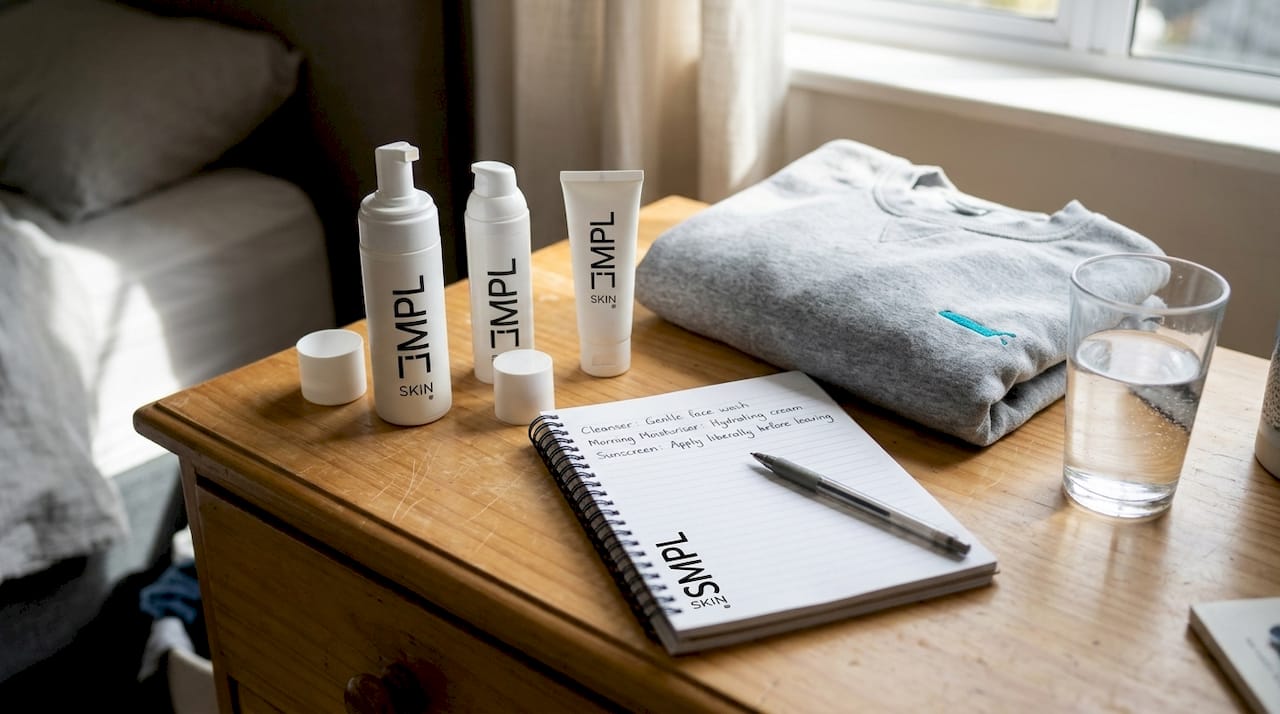
Consistency is the ingredient most people overlook. A consistent routine improves hydration and barrier function within a few weeks, while retinoids show measurable collagen increase and texture improvement over three to six months. Daily SPF use slows photoaging visibly over time. There is no shortcut, but the timeline is more encouraging than most people expect.
Lifestyle habits amplify every product you use. Sleep is when your skin repairs itself. Poor sleep elevates cortisol, which breaks down collagen and triggers inflammation. A diet rich in antioxidants (think colourful vegetables, berries, and healthy fats) supports the skin from the inside. Smoking accelerates collagen degradation and reduces blood flow to the skin, undoing much of what your routine achieves.
Simple habits that maximise your routine’s effect:
- Sleep seven to nine hours consistently
- Drink enough water throughout the day
- Eat a diet high in vegetables, lean proteins, and healthy fats
- Avoid smoking and limit alcohol
- Change your pillowcase at least twice a week
- Never sleep with makeup or sunscreen on your skin
- Reapply SPF every two hours when outdoors
For a practical reset, our guide on how to detoxify your skin at home pairs well with a consistent product routine. Understanding medical-grade product advantages can also help you make smarter choices when upgrading your essentials.
The key mindset shift: stop chasing the next big product launch and start measuring how consistently you use what you already have.
What most people get wrong about achieving healthy skin
With those benchmarks in mind, here’s a candid perspective on what trips most people up on the journey to truly healthy skin.
We see it constantly. Someone tries a new routine, gets impatient after two weeks, and adds three more products. The skin reacts. They blame the original routine. The real culprit is the pile-on approach, not the foundation.
More products do not equal better results. In fact, layering too many actives at once is one of the fastest ways to compromise your skin barrier, which leads to sensitivity, breakouts, and dullness. The irony is that chasing better skin with more products often creates the very problems you are trying to solve.
The science is clear, and so is our experience: the basics win. A gentle cleanser, a solid moisturiser, and daily SPF will outperform a complicated ten-step routine for most people, most of the time. Add one active at a time, give it three months, and actually assess the result before changing anything.
We are also big believers in simple eco-friendly skincare as a parallel value. Fewer products means less waste, less environmental impact, and a cleaner bathroom. Simplicity is not a compromise. It is the smarter choice.
Streamline your routine with professional-grade essentials
Ready to put these principles into action? Start with clinically designed essentials verified by experts.
We have done the work of curating what actually belongs in a minimalist routine. Our products are formulated with ingredients like German Chamomile and Cucumber Extract to support hydration, calm, and protection without unnecessary complexity.
The Gentle Cleanser & SPF 15 Duo is the perfect starting point, giving you two of the three non-negotiable essentials in one bundle. If you want to upgrade your daily protection, the SPF 15 Daily Moisturiser combines hydration and sun protection in a single step. For those ready to target fine lines and firmness, the PRO Firm Serum brings professional-grade performance to your at-home routine. Simple. Effective. Exactly what your skin needs.
Frequently asked questions
How long does it take to see real improvements with a minimalist skincare routine?
Most people notice better hydration and smoother texture within a few weeks. Significant changes from retinoids, including improved collagen and texture, typically appear over three to six months of consistent use.
Should I skip sunscreen if I spend most of my day indoors?
No. UV light penetrates windows and causes cumulative damage even with limited exposure. Daily SPF slows photoaging and prevents collagen breakdown regardless of how much time you spend outdoors.
Which ingredient should I use if I want to target both fine lines and dark spots?
Retinoids and Vitamin C both address wrinkles and dark spots effectively. A Delphi consensus also highlights niacinamide as a strong performer for dark spots and redness concerns.
How do I know if a product is too harsh for my skin?
Burning, persistent redness, flaking, or increased sensitivity are clear signs to stop. For sensitive or reactive skin, return to a gentle, fragrance-free, barrier-focused routine before reintroducing any actives.
Can I use both a retinoid and Vitamin C in my routine?
Yes. Use Vitamin C in the morning for antioxidant protection and your retinoid at night for renewal. This timing maximises both ingredients without interference.
Recommended
- Build a healthy skin regimen: simple routines for hydration – SMPL SKIN South Africa
- Detoxify your skin at home: simple routines for results – SMPL SKIN South Africa
- Sustainable skincare: A simple guide to eco-friendly routines – SMPL SKIN South Africa
- Simple men’s skincare: Easy routines for hydrated skin – SMPL SKIN South Africa
- Why Simple Skincare Matters for Modern Men – NORML
- Maintain natural skin health with a medically guided workflow