

TL;DR:
- A minimalist skincare routine with cleanser, moisturizer, and sunscreen ensures healthy, consistent skin.
- Focus on science-backed products that cleanse, hydrate, and protect without unnecessary extras.
- Overusing actives or adding unnecessary steps can harm skin; simplicity promotes better adherence and results.
Walk into any pharmacy or scroll through social media and you’ll face hundreds of skincare products all claiming to be essential. It’s exhausting. The truth is, a minimalist approach built around a cleanser, moisturizer, and sunscreen can deliver genuinely healthy, glowing skin without the noise. This article cuts through the clutter and gives you an expert-backed essentials list that actually works. Whether you’re starting fresh or simplifying an overcrowded bathroom shelf, we’ve got you covered with clear, practical guidance.
Table of Contents
- Defining your criteria: Choosing truly essential steps
- The core essentials: Cleanser, moisturizer, and sunscreen
- Optional boosters: Serums and targeted treatments
- Customizing your essentials by skin type and daily routine
- What to avoid: Overuse, harsh ingredients, and common pitfalls
- Why minimalism works better for most: A real-world skincare perspective
- Get started with simple, effective skincare solutions
- Frequently asked questions
Key Takeaways
| Point | Details |
|---|---|
| Three-step core | Cleanser, moisturizer, and sunscreen are the only non-negotiable daily essentials for most people. |
| Consistency wins | Sticking to a simple routine matters more for skin health than having lots of different products. |
| Customize for your skin | Adapt product texture and add treatments based on your unique skin type and goals, not social media trends. |
| Avoid common mistakes | Skip harsh ingredients, over-layering, and excessive steps to protect your skin barrier. |
| Minimalism pays off | A streamlined routine reduces irritation and makes healthy skin achievable for everyone. |
Defining your criteria: Choosing truly essential steps
With those expectations set, let’s clarify what makes a product truly essential in your daily routine. Not every product that promises results deserves a spot in your routine. A product earns the label ‘essential’ when it consistently performs one critical function: cleansing, hydrating, or protecting your skin from damage. Anything beyond that is a bonus, not a requirement.
Minimal routines promote adherence, leading to better long-term skin health. That’s the core argument for keeping things simple. Consistency with three well-chosen products will always outperform an inconsistent ten-step routine.
Here’s a quick framework for deciding what truly belongs in your daily lineup:
- Cleanse effectively: Removes dirt, excess oil, and pollution without stripping the skin barrier.
- Hydrate long-term: Locks in moisture and supports the skin’s natural repair process overnight and throughout the day.
- Protect from damage: Shields skin from UV rays, pollution, and environmental stressors that accelerate aging.
What about toners, sheet masks, or facial mists? These are not essentials. They may offer minor benefits for specific concerns, but they’re not required for healthy skin. The Cleveland Clinic’s routine guide reinforces this view, noting that most people can maintain excellent skin health with just the basics.
When choosing skincare products, always prioritize science-backed formulations over trend-driven ones.
Pro Tip: Ignore the packaging and focus on the ingredient list. If a product’s active ingredients are backed by peer-reviewed research, it earns a place in your routine. If it’s riding a social media wave, leave it on the shelf.
The core essentials: Cleanser, moisturizer, and sunscreen
Now that you know the selection criteria, here’s what consistently tops every dermatologist’s essentials list. The three core essentials are cleanser, moisturizer, and sunscreen. These aren’t suggestions. They’re non-negotiable for every skin type, every age, and every gender.
| Essential | What it does | Best formula by skin type |
|---|---|---|
| Cleanser | Removes impurities without disrupting the skin barrier | Gel for oily; cream for dry; micellar for sensitive |
| Moisturizer | Replenishes hydration and supports barrier repair | Lightweight lotion for oily; rich cream for dry |
| Sunscreen | Blocks UVA/UVB rays and prevents premature aging | Fluid SPF for oily; moisturizing SPF for dry skin |
What to look for in each product:
- Cleanser: Sulfate-free, pH-balanced, gentle surfactants like glucosides.
- Moisturizer: Key ingredients like hyaluronic acid, ceramides, or glycerin for lasting hydration.
- Sunscreen: Broad-spectrum SPF 30 or higher, applied every single morning.
“Sunscreen is the number one anti-aging product you can use. Nothing else comes close to its proven ability to prevent wrinkles, dark spots, and skin cancer.” — Northwell’s expert tips
Dermatologists consistently prioritize sunscreen above every serum or treatment on the market. It’s the one product with decades of research proving its results. For a deeper look at how these three fit together in your morning, check out these morning routine steps and build a simple routine for healthy skin that you’ll actually stick to.
Optional boosters: Serums and targeted treatments
For those who want more than the basics or have specific skin goals, here’s how and when to add a targeted step. Boosters are not for everyone, and that’s completely fine. But if you’re dealing with hyperpigmentation, early signs of aging, or persistent acne, a targeted treatment can make a real difference.
Optional targeted treatments like vitamin C in the morning for brightening, or retinol at night for cell turnover, are worth adding once your core routine is solid and your skin barrier is healthy.
| Booster type | Best for | When to use |
|---|---|---|
| Vitamin C serum | Brightening, antioxidant protection | Morning, after cleansing |
| Retinol | Anti-aging, cell renewal | Night, 2 to 3 times weekly |
| Exfoliant (AHA/BHA) | Texture, congestion, acne | Night, 1 to 2 times weekly |
| Hydrogel mask | Intense hydration boost | Weekly or as needed |
How to add a booster without losing simplicity:
- Get your core three working consistently for at least four weeks before adding anything new.
- Introduce one product at a time, never two simultaneously.
- Apply the new product for two weeks before judging whether it works.
- If irritation occurs, stop immediately and return to basics.
- Reassess after eight weeks: is this product genuinely improving your skin?
Check out our guide to layering skincare products for a practical walkthrough on doing this correctly. It’s also worth understanding the multi-step skincare pros and cons before committing to a longer routine.
Pro Tip: Start with no more than one serum at a time. Your skin can only absorb so much, and stacking actives is one of the fastest ways to trigger irritation, redness, or a compromised skin barrier.
Customizing your essentials by skin type and daily routine
Even the core essentials should adjust for your skin’s unique needs and the time of day. The three-step framework stays the same, but the textures and formulations you choose within it should match your skin type and your routine timing.

For morning routines, the priority is protection. Cleanse gently, moisturize, and always finish with SPF. For night routines, the focus shifts to repair. You can skip sunscreen and focus on a slightly richer moisturizer or add your chosen booster.
Here’s how to match products to skin type to avoid disrupting your skin barrier:
- Oily or acne-prone skin: Use a gel cleanser, an oil-free gel moisturizer, and a non-comedogenic SPF fluid. Look for salicylic acid in your cleanser if breakouts are a concern.
- Dry skin: Choose a cream cleanser, a rich moisturizer with ceramides, and an SPF that doubles as a moisturizer. Avoid anything with alcohol high on the ingredient list.
- Sensitive skin: Fragrance-free everything. Opt for soothing ingredients like German Chamomile or Cucumber Extract. Keep routine steps to an absolute minimum and introduce new products slowly.
- Combination skin: Use a balanced gel-cream moisturizer and focus SPF on drier areas around the cheeks.
A helpful stat to keep in mind: studies show that a significant portion of people who experience skin sensitivity report that overusing active ingredients was the primary trigger. More is rarely better. Use our daily skincare glow tips and explore these men’s skincare routines for a practical starting point. For broader guidance, this minimal routine guide is also worth bookmarking.
What to avoid: Overuse, harsh ingredients, and common pitfalls
To keep your skin barrier in top shape, avoid these common traps even with a simple routine. A minimalist routine can still go wrong if you’re using the wrong ingredients or applying too many actives too often.
Key ingredients to favor include ceramides, niacinamide, and hyaluronic acid. These support the skin barrier, control inflammation, and maintain hydration without causing irritation.
Ingredients and habits to avoid:
- Fragrance: A leading cause of contact dermatitis and sensitivity reactions.
- Over-exfoliation: Using acids or scrubs more than twice a week breaks down the skin barrier.
- Layering incompatible actives: Vitamin C and retinol used together can cause irritation. Use them at different times.
- Skipping patch tests: Always test a new product on a small area before applying it to your face.
“Using too many active ingredients simultaneously is one of the most common reasons people damage their skin barrier and end up in worse shape than when they started.” — Skincare dermatologist consensus
Skin cycling is a practical method worth knowing. It involves rotating actives (like retinol one night, exfoliant the next, then two recovery nights) to give your skin time to breathe between treatments. Learn more about minimum skin cycling and how it fits a minimalist lifestyle. Research on active ingredients and irritation backs the case for rotating rather than stacking. For a broader view on what actually delivers holistic skincare results, we’ve put together a practical read.
Bonus tip: Check your product expiration dates. Opened products degrade over time, and using expired skincare can introduce bacteria or reduce efficacy. Store products away from heat and direct sunlight.
Why minimalism works better for most: A real-world skincare perspective
Beyond expert opinion and theory, our hands-on experience paints an even clearer picture. We’ve seen it consistently: people who commit to a three-step routine get better results than those who juggle ten products. Not because the extra products are useless, but because the simpler routine gets done every day.
Skin fatigue is real. When a routine feels like a chore, it gets skipped. And skipping is where skin health deteriorates. The moment a routine becomes manageable, it becomes a habit. And habits are where real, lasting change happens.
Most complicated regimens fail not because the products don’t work, but because the user gets confused, overwhelmed, or irritated by the sheer volume of steps. We genuinely believe that simple daily consistency beats advanced multi-step methods for 90% of people.
Adopting a minimalist routine isn’t ‘missing out.’ It’s actually gaining more control. You know exactly what you’re putting on your skin, you can troubleshoot reactions quickly, and you save money. Explore simple skin hydration routines that prove less is genuinely more when it’s done right.
Get started with simple, effective skincare solutions
Ready to build your own minimalistic and effective skincare routine? We’ve made it easy. At SMPL SKIN, our products are formulated around the exact essentials this article covers: a gentle cleanser, a protective moisturizer, and targeted boosters for those who want a little more.
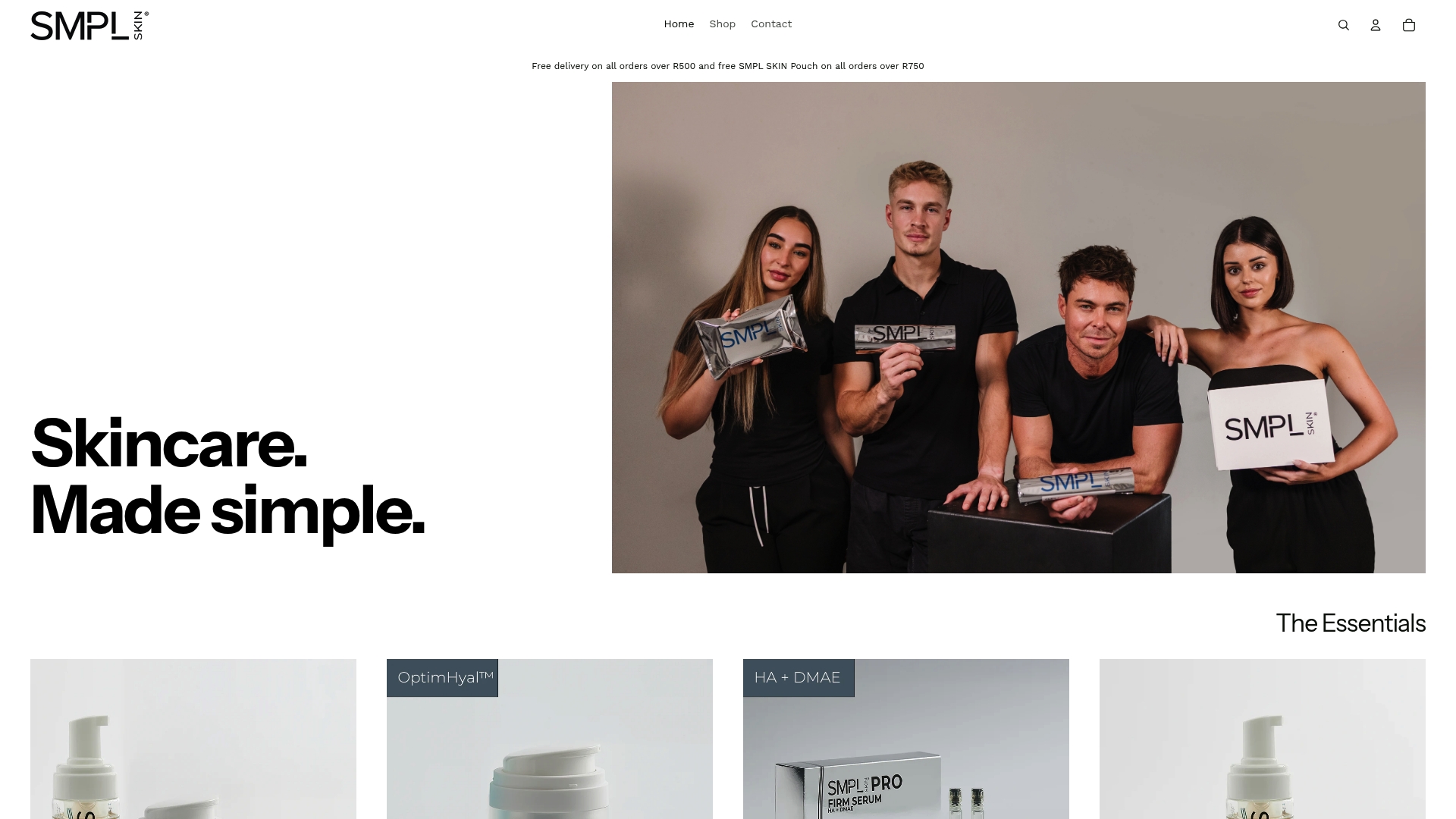
Start with our gentle cleanser and SPF duo for an instant two-step foundation, or grab the daily moisturizer with built-in SPF 15 if you want to combine steps. For those ready to add a booster, our firming serum and hydro gel bundle is a smart, targeted next step. Pick one essential, start there, and build your confidence from the ground up.
Frequently asked questions
Can I skip moisturizer if my skin is oily?
No, even oily skin needs moisturizer. Skipping it can cause your skin to produce even more oil to compensate, so look for gel-based formulas that hydrate without clogging pores.
Is sunscreen necessary indoors or on cloudy days?
Yes, daily broad-spectrum SPF is essential even indoors or on overcast days, since UVA rays penetrate clouds and windows.
How often should I use active ingredients like retinol?
Introduce retinol slowly. Starting at 2 to 3 times weekly gives your skin time to adjust and minimizes the risk of irritation or peeling.
Should sensitive skin types use fragrance-free products?
Absolutely. Fragrance-free products significantly reduce the risk of contact irritation and are the safest choice for reactive or sensitive skin.
Do I need a toner in my daily routine?
For most people, toners are not essential and can be skipped without any negative effect on skin health. They may suit specific needs but are not a daily must-have.
Recommended
- How to achieve healthy skin with a simple routine – SMPL SKIN South Africa
- How to choose skincare products for a simple routine – SMPL SKIN South Africa
- Morning skincare routine: 4 steps for maximum hydration – SMPL SKIN South Africa
- Skincare routine tips: 4 steps to a daily glow – SMPL SKIN South Africa