

TL;DR:
- Minimalist skincare focusing on essential products often yields better results than complicated routines.
- Identifying your skin type accurately guides effective product selection and routine design.
- Evidence-backed ingredients like retinoids, niacinamide, and broad-spectrum SPF are key for visible skin improvements.
Walk into any pharmacy and the sheer number of cleansers, serums, toners, and treatments can feel overwhelming. Most of us have tried products that promised everything and delivered very little. The good news? You do not need a 10-step routine to get healthy, glowing skin. Evidence shows that a focused, minimalist approach consistently outperforms product overload. In this guide, we walk you through exactly how to identify your skin type, build a core routine, choose ingredients that actually work, and read labels like a pro. Simple steps, real results.
Table of Contents
- Determine your skin type at home
- Focus on core products for effective minimalism
- Choose evidence-based ingredients for results
- Read labels and avoid common pitfalls
- Why minimalism outperforms complicated routines
- Discover minimalistic skincare options from SMPL SKIN
- Frequently asked questions
Key Takeaways
| Point | Details |
|---|---|
| Identify skin type | Knowing whether your skin is dry, oily, combination, or sensitive is the first step toward choosing effective skincare products. |
| Build a minimal routine | Focus on three essentials—cleanser, moisturizer, and SPF—to simplify your daily skincare and boost results. |
| Use evidence-based actives | Professional-grade ingredients like retinoids and vitamin C deliver proven benefits when used consistently. |
| Avoid extra steps and products | Skipping complicated routines reduces irritation and makes sticking to your skincare plan easier. |
| Read labels carefully | Check ingredient lists for actives, avoid fragrances, and patch test new products for safety and effectiveness. |
Determine your skin type at home
Knowing your skin type is the single most important step before buying anything. Without it, you are essentially guessing. The good news is that identifying your skin type at home is straightforward and takes less than an hour.
Here is how to do it:
- Wash your face with a gentle, fragrance-free cleanser.
- Pat dry and leave your skin completely bare, no moisturiser, no serum.
- Wait 30 to 60 minutes.
- Observe how your skin looks and feels in natural light.
What you notice tells you a lot. If your skin feels tight or flaky, you likely have dry skin. If your forehead, nose, and chin look shiny all over, that points to oily skin. A shiny T-zone with dryness on the cheeks suggests combination skin. Redness, itching, or a burning sensation after cleansing often signals sensitive skin. These common skin types each respond differently to ingredients and formulations.
| Skin type | Key characteristics | What to avoid |
|---|---|---|
| Dry | Tight, flaky, dull | Alcohol-based products |
| Oily | Shiny, enlarged pores | Heavy creams, pore-clogging oils |
| Combination | Oily T-zone, dry cheeks | Harsh stripping cleansers |
| Sensitive | Redness, stinging, reactive | Fragrance, strong actives |
| Normal | Balanced, minimal concerns | Over-cleansing |
This test gives you a reliable baseline. However, your skin type can shift with the seasons. Harmattan winds or a dry winter can make oily skin feel tight, while humid summers can make dry skin feel more balanced. If you want to go deeper into supporting your skin between seasons, learning how to detoxify skin at home can make a real difference.
Pro Tip: Repeat this skin type test in both winter and summer. Seasonal changes in humidity and temperature genuinely affect how your skin behaves, and your routine should reflect that.
Focus on core products for effective minimalism
Once you have identified your skin type, building a minimalistic routine starts with choosing key products. The goal is not to use fewer products for the sake of it. It is to use the right products consistently.
Every effective routine, regardless of skin type, rests on three pillars. Experts consistently prioritise a gentle cleanser, a moisturiser matched to your skin type, and a broad-spectrum SPF 30 or higher every single morning. These three do the heavy lifting.
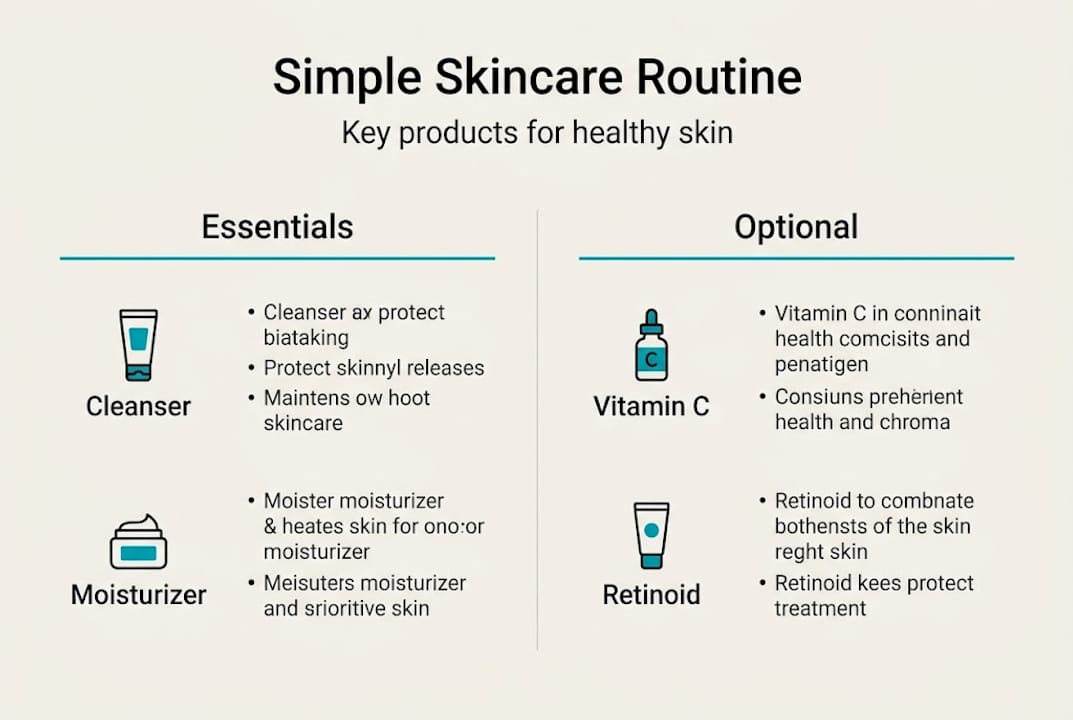
Beyond the basics, optional additions can target specific concerns. Antioxidants like vitamin C in the morning and retinol or bakuchiol at night are the most evidence-backed upgrades. But they are optional, not mandatory.
| Product | Essential or optional | Best for |
|---|---|---|
| Gentle cleanser | Essential | All skin types |
| Moisturiser | Essential | All skin types |
| SPF 30+ | Essential | All skin types |
| Vitamin C serum | Optional | Dull, uneven skin |
| Retinol or bakuchiol | Optional | Ageing, texture concerns |
| Exfoliant (AHA/BHA) | Optional | Oily, acne-prone skin |
Here is a simple structure that works for most people:
Morning routine:
- Gentle cleanser
- Moisturiser
- SPF 30+
Evening routine:
- Gentle cleanser
- Active treatment (if using one)
- Moisturiser
For more on structuring your mornings for maximum skin benefit, our guide on morning routine hydration covers it clearly. If you want to understand how products interact when layered, how to layer skincare products is worth reading. And for a practical daily framework, check out these daily glow routine tips.
Pro Tip: Skip toners, multiple serums, and separate eye creams unless a dermatologist has specifically recommended them for your skin. For most people, they add cost and complexity without meaningful results.
Choose evidence-based ingredients for results
With a streamlined routine, the next step is ensuring your products contain proven ingredients. Not every ingredient on a label earns its place. Some are there for texture or marketing appeal. The ones that genuinely move the needle have clinical data behind them.
A Delphi consensus of skin experts identified a clear shortlist of ingredients with strong, reproducible evidence. These include:
- Retinoids (retinol, retinal): Proven to stimulate collagen, reduce fine lines, and improve skin texture.
- Niacinamide: Reduces redness, regulates oil production, and strengthens the skin barrier.
- Vitamin C (L-ascorbic acid): Brightens skin, fades pigmentation, and neutralises free radicals.
- Hyaluronic acid: Draws moisture into the skin and supports plumpness.
- Sunscreen actives (zinc oxide, titanium dioxide, chemical filters): The most impactful single product for long-term skin health.
- Peptides like Tripeptide-29: Clinical studies show measurable improvements in hydration, skin dryness, and pigmentation.
Broad-spectrum sunscreen is the most evidence-backed skincare product available. Daily use prevents up to 90% of UV-related skin damage, making it the one non-negotiable in any routine.
When reading labels, look for these actives near the top of the ingredient list. Ingredients are listed in descending order of concentration, so if niacinamide appears near the bottom, there likely is not enough of it to make a difference. A shorter ingredient list is often a sign of a more focused, effective formulation.

Price does not equal performance. An expensive product with a long list of filler ingredients can underperform a straightforward, affordable formula with the right actives at effective concentrations. Our guide on actives in skincare explains exactly what to look for. For a broader look at ingredient evidence, clinical ingredient research offers a solid reference point.
If your skin concerns are complex, persistent acne, significant pigmentation, or post-procedure recovery, a dermatologist visit is worth it before adding strong actives.
Read labels and avoid common pitfalls
Identifying evidence-based ingredients is essential, but knowing how to interpret labels and avoid missteps is equally important. Even great ingredients can cause problems if the product is formulated poorly or introduced incorrectly.
Here is what to check on every label:
- Ingredient order: Actives near the top mean higher concentrations. If your key ingredient is buried near the end, the product likely contains too little to be effective.
- Comedogenicity: For acne-prone skin, look for the label non-comedogenic, meaning the product is formulated to avoid clogging pores.
- Fragrance: Fragrance is one of the most common causes of skin irritation. Fragrance-free is the safer choice for sensitive skin.
- pH level: A skin-friendly pH of 4.5 to 5.5 supports your skin barrier. Cleansers that are too alkaline can strip the skin and disrupt its natural balance.
- Patch testing: Always patch test new products before applying them to your full face.
Common mistakes that undermine results:
- Introducing multiple new products at the same time.
- Skipping SPF because it feels heavy or greasy.
- Over-exfoliating, which damages the skin barrier.
- Assuming expensive means effective.
- Ignoring how your skin reacts and pushing through irritation.
For sensitive, acne-prone, ageing, or post-procedure skin, the rules are the same but the margin for error is smaller. These skin situations call for even shorter ingredient lists and a slower, more careful introduction of new products.
Pro Tip: Introduce only one new product at a time and monitor your skin for at least two weeks before adding anything else. This makes it easy to identify what is working and what is causing a reaction.
For more on building a routine that respects your skin’s needs, explore holistic skincare results and our guide to building a healthy skin regimen.
Why minimalism outperforms complicated routines
We have seen it time and again. Someone starts a 10-step routine, their skin reacts, and they blame their skin instead of the overload. The truth is that more products mean more variables, more potential irritants, and more room for things to go wrong.
Expert consensus strongly favours minimalism over multi-step routines. Fewer products reduce irritation, make it easier to stay consistent, and let each ingredient actually do its job without interference.
Social media has convinced many people that a 12-product shelfie is the goal. It is not. The goal is healthy skin. And healthy skin responds best to consistency, not complexity. A simple routine you follow every day beats an elaborate one you abandon by Wednesday.
Price is another misconception worth addressing. We have seen budget formulations with the right actives outperform luxury products with impressive packaging and weak concentrations. Focus on what is in the bottle, not what is on the label. For a routine grounded in real evidence, our expert-backed skin routine guide is a great place to start.
Discover minimalistic skincare options from SMPL SKIN
Having learned the science and strategies, you can now put minimalism into practice with trusted products.
At SMPL SKIN, we have built our entire range around this philosophy. Every product is formulated with purpose, using evidence-backed ingredients like German Chamomile and Cucumber Extract to deliver hydration, protection, and skin health without unnecessary complexity. If you are starting out, our gentle cleanser and moisturiser duo gives you the two essentials in one simple bundle. Prefer to start with just one product? Our gentle cleanser is the perfect first step. Simple skincare that actually works, that is what we are here for.
Frequently asked questions
How can I quickly identify my skin type at home?
Cleanse your face, wait 30 to 60 minutes without applying anything, and check for dryness, shine, or balance to reveal your skin type. What you observe in natural light gives you a reliable starting point.
Which skincare products are truly necessary for a minimalist routine?
A gentle cleanser, a suitable moisturiser, and a broad-spectrum SPF 30+ form the non-negotiable foundation. Optional actives like vitamin C or retinoids can be added once the basics are consistent.
How do I know if a product has evidence-based ingredients?
Look for actives like retinoids, vitamin C, and niacinamide, and confirm they appear near the top of the ingredient list. Products aligned with expert-reviewed ingredient standards are your safest bet.
What is the best way to patch test a new skincare product?
Apply a small amount to your inner arm or jawline, wait 48 hours, and check for redness or irritation before introducing one product at a time to your full routine.
Recommended
- How to achieve healthy skin with a simple routine – SMPL SKIN South Africa
- Skincare routine tips: 4 steps to a daily glow – SMPL SKIN South Africa
- How to layer skincare products for effective hydration – SMPL SKIN South Africa
- Morning skincare routine: 4 steps for maximum hydration – SMPL SKIN South Africa