

TL;DR:
- The skin hydration cycle involves continuous absorption, transport, and retention of water, essential for healthy skin function. Damage to the skin barrier disrupts this process, leading to dryness, dullness, and increased sensitivity. Supporting the cycle requires proper layering, barrier protection, and environmental awareness for optimal skin health.
Most people assume that skin hydration is simply about drinking more water or slapping on a moisturiser. That view misses most of what actually happens. Understanding what is skin hydration cycle means getting to grips with a continuous biological process, one where your skin absorbs, transports, distributes, and retains water in a carefully regulated loop. When any part of that loop breaks down, the effects show up fast: tightness, dullness, and lines that seem to appear from nowhere. This guide breaks down every phase, the biology behind it, and what you can do to keep the cycle working properly.
Table of Contents
- Key takeaways
- What is the skin hydration cycle?
- Factors that affect the hydration cycle
- Practical steps to support the cycle
- Advanced nuances: skin types and hydration depth
- Werner’s take on real hydration
- Build your hydration routine with Smplskin
- FAQ
Key takeaways
| Point | Details |
|---|---|
| Hydration is a biological cycle | Skin actively absorbs, transports, and retains water through specific phases, not just surface application. |
| Barrier integrity is everything | A compromised lipid barrier raises transepidermal water loss, which breaks the hydration loop. |
| Dry skin and dehydrated skin differ | Dry skin lacks oil; dehydrated skin lacks water. Each needs a different product approach. |
| Layering order changes outcomes | Applying humectants on damp skin, then sealing with emollients, delivers measurably better hydration. |
| Hydration cycle is not skin cycling | The hydration cycle runs daily, while skin cycling routines operate on a 4 to 7 day schedule. |
What is the skin hydration cycle?
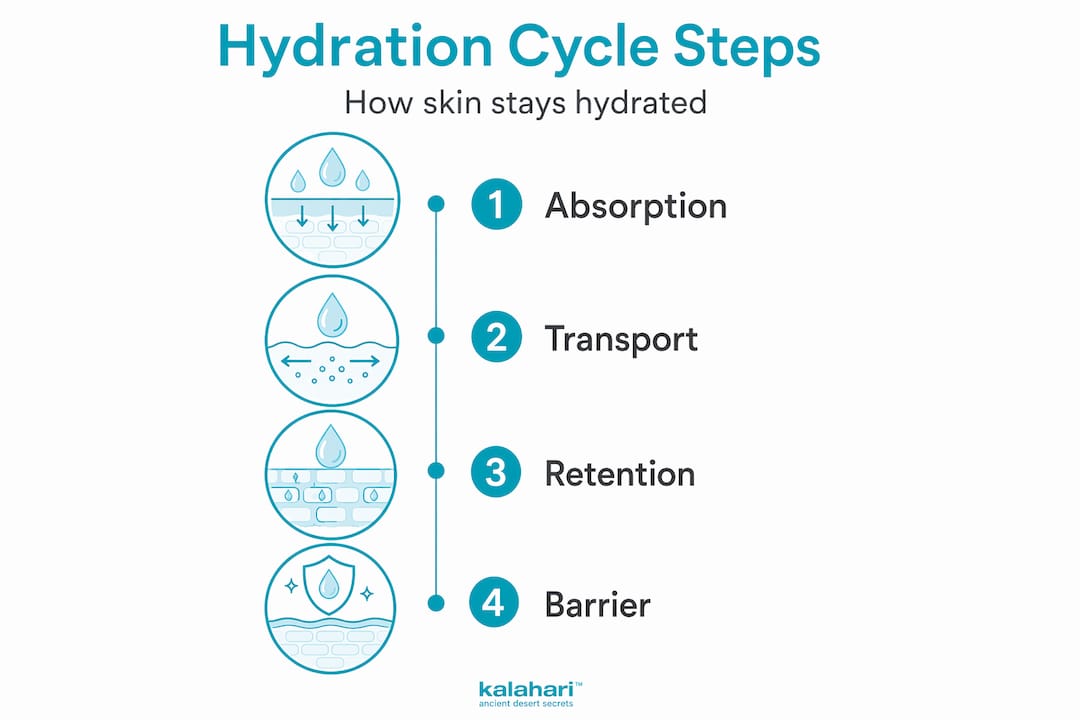
The skin hydration cycle is the ongoing biological process by which your skin draws in water, moves it through internal structures, and holds onto it long enough to function properly. Think of it less like a single action and more like a relay race, with each layer of skin passing water along to the next.
The cycle moves through three broad phases:
- Water absorption: Skin pulls moisture from the environment and from deeper tissue layers. Humidity, temperature, and the state of the surface barrier all influence how much water enters at this stage.
- Internal transport via aquaporins: Once inside the skin, water moves through protein channels called aquaporins. These channels sit within skin cells and act as gateways, directing water across the epidermis and deeper into the dermis. Aquaporins are specialised water channels that are critical for maintaining consistent hydration throughout skin tissue.
- Retention in the stratum corneum: The outermost layer of skin, the stratum corneum, is responsible for holding water in place. It does this through a network of natural moisturising factors (NMFs) and the surrounding lipid matrix, the fats and ceramides that seal the structure together.
The integrity of the skin barrier is what makes or breaks this cycle. When the lipid layer is intact, transepidermal water loss (TEWL) stays low and water stays in the skin. When it is disrupted by harsh cleansers, environmental stress, or over-exfoliation, water escapes faster than the skin can replenish it.
It helps to separate the skin hydration process from a different concept called skin cycling. Skin cycling refers to a scheduled routine that rotates active ingredients like retinoids and exfoliants over a 4 to 7 day cycle focused on cell turnover. Hydration, by contrast, is happening every single day without a schedule. Your skin needs water-retaining support constantly, regardless of where you are in any active ingredient rotation.
Pro Tip: If your skin feels tight right after cleansing, that is a sign your barrier is already losing moisture faster than it should. Switch to a pH-balanced cleanser and treat the tightness as feedback, not just discomfort.
Factors that affect the hydration cycle
Knowing how the skin hydration cycle works is useful. Knowing what disrupts it is where real change happens.
The most important distinction to understand is the difference between dry skin and dehydrated skin. Dry skin is a skin type, meaning the sebaceous glands produce less oil than average. Dehydrated skin arises from barrier compromise and elevated TEWL, making it a condition rather than a type. You can have oily skin that is simultaneously dehydrated, which is far more common than most people realise. Treating dehydrated oily skin with heavy, occlusive creams makes the situation worse.
Signs that your hydration cycle is disrupted include:
- Persistent tightness or a feeling of “stretched” skin after washing
- Dullness and uneven texture that does not respond to exfoliation
- Fine lines that appear when you smile or squint, even on young skin
- Increased sensitivity and redness, often without a clear cause
- Skin that feels oily on the surface but dry underneath
Environmental factors play a significant role in the skin moisture cycle. Low humidity pulls moisture out of the stratum corneum, particularly during winter or in air-conditioned environments. High temperatures speed up TEWL. Even the water you wash your face with matters. Hot water raises TEWL by up to 20% by stripping essential lipids from the barrier, which is a measurable and avoidable problem.
The good news is that supporting the hydration cycle works. Well-formulated hydrating emulsions improve skin elasticity by 30% after eight weeks of consistent use, and studies show hydration levels can rise by over 50% within just 15 minutes of application when the right product is used correctly. The importance of skin moisture goes well beyond aesthetics. Properly hydrated skin maintains its barrier function, heals faster, and is more resilient to environmental stressors.

Practical steps to support the cycle
Translating the biology of the skin hydration process into a routine does not require an elaborate product shelf. It requires the right sequence and a few non-negotiable principles.
- Start with a gentle, pH-balanced cleanser. The skin’s surface sits at around pH 4.5 to 5.5. Cleansers with a pH of 5.5 or lower preserve the acid mantle and avoid stripping the lipid barrier. Use lukewarm water, never hot.
- Apply humectants on damp skin. Humectants like hyaluronic acid draw water into the skin, but they work best when there is moisture nearby to attract. Applying serum to slightly damp skin gives the humectant something to work with. Understanding the role of humectants in skincare is key to making this step count.
- Layer by molecular weight. Lighter, water-based products go first. Thicker emollients follow. Occlusives go last. Layering by molecular weight and allowing adequate absorption time between steps prevents pilling and keeps each layer doing its job properly.
- Wait between layers. A 5 to 10 minute wait between your hydrating serum and your moisturiser allows absorption without interfering with the next product’s ability to sit correctly on the skin.
- Seal with the right emollient or barrier cream. Ceramides and niacinamide strengthen the skin’s lipid barrier from within. A moisturiser containing these ingredients not only seals in the water delivered by your humectant but also repairs the cycle’s most vulnerable point, which is the stratum corneum’s ability to hold onto what it has received.
Common mistakes that break the cycle include overwashing, using hot water, skipping moisturiser because skin feels oily, and assuming that drinking more water will resolve topical dehydration. Understanding how to layer skincare products correctly is often the single biggest shift people can make.
Pro Tip: Niacinamide at 5% concentration is one of the most studied barrier-strengthening ingredients available. Add it between your humectant and your moisturiser for compounded benefit.
Advanced nuances: skin types and hydration depth
Here is where most generic hydration advice falls short. Different skin types have genuinely different hydration challenges, and a one-size approach misses them.
| Skin type | Hydration challenge | Recommended approach |
|---|---|---|
| Dry skin | Low oil production, high TEWL | Rich emollients with ceramides; occlusive finish |
| Oily skin | Surface sebum masks inner dryness | Lightweight humectants; avoid heavy occlusives |
| Combination skin | Uneven hydration across zones | Zone-targeted application; gel humectants for T-zone |
| Sensitive skin | Barrier disruption triggers reactivity | Fragrance-free, barrier-focused ingredients first |
The concept of “inner dryness” (known in Korean beauty circles as sok-geon-jo) explains why oily skin types are frequently dehydrated. The skin overproduces sebum as a compensatory response to water loss, not because it is inherently oily. Hydration strategies for oily yet dehydrated skin need to address this inner dryness without adding greasy products to an already sebum-rich surface.
For deeper hydration coverage, a multi-weight hyaluronic acid approach addresses hydration at different depths within the skin. Low-molecular-weight hyaluronic acid penetrates further into the epidermis, while larger molecules work at the surface. Using both in the same routine gives complete coverage rather than surface-level relief.
Research is also pointing toward aquaporin modulation as the next frontier in skincare for hydration. Ingredients that enhance aquaporin expression hold real promise for improving how efficiently water moves through skin tissue, which would support the entire hydration cycle from transport to retention. This is an area worth watching as formulations evolve.
Werner’s take on real hydration
I have seen a pattern repeat itself more times than I can count. Someone buys a well-reviewed moisturiser, uses it consistently, and still feels like their skin is not responding. When I dig into their routine, the issue is almost never the product. It is the sequence, the water temperature during cleansing, or the fact that they are applying everything to completely dry skin and wondering why nothing absorbs.
What I have learned is that respecting the skin barrier is non-negotiable. The stratum corneum and lipid barrier are not passive structures. They are active participants in the hydration cycle, and the moment you damage them with alkaline cleansers or aggressive exfoliation, every product you apply afterward performs at a fraction of its potential.
My take is this: technique matters more than the price point of your products. A well-applied R200 serum on damp skin, followed by a ceramide moisturiser and 10 minutes of patience, will outperform a luxury cream applied incorrectly. Hydration is a foundation, not a finishing touch. Get the foundation right, and every other part of your skincare routine builds on something solid.
— Werner
Build your hydration routine with Smplskin
Understanding the skin hydration cycle is the start. Putting it into practice with the right products makes it real.
At Smplskin, we have built our range around exactly the biology this article describes: gentle cleansers that protect your barrier, serums formulated to deliver humectants where they are needed, and moisturisers that lock the cycle in place. Our skincare and hydration products are designed for people who want results without the complexity. Whether you are building a routine from scratch or refining what you already have, the Smplskin blog offers clear guidance on why skin hydration matters for your barrier and your glow. Start simple. Stay consistent. Let the cycle do its work.
FAQ
What exactly is the skin hydration cycle?
The skin hydration cycle is the continuous biological process through which skin absorbs water, transports it via aquaporin channels, and retains it in the stratum corneum. It runs daily and is regulated by the skin’s lipid barrier and natural moisturising factors.
How is dehydrated skin different from dry skin?
Dry skin is a type defined by low oil production, while dehydrated skin is a condition caused by water loss through a compromised barrier. Oily skin types can also be dehydrated, which is why hydration and oiliness are not opposites.
What are the biggest factors affecting skin hydration?
Environmental factors like low humidity, hot water during cleansing, and harsh cleansers all elevate TEWL and disrupt the hydration cycle. Internal factors include barrier integrity, aquaporin function, and natural moisturising factor levels in the stratum corneum.
How does layering skincare products support the hydration cycle?
Applying humectants on damp skin, followed by emollients and then occlusives, mirrors the natural phases of the hydration cycle. Waiting 5 to 10 minutes between layers improves absorption and prevents products from interfering with each other.
Is the skin hydration cycle the same as skin cycling?
No. The skin hydration cycle is a daily biological process focused on water balance. Skin cycling is a scheduled skincare routine that rotates active ingredients like retinoids and exfoliants over a 4 to 7 day period to manage cell turnover.
Recommended
- Why skin hydration matters: glow and barrier health – SMPL SKIN South Africa
- 10 simple ways to boost skin hydration for glowing skin – SMPL SKIN South Africa
- Role of humectants in skincare: a hydration guide – SMPL SKIN South Africa
- What is a hydrogel? The science of ultra-hydrating skincare – SMPL SKIN South Africa