

TL;DR:
- Humectants attract water to the skin’s surface but cannot hold it in without support.
- For lasting hydration, they need to be paired with emollients and occlusives that seal in moisture effectively.
Most people assume that applying a humectant means their skin is hydrated and protected. It is not that simple. The role of humectants is to attract water to the skin’s surface, but they cannot hold it there on their own. Without the right supporting ingredients, that moisture evaporates fast, leaving skin drier than before. If you have ever applied a serum and still felt tight or dry an hour later, this is likely why. This guide breaks down exactly how humectants work, what they need to function properly, and how to use them in a simple, effective routine.
Table of Contents
- What are humectants and how do they work
- Why humectants alone aren’t enough for lasting hydration
- Comparing humectants, emollients, and occlusives: functions and effects
- Applying humectants effectively in minimalist hydration routines
- Rethinking humectants: what most skincare guides miss
- Explore SMPL SKIN’s gentle cleanser & SPF 15 moisturiser duo for balanced hydration
- Frequently asked questions
Key Takeaways
| Point | Details |
|---|---|
| Humectants attract moisture | They draw water to the skin surface but need sealing to maintain hydration. |
| Pair with occlusives | Occlusives prevent water loss by forming a barrier after humectant application. |
| Layer properly | Apply humectants first on damp skin, then emollients and occlusives for best effect. |
| Minimalist hydration | Well-formulated products can combine multiple functions, reducing product steps. |
| Avoid humectant overload | Too much humectant without sealing can cause stickiness and dryness. |
What are humectants and how do they work
Humectants are water-attracting ingredients. They are hygroscopic, which means they naturally draw water molecules toward themselves. Humectants work by attracting water to the skin’s outer layer, called the stratum corneum, through a process called hydrogen bonding. Think of them as a magnet for moisture.
Where that moisture comes from depends on the environment. In a humid climate, humectants pull water vapour from the air into the skin. In dry or cold conditions, they can draw water up from the deeper layers of the skin instead. This is an important distinction, because it directly affects how well they perform and whether you need additional products to support them.
Here are the most common humectant ingredients you will find in skincare formulations:
- Glycerin: One of the most studied and effective humectants. Affordable, well-tolerated, and found in most moisturisers.
- Hyaluronic acid: Can hold up to 1,000 times its weight in water. Works best in layered or multi-weight formulations.
- Sodium PCA: A naturally occurring compound in skin that helps maintain moisture balance.
- Panthenol (Vitamin B5): Hydrates and supports skin barrier function at the same time.
- Betaine: Gentle, soothing, and suitable for sensitive skin types.
Understanding this humectant ingredients list helps you read labels with more confidence. When you know what each ingredient does, choosing products becomes a lot less overwhelming.
To get the most out of any humectant, you need to understand how to layer skincare products effectively. Humectants sit at the beginning of your routine for a reason, and skipping that logic reduces how well they work.
Now that we understand the basic role of humectants, let’s explore why they alone are not sufficient for lasting skin hydration.
Why humectants alone aren’t enough for lasting hydration
Here is the misconception that catches most people out. You apply a hyaluronic acid serum, your skin feels plump, and you assume the job is done. But without occlusives, attracted water can evaporate quickly, making hydration temporary. That serum pulled water to the surface, but without anything to seal it in, it disappeared into the air around you.
This is the core limitation of humectants used alone. They increase water content in the skin, but they do not create any kind of barrier to keep that water where it belongs.
Here is how the three moisturising ingredient categories work together:
- Humectants draw water to the skin’s surface, increasing hydration in the outer layers.
- Emollients fill in the gaps between skin cells, smoothing texture and supporting barrier repair. They make skin feel soft and comfortable.
- Occlusives sit on top and form a protective film that slows water evaporation. They are the sealant in your routine.
In dry or cold environments, the risk increases. If a humectant is pulling moisture up from your skin’s deeper layers but there is nothing to prevent that moisture from then evaporating off the surface, you end up with net water loss. Your skin can actually feel drier after using a humectant alone in winter.
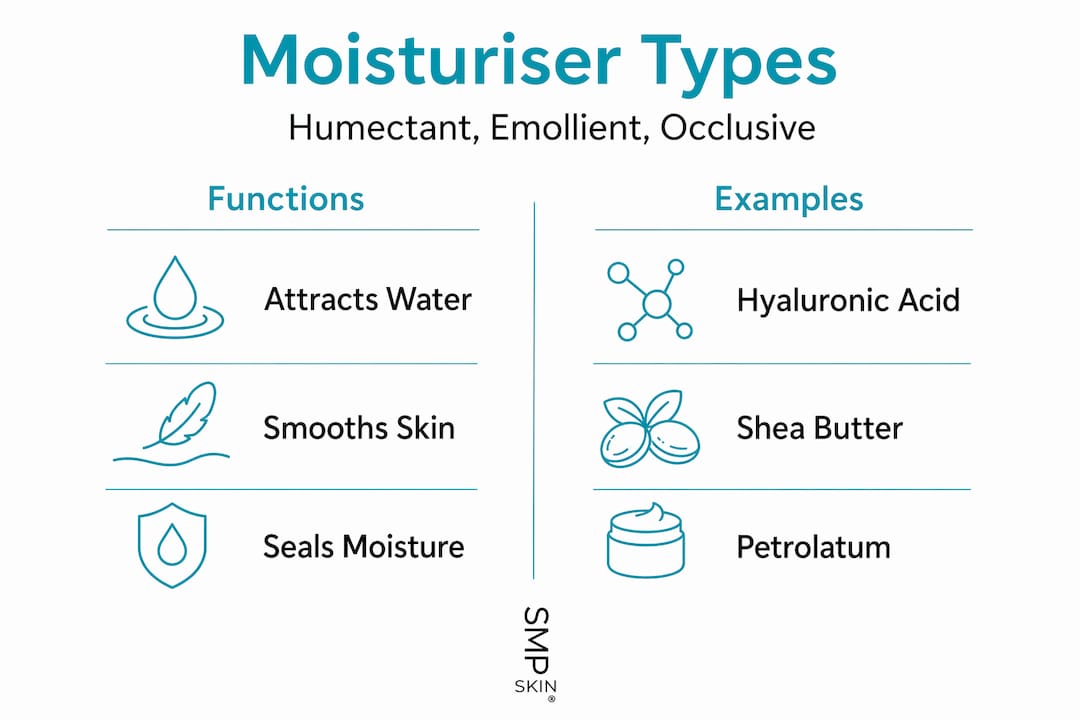
The importance of humectants becomes fully realised only when they are part of a complete approach. Humectants attract. Emollients smooth. Occlusives seal. Each step depends on the others.
Pro Tip: If you live in a dry climate or spend a lot of time in air-conditioned environments, always follow your humectant with an occlusive skincare product to prevent moisture from evaporating off the surface of your skin.
Understanding these limitations highlights the need for a balanced approach. Next, we will compare all three moisturising ingredient types side by side for complete clarity.
Comparing humectants, emollients, and occlusives: functions and effects
Humectants hydrate by attracting water, emollients smooth skin, and occlusives seal hydration to reduce water loss. Seeing all three side by side makes it easier to understand why each one plays a distinct role, and why a minimalist routine still needs to account for all three functions.
| Property | Humectants | Emollients | Occlusives |
|---|---|---|---|
| Primary function | Attract and bind water | Smooth and soften skin | Seal in moisture |
| Mechanism | Hydrogen bonding | Fill gaps between cells | Form a protective film |
| Feel on skin | Can feel slightly sticky | Light to moderately rich | Thick, heavy |
| Climate sensitivity | High (needs humidity or layers) | Low | Low |
| Water source needed | Yes | No | No |
| Best used | First step, damp skin | Second step | Last step |
This table shows clearly why the order matters. Applying an occlusive before a humectant is like putting a lid on an empty pot. The occlusive seals, but there is nothing to seal in.
Here are a few practical points to keep in mind when choosing products:
- Dry skin benefits most from a richer emollient paired with a strong occlusive and a humectant serum underneath.
- Oily or combination skin can often get away with a lightweight emollient that contains humectants, skipping a separate occlusive layer.
- Sensitive skin tends to respond well to glycerin and panthenol as humectant choices, since they are gentle and less likely to cause reactions.
- Hot, humid climates reduce the need for heavy occlusives, since ambient humidity supports the humectant’s water-attracting role naturally.
Knowing how to balance these functions is the foundation of choosing skincare products simply without overcomplicating your shelf.
With this understanding, you are ready to learn how to apply these principles in a practical daily routine for maximum hydration with minimal products.
Applying humectants effectively in minimalist hydration routines
The functions of humectants are best expressed when you apply them correctly. A small change in timing or order can make a real difference in how your skin feels throughout the day. Here is what actually works, based on formulation science and real-world use.
Start with slightly damp skin. Immediately after cleansing, while your face still has some moisture on it, apply your humectant serum or product. This gives the humectant a surface water source to work with, making it far more effective than applying to completely dry skin. It is a simple habit that most people overlook.
- Apply humectants first, always. They are typically lightweight and absorb fast.
- Follow with an emollient to soften skin and help bridge the humectant to the next step.
- Seal with an occlusive to lock everything in. This is especially important in dry or cold environments.
- Do not overload on humectants. More product does not mean more hydration. It can mean more stickiness and a compromised barrier over time.
- Choose multi-function products when possible. Well-formulated moisturisers often combine all three ingredient classes, making minimalist routines far more achievable.
Pro Tip: For a morning minimalist hydration routine, look for a moisturiser that includes glycerin or hyaluronic acid (your humectant), a fatty alcohol or plant oil (your emollient), and a light film-forming ingredient like dimethicone or shea butter (your occlusive). One product, three functions.
Combining humectants with emollients and occlusives in a single product delivers full hydration benefits without requiring five separate steps. For anyone building a results-driven minimalist routine, multi-function products are not a compromise. They are smart formulation. You can explore more hydration minimalist routine tips to build on what you have learned here.
Finally, to deepen your understanding, here is a fresh perspective on maximising humectants’ role based on what most skincare guides still get wrong.
Rethinking humectants: what most skincare guides miss
Most guides tell you what humectants do. Few tell you when they can work against you. We think that is worth talking about honestly.
Humectant effectiveness depends on post-application water behaviour, meaning humidity levels, evaporation rate, and your skin barrier’s current condition all influence whether a humectant helps or hurts. If your skin barrier is compromised, which happens with conditions like eczema, rosacea, or from overusing harsh actives, humectants can actually draw moisture out of the skin rather than into it. The sealing step becomes even more critical in these cases, not optional.
We also want to push back on the idea that “more ingredients” equals “better hydration.” Piling five different humectant serums on top of each other does not multiply the benefit. Each layer has a ceiling. Once the stratum corneum is saturated, additional humectant has nowhere useful to go.
The layering order is not just a suggestion. It is the difference between a product working and a product sitting on top of your skin doing very little. Skincare layering explained follows a clear logic: lightest to heaviest, water to oil, draw first then seal. Reversing this order, even partially, compromises the entire system.
Our honest take? Minimalist routines win not because they use fewer products, but because they choose products that respect the function of each ingredient class. A single well-formulated moisturiser that includes a humectant, an emollient, and a mild occlusive will outperform three separate products applied in the wrong order or at the wrong time. Simplicity is not about cutting corners. It is about understanding what the skin actually needs and delivering exactly that.
Explore SMPL SKIN’s gentle cleanser & SPF 15 moisturiser duo for balanced hydration
If this guide has shifted the way you think about hydration, we want to make the next step easy for you.
Our gentle cleanser & SPF 15 moisturiser duo is built around exactly the principles covered here. The moisturiser combines humectant hydration with emollient softening and light occlusive protection, so you get the full hydration stack in one simple step. The cleanser preps your skin without stripping it, so your humectants have the best possible surface to work on. Together, they cover cleansing, hydration, barrier support, and sun protection in one uncomplicated routine. If you want to go deeper on how to layer skincare products around this duo, we have you covered there too. Simple. Effective. Done.
Frequently asked questions
What is the main function of humectants in skincare?
Humectants primarily attract and bind water to the skin’s surface, increasing hydration in the outer skin layers. Humectants work by attracting water to the stratum corneum through hygroscopic, hydrogen-bonding interactions.
Can humectants alone provide lasting skin hydration?
No. Without occlusives, attracted water evaporates quickly, making hydration temporary. Humectants must be paired with emollients and occlusives to seal moisture in and prevent loss.
How should I layer humectants in my skincare routine?
Apply humectants first on slightly damp skin, then follow with an emollient and a sealing occlusive. Humectants are lightweight and applied first, followed by heavier products, for optimal moisture retention.
What are some common humectants used in skincare?
Common humectants include glycerin, hyaluronic acid (sodium hyaluronate), sodium PCA, panthenol, and betaine, each offering slightly different hydration benefits depending on skin type and formulation.
Can using too much humectant be harmful?
Yes. Excess humectants can increase water loss and cause stickiness if not properly sealed, particularly in low-humidity environments where they may pull moisture from deeper skin layers instead of the air.
Recommended
- 10 simple ways to boost skin hydration for glowing skin – SMPL SKIN South Africa
- What is a hydrogel? The science of ultra-hydrating skincare – SMPL SKIN South Africa
- Hydration tips for skin: minimalist routines and expert advice – SMPL SKIN South Africa
- Serum guide: boost hydration and skin health simply – SMPL SKIN South Africa