

TL;DR:
- Holistic skincare emphasizes evidence-based, simple routines that support overall skin health.
- Multitarget ingredients like green tea and tea tree oil provide multiple benefits efficiently.
- Minimalist, consistent routines often outperform complex, product-heavy regimens.
Holistic skincare gets a bad reputation. Many people assume it means slathering on unfiltered plant extracts or following wellness trends with no scientific backing. The truth is quite different. Holistic skincare is grounded in evidence, built around how your skin connects to your overall health, and designed to simplify your routine rather than complicate it. Herbal and natural ingredients used in holistic approaches offer multitarget effects, including antioxidative and anti-inflammatory benefits that conventional single-action products often cannot match. In this article, we break down what holistic skincare really means, who benefits most, and how to build a routine that works.
Table of Contents
- What holistic skincare really means
- Key benefits and multitarget effects of holistic approaches
- Sensitive skin and holistic skincare: Science and special considerations
- Building a minimalist holistic routine: Practical steps and real-world examples
- A fresh perspective: Why ‘less is more’ works in holistic skincare
- Experience holistic skincare with SMPL SKIN
- Frequently asked questions
Key Takeaways
| Point | Details |
|---|---|
| Holistic means whole-body wellness | Holistic skincare treats the skin in balance with overall health, not just surface appearance. |
| Minimalist routines offer multitarget benefits | Evidence shows simple, multitarget ingredients outperform many single-use conventional products. |
| Sensitive skin thrives with holistic methods | Gentle, multitarget holistic routines can be ideal for those with sensitive skin, when used cautiously. |
| Evidence-based products matter | Choose multitarget ingredients proven by research, such as green tea, licorice, and tea tree oil. |
| Less is more for results | Minimal routines using multitarget solutions yield lasting skin health and reduce product overload. |
What holistic skincare really means
Having introduced holistic skincare, let’s clarify what it truly means and why it’s often misunderstood.
Holistic skincare treats your skin as part of your whole body, not as a surface problem to fix with the right cream. It considers lifestyle habits, stress levels, sleep, nutrition, and product choices together. This is very different from picking a product simply because it says “natural” on the label.
Here is where most people get confused. The word “natural” carries no legal weight in the skincare industry. As expert analysis confirms, holistic skincare is not the same as natural products, and there is no FDA regulation governing what brands can call “natural.” That means a product packed with synthetic fillers can legally call itself natural. Holistic skincare, by contrast, is defined by its approach, not its marketing language.
“Natural” on a skincare label means nothing legally. The FDA does not regulate this claim, so always look beyond the label and focus on ingredients with evidence behind them.
What makes a routine truly holistic? A few core principles:
- Simplicity first: Fewer products with multitarget benefits reduce the risk of irritation and product overload.
- Lifestyle alignment: Sleep, hydration, and stress management are treated as part of the skincare routine.
- Evidence-based choices: Ingredients are chosen for proven efficacy, not just trend appeal.
- Consistency over complexity: A simple routine done daily outperforms an elaborate one done occasionally.
You can explore eco-friendly skincare routines that align with these principles, or start with simple skin routines backed by expert guidance. The goal is always the same: skin that functions well because you are supporting it from every angle.
Holistic skincare is not a luxury reserved for wellness enthusiasts. It is a practical, science-supported approach that anyone can adopt, regardless of their current routine or skin type.
Key benefits and multitarget effects of holistic approaches
Now that you understand what holistic skincare means, let’s see how its multitarget benefits work in practice.
The biggest advantage of a holistic approach is that certain ingredients do more than one job at once. Instead of buying a separate antioxidant serum, a UV protector, and an anti-inflammatory treatment, one well-chosen ingredient can cover multiple needs simultaneously.
The science here is compelling. Green tea polyphenols provide 75% UVB absorption, licorice extract reduces tyrosinase activity (the enzyme behind dark spots) by 45%, and tea tree oil delivers acne-fighting results comparable to conventional treatments. These are not fringe claims. They are backed by peer-reviewed research.
| Ingredient | Primary benefit | Additional benefits |
|---|---|---|
| Green tea | 75% UVB absorption | Antioxidant, anti-inflammatory |
| Licorice extract | 45% tyrosinase reduction | Brightening, soothing |
| Tea tree oil | Acne treatment | Antimicrobial, anti-inflammatory |
| German Chamomile | Calming sensitive skin | Antioxidant, healing |
Conventional single-action products often target one concern at a time. A holistic ingredient like green tea protects, repairs, and soothes in a single step. That is efficiency your skin actually feels.
Pro Tip: When evaluating any holistic product, look for ingredients with published clinical studies behind them. If a brand cannot point to research, treat the claims with healthy scepticism.
For practical guidance on putting this into action, check out these steps for a daily glow or build a morning routine for hydration that uses multitarget ingredients from the start. Starting your day with evidence-backed products means your skin is protected, hydrated, and supported before you even leave the house.
Sensitive skin and holistic skincare: Science and special considerations
While multitarget benefits are exciting, it’s crucial to address specific needs, especially for sensitive skin types.

Sensitive skin is reactive, easily irritated, and often overwhelmed by complex routines. This is exactly why holistic, minimalist approaches tend to work so well for this skin type. Fewer ingredients mean fewer potential triggers. Evidence-backed choices mean lower risk of unexpected reactions.
That said, sensitive skin benefits most from holistic approaches, but users must prioritise evidence-backed ingredients. The challenge is that dosage standardisation across holistic products is inconsistent. One brand’s chamomile extract may be far more concentrated than another’s, making it hard to predict how your skin will respond.
Here are the key signs that your skin may be sensitive, along with holistic solutions that help:
- Redness or flushing easily: Look for calming ingredients like German Chamomile or cucumber extract.
- Tightness after cleansing: A gentle, non-stripping cleanser is essential. Avoid foaming cleansers with sulphates.
- Frequent breakouts from new products: Introduce one new product at a time and give it two to three weeks before judging results.
- Itching or stinging with most products: Fragrance-free, minimal-ingredient formulas are your safest starting point.
- Dryness that does not respond to moisturiser: Your skin barrier may be compromised. Focus on barrier-repair ingredients like ceramides and hyaluronic acid.
Pro Tip: Always patch test a new holistic product on the inside of your wrist for 24 hours before applying it to your face. Start with the smallest amount and build up slowly.
For more on managing reactive skin, explore hydration for sensitive skin to find solutions that support your skin without overwhelming it.
Building a minimalist holistic routine: Practical steps and real-world examples
Let’s move from theory to practice. Here is how you can build a routine that delivers holistic benefits with minimal steps.
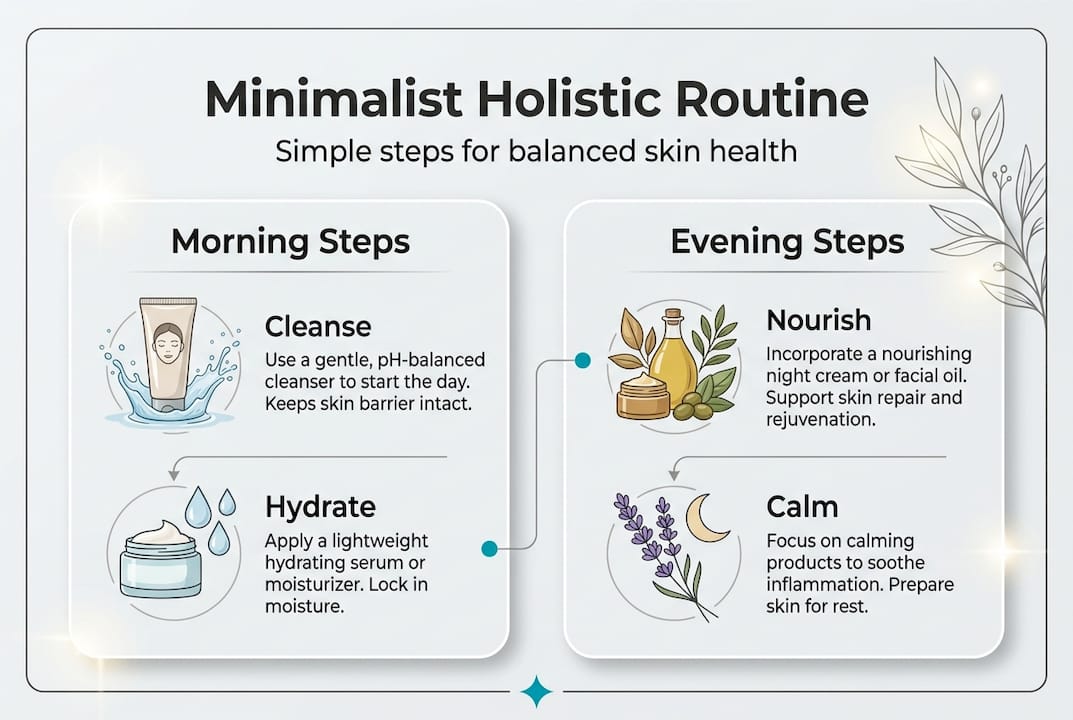
The goal is not to own fewer products for the sake of it. The goal is to own products that do more. A three-step routine built on multitarget ingredients will consistently outperform a ten-step routine built on single-action products.
Here is a straightforward three-step holistic routine:
- Cleanse gently: Use a mild, non-stripping cleanser morning and evening. This removes impurities without disrupting your skin barrier. Look for formulas free of harsh sulphates and synthetic fragrances.
- Treat with a multitarget serum: Choose a serum with evidence-backed ingredients like green tea, niacinamide, or tea tree oil. One product that addresses hydration, antioxidant protection, and inflammation is more effective than three separate treatments.
- Protect and moisturise: A daily moisturiser with SPF combines hydration and sun protection in one step. This is non-negotiable for any holistic routine.
| Routine type | Number of steps | Ingredient complexity | Efficacy |
|---|---|---|---|
| Minimalist holistic | 3 | Low, multitarget | High |
| Conventional layered | 6 to 10 | High, single-action | Variable |
| Trend-based | 5 to 8 | Mixed, often unverified | Unpredictable |
Consider someone dealing with acne-prone skin. Rather than using a harsh benzoyl peroxide wash, a separate toner, and a spot treatment, a holistic approach might use a gentle cleanser and a serum containing tea tree oil. Tea tree oil’s effectiveness against acne is comparable to conventional treatments, with significantly less irritation risk. That is a real result with fewer steps.
For more guidance, explore this simple hydration regimen or discover ways to boost hydration that fit neatly into a minimalist approach.
A fresh perspective: Why ‘less is more’ works in holistic skincare
Having explored practical steps, let’s challenge some traditional assumptions about what good skincare actually looks like.
We see it constantly. People invest in ten, twelve, sometimes fifteen products, convinced that more steps equal better skin. In our experience, the opposite is usually true. Every additional product introduces a new variable, a new potential irritant, and a new opportunity for ingredients to conflict with each other.
The skincare industry profits from complexity. More products mean more purchases. But your skin does not benefit from that complexity. It benefits from consistency, from gentle support, and from ingredients that have genuine science behind them.
Minimalism is not a compromise. It is a strategy. When you detoxify skin simply and strip your routine back to what actually works, you give your skin the chance to regulate itself. You stop chasing problems created by product overload and start building real, lasting skin health.
Evidence-driven minimalism is not a trend. It is the most sustainable approach to skincare we know.
Experience holistic skincare with SMPL SKIN
If you are ready to try a holistic approach, the good news is that you do not need to overhaul everything at once. Start simple. Start smart.
At SMPL SKIN, we have built our entire range around the principle that fewer, better products deliver lasting results. Our gentle cleanser and SPF moisturiser duo gives you a complete two-step foundation for any holistic routine. If daily sun protection is your priority, our SPF 15 daily moisturiser is a simple, effective choice. For those wanting targeted treatment alongside hydration, the firm serum and hydro gel bundle covers both in one go. Simple routines. Real results. That is what we stand for.
Frequently asked questions
Is holistic skincare just using natural products?
No. Holistic skincare focuses on skin wellness and evidence-based routines, not simply natural ingredients. The term “natural” carries no regulatory meaning in the skincare industry.
Are holistic routines safe for sensitive skin?
Holistic routines often suit sensitive skin well, but you should always patch test first and choose products with evidence-backed ingredients to minimise the risk of irritation.
Can minimalist routines outperform conventional products?
Yes. Multitarget ingredients like green tea and tea tree oil can match or exceed conventional treatments, with green tea providing 75% UVB absorption and tea tree oil delivering acne results comparable to standard treatments.
What ingredients should I look for in holistic skincare?
Prioritise ingredients with multitarget scientific backing, such as green tea, licorice extract, tea tree oil, German Chamomile, and cucumber extract. Each of these offers more than one proven skin benefit.
Recommended
- Sustainable skincare: A simple guide to eco-friendly routines – SMPL SKIN South Africa
- How to achieve healthy skin with a simple routine – SMPL SKIN South Africa
- Detoxify your skin at home: simple routines for results – SMPL SKIN South Africa
- Skincare routine tips: 4 steps to a daily glow – SMPL SKIN South Africa
- Holistic wellness: Empowering women through balanced health – RICH FIT BITCH