

TL;DR:
- Simplifying your skincare routine with fewer, well-chosen products often yields better results than using complex, multi-step regimes.
- Building a consistent routine around cleansing, moisturizing, and sun protection forms a solid foundation, while careful layering and introducing actives gradually helps prevent irritation.
Most people trying to figure out how to develop efficient skin maintenance routines end up buying ten products they barely use and feeling more confused than when they started. The shelves are full of promises, and the internet adds a new “must-have” ingredient every week. Here’s the truth: fewer, well-chosen products beat a complex routine almost every time. This article walks you through the real foundation of effective skincare practices, how to layer correctly, how to introduce actives without wrecking your barrier, and how to adjust your routine as life changes.
Table of Contents
- Key takeaways
- Your daily base: cleanse, moisturise, protect
- How to layer products correctly
- Adding actives without overwhelming your skin
- Adapting your routine over time
- My honest take on simple routines
- Build your base with Smplskin
- FAQ
Key takeaways
| Point | Details |
|---|---|
| Start with three steps | A gentle cleanser, moisturiser, and broad-spectrum SPF form the daily base recommended by dermatologists. |
| Layer thin to thick | Apply products from lightest to heaviest texture to maximise absorption and prevent pilling. |
| Introduce one active at a time | Add new treatments slowly, keeping your base stable for 4 to 6 weeks before changing anything. |
| Adapt with your skin | Seasonal changes, stress, and lifestyle shifts all require minor routine adjustments to maintain results. |
| Consistency beats complexity | Reliable daily use of a few quality products delivers better results than an inconsistent 12-step routine. |
Your daily base: cleanse, moisturise, protect
This is where best skin care routines begin and, honestly, where most of them should stay for a while. Dermatologists consistently recommend a three-step daily base: a gentle cleanser, a moisturiser, and a broad-spectrum sunscreen in the morning. That’s it. Not boring. Actually powerful.
Choosing the right cleanser
Your cleanser does one job: remove dirt, oil, and sunscreen without stripping your skin. For oily or acne-prone skin, a gel or foam cleanser works well. For dry or sensitive skin, a cream or micellar cleanser causes far less disruption. The golden rule is to avoid anything that leaves your face feeling tight after washing. That tight feeling means your barrier is already stressed.
Moisturising with purpose
A good moisturiser supports your skin barrier using ingredients like ceramides, hyaluronic acid, and glycerin. These aren’t luxury additions. They keep water in and irritants out, which is the actual job of your skin. Without this step, even the most expensive serums won’t perform well because your barrier isn’t ready to hold anything in.

Sunscreen: the step most people get wrong
Correct sunscreen application requires about one teaspoon for your face, head, and neck combined, applied 15 to 30 minutes before sun exposure, and reapplied every two hours outdoors. Most people use a fraction of that amount, which dramatically lowers the real-world protection they receive. SPF 30 or higher, broad-spectrum, and water-resistant are the three things to look for on the label.
Your evening routine skips the sunscreen and can include a richer moisturiser or any treatment products you use. Morning protects. Evening repairs.
Pro Tip: Look for a moisturiser that already contains SPF 15 or higher. It cuts your morning routine to two steps and removes any excuse to skip sun protection on busy days.
How to layer products correctly
The order you apply products matters more than most people realise. Product layering directly affects how well each formula absorbs into the skin and how effectively active ingredients do their job.
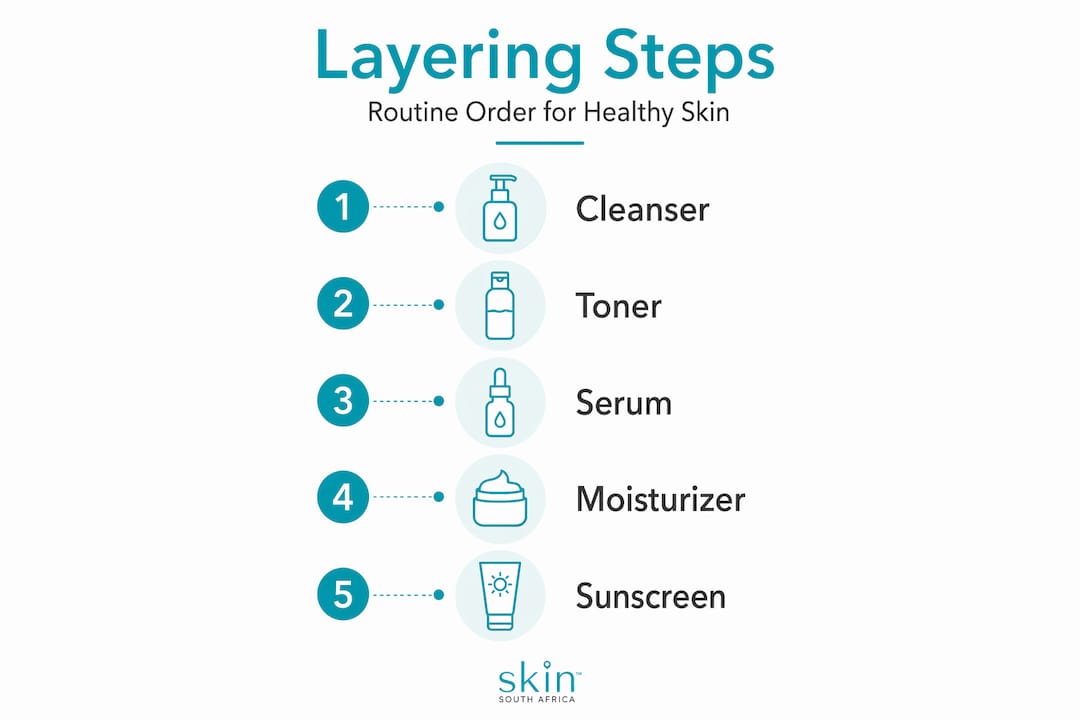
Here is the correct sequence to follow every morning:
- Cleanser. Apply to damp skin, massage gently for 30 to 60 seconds, rinse thoroughly.
- Toner or essence (if you use one). Pat onto skin while still slightly damp. These are water-based and the lightest layer.
- Serum or treatment. Your thinnest active product goes here. Vitamin C serum, niacinamide, or any water-based treatment fits in this slot.
- Eye cream (if needed). Tap gently around the orbital bone with your ring finger.
- Moisturiser. Lock in the layers beneath with a medium-weight formula.
- Sunscreen. Always the final step in your morning routine.
Wait roughly 10 to 30 seconds between light layers and about one to three minutes before applying a heavier product on top. Waiting between layers prevents pilling, where products ball up on your skin because they haven’t had time to absorb. It also means each formula gets a proper chance to do its job before the next one arrives.
The most common layering mistake is applying a face oil before a water-based serum. Oils create a barrier. Everything applied on top of an oil sits on the surface rather than absorbing into the skin. Always apply oils near the end of your routine, just before or after moisturiser, depending on the oil’s weight.
Pro Tip: If you use a hydrating toner or essence, apply it while your face is still slightly damp from cleansing. Damp skin absorbs these lightweight formulas faster and more evenly.
For more guidance on building hydration layer by layer, Smplskin has a detailed resource on layering for hydration worth reading before you invest in new products.
Adding actives without overwhelming your skin
This is where skin maintenance tips get specific, and where most people go wrong. They read about retinoids, vitamin C, AHAs, niacinamide, and azelaic acid and decide they want all of them. Then their skin reacts, they blame the routine, and they start over. Sound familiar?
The smarter approach looks like this:
- Pick one primary skin goal. Targeting hyperpigmentation? Focus on vitamin C or azelaic acid. Concerned about texture and ageing? Retinoids are your lane. Trying to control breakouts? Look at salicylic acid or niacinamide.
- Keep your base routine completely stable. Hold that stable base for 4 to 6 weeks before adding anything new. This gives your skin a clear baseline and helps you spot what’s working.
- Introduce one active at a time. Start with a low concentration, use it two or three times a week, and increase frequency only once your skin has adapted with zero reaction.
- Know what not to combine. Retinoids and AHAs together can cause significant irritation. Vitamin C and niacinamide are actually fine together despite old myths, but they can feel heavy. Keep it simple rather than trying to pack every active into one routine.
Knowing the difference between irritation and purging is also worth learning. Purging happens when a retinoid or exfoliant speeds up cell turnover and brings existing congestion to the surface faster than normal. It typically clears within four to six weeks and affects areas where you already break out. Irritation, on the other hand, shows up as redness, flaking, stinging, or burning in areas where you don’t normally have issues. If that happens, stop the active and give your skin a rest.
If irritation does occur, a 7-day skin reset using just cleanser, moisturiser, and sunscreen allows your skin barrier to stabilise before you reintroduce anything. Think of it as clearing the clutter before you rearrange the room.
A helpful guide on choosing skincare products for a simpler routine can also help you decide what’s actually worth adding and what’s just noise.
Adapting your routine over time
Building a skincare regimen is not a once-off event. Your skin changes with seasons, hormones, stress, travel, and age. A routine that works perfectly in summer may leave your skin dry and reactive in winter. The good news is that adapting doesn’t mean rebuilding from scratch. It means making small, informed tweaks.
Here’s how to stay on top of it:
- Track your skin with photos. Take a photo once a month in the same lighting. Progress in skincare is slow and easy to miss in the mirror every day. Photos make it visible.
- Scale back when your skin signals stress. Redness, excessive oiliness, or sudden breakouts are your skin telling you it’s overwhelmed. Drop any actives temporarily and return to your three-step base.
- Adjust for seasons. In colder, drier months, swap gel moisturisers for cream-based formulas and consider adding a hydrating serum. In humid months, lighten up. Your cleanser and SPF can often stay the same year-round.
- Commit to patience. Committing 8 to 12 weeks to a new treatment before judging results is the realistic minimum. Skin cell turnover takes about 28 days. Real change takes longer.
- Avoid chasing trends. A new ingredient going viral on social media is rarely the thing your skin is missing. Stick to what’s evidence-backed.
The goal of daily skincare tips isn’t to keep adding. It’s to keep refining until your routine is so simple and effective that you barely have to think about it.
My honest take on simple routines
I’ve seen it dozens of times. Someone commits to a ten-step routine, spends a lot of money, and then wonders why their skin is worse than before they started. In my experience, the problem is almost never a missing product. It’s a compromised skin barrier that’s been asked to absorb too much, too fast.
What actually made a difference for me and for the people I’ve spoken to is trusting the basics. Cleanser, moisturiser, SPF. Done consistently, those three steps solve more skin problems than most people expect. A healthy skin barrier is the foundation of everything. When that’s intact, your skin manages itself remarkably well.
The overcomplicated routines you see on social media look impressive. But they’re often performed by people with good skin who attribute it to the products rather than their genetics and consistency. Less is genuinely more in skin maintenance. Pick your steps with intention, give them time, and resist the urge to add the next thing before the current thing has had a chance to work.
My advice: start simple, observe carefully, and only add complexity when there’s a real reason to.
— Werner
Build your base with Smplskin

At Smplskin, we built our product range around exactly what this article covers: the effective, minimal daily base that actually works. If you’re ready to simplify, the Gentle Cleanser and SPF 15 Moisturiser Duo gives you both your morning steps in one bundle, formulated with skin-calming ingredients like German Chamomile and Cucumber Extract. No guesswork, no overload. If you prefer a standalone option, the SPF 15 Daily Moisturiser combines hydration and sun protection in a single lightweight formula. We also have a growing library of practical guides on the Smplskin blog for when you’re ready to go deeper.
FAQ
What are the three core steps in an efficient skin routine?
The three core steps are a gentle cleanser, a moisturiser, and a broad-spectrum SPF applied in the morning. Dermatologists recommend this minimal foundation as the most effective and sustainable daily base.
In what order should I apply skincare products?
Apply products from thinnest to thickest texture: cleanser first, then toner or essence, then serum, then moisturiser, then sunscreen last. Correct layering order maximises absorption and prevents products from pilling on the skin.
How long should I wait before adding a new active to my routine?
Hold your base routine steady for at least 4 to 6 weeks before adding any new active ingredient. This gives your skin time to stabilise and makes it easier to identify what’s working.
How much sunscreen should I actually apply to my face?
You need roughly one teaspoon of sunscreen for your face, head, and neck. Under-applying sunscreen significantly reduces real-world SPF protection, even with a high-SPF product.
What should I do if my skin reacts badly to an active?
Stop using the active immediately and return to your three-step base routine. A 7-day skin reset with just cleanser, moisturiser, and sunscreen is the fastest way to calm and stabilise a reactive skin barrier.
Recommended
- Build a healthy skin regimen: simple routines for hydration – SMPL SKIN South Africa
- How to achieve healthy skin with a simple routine – SMPL SKIN South Africa
- Everyday skincare essentials list for simple, healthy routines – SMPL SKIN South Africa
- Detoxify your skin at home: simple routines for results – SMPL SKIN South Africa