

TL;DR:
- Daily skin protection involves gentle cleansing, moisturising, and applying broad-spectrum sunscreen to maintain skin health consistently. Proper technique, correct product layering, and lifestyle habits like shade and protective clothing enhance long-term defense against UV damage. Tailoring products to skin type and environment ensures an effective routine that preserves skin resilience over time.
Daily skin protection is a three-step routine of gentle cleansing, moisturising, and applying broad-spectrum sunscreen that preserves your skin’s health and appearance every single day. Most people know sunscreen matters, but the real gap is in technique and consistency. Knowing how to protect skin daily means understanding not just which products to use, but how to layer them correctly, how much to apply, and which habits outside your bathroom actually move the needle. This guide covers all of it, from foundational steps to skin-type customisation, so you can build a routine that genuinely works.
How to protect skin daily: the three essential steps
Daily skin protection works through three core actions: cleansing, moisturising, and applying sunscreen. Each step has a specific job, and skipping one weakens the whole system.
Step 1: Cleanse gently
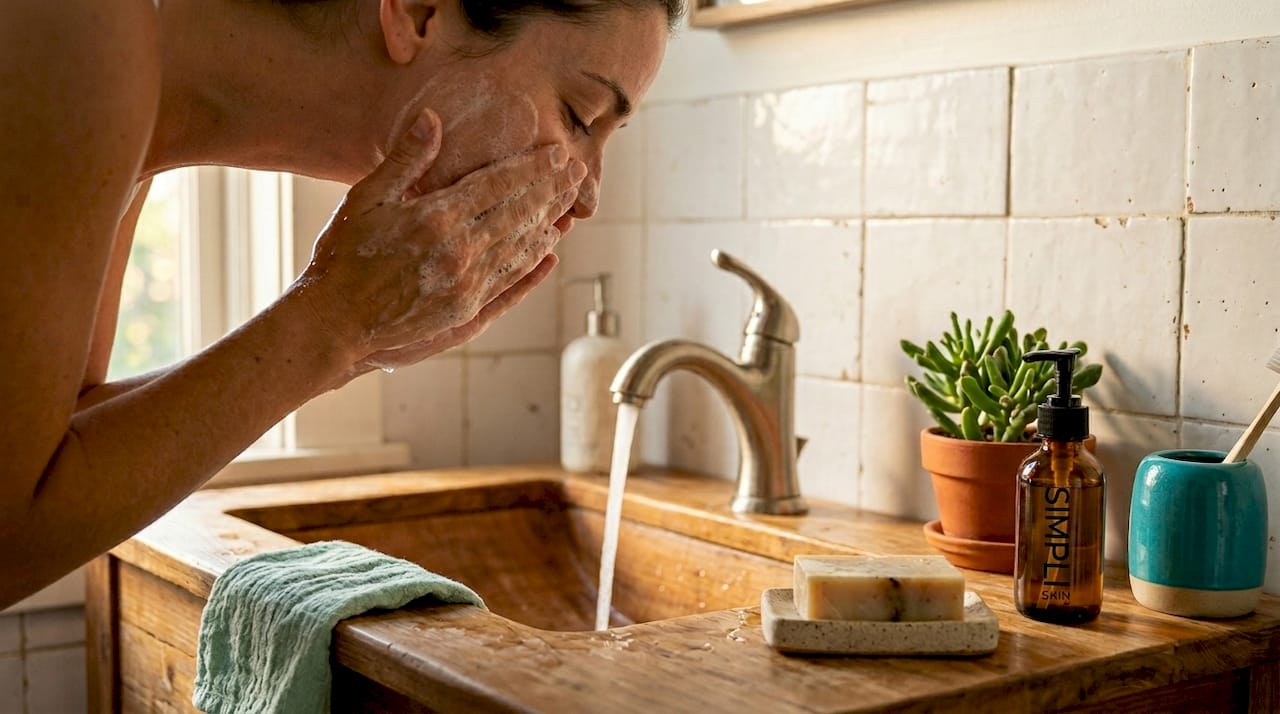
Cleansing removes dirt, excess oil, and environmental pollutants that accumulate on your skin overnight and throughout the day. The key word is gently. Harsh cleansers strip the skin’s natural oils and damage the barrier that keeps moisture in and irritants out. A mild, pH-balanced cleanser is the right tool here. Cleanse once in the morning and once at night, using lukewarm water. Hot water accelerates moisture loss and leaves skin feeling tight.
Step 2: Moisturise to reinforce your barrier
Moisturising is not just about comfort. Moisturisers reduce water loss through a tripartite mechanism combining film-forming emollients, humectants, and lipid components. This means your moisturiser is actively rebuilding and reinforcing the skin barrier, not just sitting on top of it. Apply your moisturiser to slightly damp skin, right after cleansing, to lock in that residual hydration and get the most from the formula.
Step 3: Apply sunscreen every morning
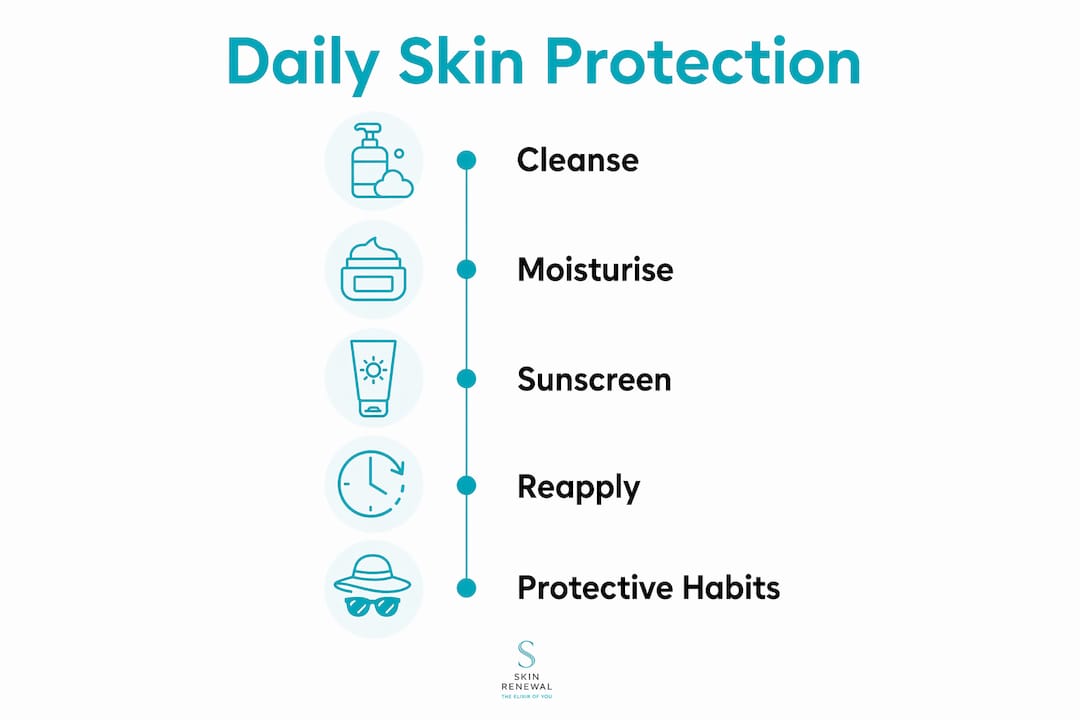
Sunscreen is the single most protective step in any daily skincare routine. Use a broad-spectrum product with SPF 30 or higher, applied as the last step in your morning routine. Applying it last prevents dilution and keeps the UV filters working at full strength. These three steps work together: a clean surface lets moisturiser absorb properly, and a well-hydrated skin barrier helps sunscreen sit evenly and perform as intended.
Pro Tip: Apply your moisturiser while your skin is still slightly damp from cleansing. The moisturiser on damp skin technique seals in extra hydration and primes the surface for better sunscreen adhesion.
How to apply sunscreen for maximum daily protection
Sunscreen is only as effective as the way you apply it. This is where most routines fall short, not in product choice, but in execution.
The amount matters more than most people realise. Experts recommend about 1 ounce of sunscreen for full-body coverage, roughly a shot-glass worth. For the face alone, a generous, even layer is needed. The SPF value printed on the bottle is measured under controlled lab conditions using a specific application amount. Use less than that amount, and you get less protection than the label promises.
A practical visual cue helps here. Under-application significantly reduces real-world SPF protection compared to labelled values. A visible white film when applying mineral sunscreen is actually a sign you have used enough product. Most people rub it in too quickly and too thinly, cutting their protection in half without knowing it.
Here is what correct sunscreen application looks like in practice:
- Apply sunscreen as the final step in your morning routine, after moisturiser and before makeup
- Cover your face, ears, neck, and the backs of your hands, areas that are frequently missed
- Reapply every two hours when outdoors, and immediately after swimming or heavy sweating
- On cloudy days and near windows, UV rays still penetrate, so reapplication still applies
- Choose between mineral sunscreens (zinc oxide, titanium dioxide) and chemical sunscreens based on your skin type and preference
Pro Tip: Check the expiry date on your sunscreen. Sunscreen expires after about three years, and heat or humidity accelerates breakdown. Store it in a cool, dry place and replace it if the texture or smell has changed.
The mineral versus chemical debate is worth a brief note. Mineral sunscreens sit on top of the skin and physically deflect UV rays, making them a better fit for sensitive or reactive skin. Chemical sunscreens absorb UV energy and convert it to heat, and they tend to feel lighter on the skin. Neither is universally better. The best sunscreen for daily use is the one you will actually apply consistently and in the right amount.
For a deeper look at building this habit, the Smplskin guide on daily sunscreen habits covers the practical side in detail.
What lifestyle habits support daily skin protection?
Products alone do not complete the picture. Physical habits and clothing choices reduce UV exposure in ways that sunscreen cannot fully compensate for on its own.
National health guidance recommends avoiding peak sun exposure between 10 a.m. and 4 p.m., when UV radiation is most intense. Shade, clothing, and timing work alongside sunscreen to create a layered defence.
Practical lifestyle measures to build into your day:
- Seek shade between 10 a.m. and 4 p.m., especially during outdoor activities or when UV index readings are high
- Wear a wide-brimmed hat to protect your face, scalp, ears, and neck, areas sunscreen often misses or wears off quickly
- Choose long-sleeved, tightly woven clothing for extended outdoor exposure. Lighter colours reflect heat; darker, tightly woven fabrics block more UV
- Wear UV-protective sunglasses to shield the delicate skin around your eyes and reduce the risk of UV-related eye damage
- Avoid tanning beds entirely. They emit concentrated UV radiation and offer no safe dose
These habits are not just backup measures. They reduce the total UV load your skin absorbs each day, which means your sunscreen has less work to do and your skin accumulates less damage over time. Think of it as reducing your skin’s daily burden rather than relying on one product to carry all the weight.
How to customise your routine for your skin type
A one-size-fits-all approach to daily skin care tips only goes so far. Your skin type, local climate, and UV index all affect which products will serve you best.
Different skin types benefit from tailored product selections. Oily skin does better with non-comedogenic, oil-free formulas that will not clog pores. Dry or mature skin benefits most from moisturisers containing ceramides, hyaluronic acid, or barrier-repair lipids. Sensitive skin responds well to fragrance-free products and mineral sunscreens, which are less likely to cause irritation.
The table below maps skin type to the most effective product and routine choices:
| Skin type | Cleanser | Moisturiser | Sunscreen type |
|---|---|---|---|
| Oily | Gel or foaming, oil-free | Lightweight, non-comedogenic | Chemical or mattifying mineral |
| Dry | Cream or milk, hydrating | Rich, ceramide or lipid-based | Hydrating mineral or chemical |
| Sensitive | Fragrance-free, gentle | Minimal ingredients, calming | Mineral (zinc oxide or titanium dioxide) |
| Combination | Balanced, gentle foam | Light gel-cream | Broad-spectrum SPF 30 or higher |
| Normal | Any gentle formula | Light to medium weight | Any broad-spectrum SPF 30 or higher |
Climate matters too. In high-UV environments like South Africa, SPF 30 is a minimum, not a ceiling. On days with a UV index above 8, SPF 50 is the more protective choice. In humid climates, lighter gel-based moisturisers prevent that heavy, congested feeling. In dry or cold climates, richer formulas help compensate for the extra moisture loss the environment causes.
If you want to add serums or targeted treatments, place them between your moisturiser and sunscreen, or use them at night to avoid any interaction with UV filters. Vitamin C serum in the morning, for example, adds antioxidant protection that works alongside sunscreen rather than replacing it. The Smplskin resource on skin hydration barrier explains how these layers interact in more detail.
Key takeaways
Consistent daily skin protection requires cleansing, moisturising, and correctly applied broad-spectrum sunscreen, supported by protective clothing and shade habits tailored to your skin type and environment.
| Point | Details |
|---|---|
| Cleanse gently every day | Use a mild, pH-balanced cleanser morning and night to protect the skin barrier. |
| Moisturise on damp skin | Apply moisturiser immediately after cleansing to lock in hydration and reinforce barrier function. |
| Apply enough sunscreen | Use about 1 ounce for full-body coverage and reapply every two hours outdoors. |
| Layer clothing and shade | Seek shade between 10 a.m. and 4 p.m. and wear hats and protective clothing alongside sunscreen. |
| Match products to skin type | Choose non-comedogenic formulas for oily skin and ceramide-rich options for dry or sensitive skin. |
What I have learned about making skin protection stick
I have spent years watching people build and abandon skincare routines, and the pattern is almost always the same. The routine is too complicated, the products feel wrong on the skin, or reapplication just never happens. Here is my honest take on what actually makes daily skin protection work long-term.
Consistency beats perfection every time. A simple three-step routine done every single day will outperform an elaborate ten-step routine done three times a week. The skin responds to regularity. When you cleanse, moisturise, and apply sunscreen at the same time each morning, it stops feeling like effort and becomes as automatic as brushing your teeth.
The order of application is something most people underestimate. Sunscreen applied before moisturiser gets diluted and loses effectiveness. Moisturiser applied to dry skin absorbs less efficiently. These are not minor details. They are the difference between a routine that delivers results and one that just feels like going through the motions.
Reapplication is the hardest habit to build, and I think the reason is practical rather than motivational. Carrying a full-size sunscreen bottle around is inconvenient. A small SPF 30 or higher stick or spray in your bag removes that friction entirely. The product you have with you is always better than the perfect product left at home.
One thing I tell everyone: do not wait until you see damage to start protecting your skin. UV damage accumulates silently over years. The routine you build today is an investment in skin that stays healthier, more resilient, and better-looking for decades. That is not a luxury. It is just good sense.
— Werner
Simple products that make your daily routine easier
Building a consistent daily skin protection routine is much easier when your products are designed to work together from the start. At Smplskin, we created the Gentle Cleanser and SPF 15 Moisturiser Duo specifically for this purpose. The Gentle Cleanser uses German Chamomile and Cucumber Extract to cleanse without stripping your skin barrier, while the SPF 15 Daily Moisturiser combines daily hydration with baseline UV protection in a single lightweight step. Together, they cover two of the three core protection steps in one simple pairing. If you are ready to take the guesswork out of your morning routine, explore the full Smplskin range and find the combination that fits your skin.
FAQ
What is daily skin protection?
Daily skin protection is a consistent routine that prevents UV damage, moisture loss, and environmental stress through cleansing, moisturising, and sunscreen application every day. The goal is to maintain a healthy skin barrier and reduce cumulative damage over time.
How much sunscreen should I apply to my face?
Apply a generous, even layer that forms a visible film on the skin before rubbing in. For full-body coverage, about 1 ounce is the standard recommendation, with the face, ears, neck, and hands all requiring coverage.
Does sunscreen need to be reapplied indoors?
Reapplication is most critical outdoors, but UV rays penetrate windows, so a morning application still matters on indoor days. If you spend time near windows or drive regularly, reapplying once midday is a sensible habit.
Can I skip moisturiser if my skin feels oily?
Skipping moisturiser on oily skin often makes oil production worse, as the skin compensates for dehydration. Choose a lightweight, non-comedogenic gel moisturiser instead of skipping the step entirely.
What SPF is best for daily use in South Africa?
SPF 30 is the minimum for daily use, but SPF 50 is the better choice on high-UV days or when spending extended time outdoors. South Africa’s UV index regularly exceeds 8, which places it in the very high to extreme category for much of the year.
Recommended
- Daily sunscreen: the simplest step for protected skin – SMPL SKIN South Africa
- Skincare routine tips: 4 steps to a daily glow – SMPL SKIN South Africa
- How to achieve healthy skin with a simple routine – SMPL SKIN South Africa
- Everyday skincare essentials list for simple, healthy routines – SMPL SKIN South Africa