

TL;DR:
- Your skin’s outer layer actively retains water and blocks irritants, with its lipid matrix crucial for barrier function. Damage manifests as increased water loss (TEWL), sensitivity, and dryness, often caused by harsh cleansers and environmental stressors. Consistent use of barrier-supportive ingredients like ceramides, humectants, and occlusives, along with simplified routines, promotes effective skin repair over time.
Your skin is doing far more than just sitting there looking good. Right now, it is actively holding water in and keeping irritants out. Understanding what is skin hydration barrier function actually means, and how it differs from simply “moisturising,” is the step most skincare routines skip entirely. The result? Products that feel good but don’t fix the real problem. In this article, we break down the science in plain language, explain what goes wrong when your barrier is compromised, and give you practical steps to actually fix it.
Table of Contents
- Key takeaways
- What is skin hydration barrier: structure and function
- When the barrier breaks down
- How scientists measure your skin barrier
- How to maintain skin hydration and repair the barrier
- My take on the “just moisturise” myth
- Products that actually support your barrier
- FAQ
Key takeaways
| Point | Details |
|---|---|
| Barrier vs. hydration | Skin hydration refers to water content in cells; barrier function controls how much water escapes. |
| Lipids are the foundation | Ceramides, cholesterol, and fatty acids form the “mortar” that seals water inside your skin. |
| TEWL is the key signal | Increased transepidermal water loss is the first measurable sign of a compromised barrier, often before visible symptoms appear. |
| Harsh products damage your barrier | Over-washing and irritating cleansers strip lipids and accelerate water loss. |
| Repair takes consistent care | The skin’s self-repair process begins within hours but full barrier normalisation takes days of steady, supportive care. |
What is skin hydration barrier: structure and function
Think of your skin’s outermost layer, the stratum corneum, as a brick wall. The brick and mortar structure consists of flattened dead skin cells called corneocytes, those are the bricks, held together by a lipid matrix made up of ceramides, cholesterol, and free fatty acids. That lipid matrix is the mortar. It is not decorative. It is the physical seal that stops water from evaporating off your skin and keeps environmental stressors from getting in.
Inside those corneocytes, your skin produces what are called Natural Moisturising Factors, or NMF. These are water-attracting compounds, including amino acids and urea, that pull water into the cells and hold it there. So hydration is about what is inside the cells, while the lipid barrier function controls how much of that water actually stays put.
Here is a simple way to think about it:
- Water content (hydration): How much water is inside your skin cells
- Transepidermal water loss (TEWL): How fast water is escaping through the skin surface
- Barrier integrity: How well the lipid matrix is doing its job of slowing that loss
These three things are connected, but they are not the same. You can have temporarily high skin water content and still have a damaged barrier. That is why just splashing water on your face or using a water-based serum does not fix dry, sensitive skin if your barrier is broken.
The skin barrier also maintains an acidic pH on the surface, called the acid mantle. This acidity supports the enzymes that regulate lipid production and keeps harmful microbes from colonising your skin. Disrupt the pH, and you disrupt the whole system.
| Concept | What it measures | Why it matters |
|---|---|---|
| Skin hydration (NMF) | Water content inside corneocytes | Determines whether skin feels supple and plump |
| TEWL | Rate of water evaporating through skin | Signals barrier integrity; higher TEWL means more damage |
| Lipid organisation | Ceramide and fatty acid structure | Controls how well the barrier seals and protects |
When the barrier breaks down
The most telling sign that your skin moisture barrier is in trouble is a spike in TEWL. Damaged skin can increase TEWL up to 30 times above normal levels. That is a dramatic shift, and it happens before you even notice visible dryness or flaking.
What causes this? The list is longer than most people expect:
- Harsh cleansers: Surfactants that are too strong strip ceramides and fatty acids directly from the lipid matrix.
- Over-washing: Multiple washes a day compounds the stripping effect, even with a gentle product.
- Environmental stress: Cold, dry air, wind, and low humidity all accelerate water loss from the skin surface.
- Irritating ingredients: Alcohol, fragrances, and certain preservatives disrupt lipid organisation and trigger inflammation.
- Ageing: Lipid production naturally slows with age, making the barrier thinner and less effective over time.
The symptoms follow a predictable pattern: tightness, flakiness, redness, and a constant “dry” feeling that no amount of moisturiser seems to fix. Sensitivity to products you used to tolerate well is another red flag. Over-washing and harsh cleansers disrupt barrier lipids and drive inflammation, which is why simplifying your routine often produces faster relief than adding more products.
Stat to know: Under normal conditions, TEWL ranges from 4 to 10 g/h/m². When the barrier is significantly compromised, that number can climb thirty-fold.
This is also why simply adding a hydrating serum on top of a broken barrier often falls short. If the lipid mortar is missing, water that you apply to the skin surface escapes almost as fast as you put it on. Treating the symptom without addressing the cause is what keeps people stuck in an endless loop of reapplying products without real improvement.
Pro Tip: If your skin stings or reacts to products it previously tolerated fine, that is a strong signal your barrier is compromised, not that you have suddenly developed “sensitive skin.” Step back, simplify your routine, and focus on barrier repair first.

How scientists measure your skin barrier
Understanding how the function of skin barrier health is measured helps you make sense of skincare research and ingredient claims. There are two primary tools researchers and dermatologists use.
The first is TEWL measurement. Devices placed on the skin surface assess barrier integrity by measuring how much water vapour is escaping per unit area, per hour. It is objective data. When a product claims to “strengthen the barrier,” studies measuring TEWL before and after use are the gold standard proof.
The second is corneometry. This technique measures water content in the uppermost 10 to 20 micrometres of the stratum corneum using electrical capacitance. It tells you how hydrated the skin cells themselves are, not how fast water is leaving.
Here is why both matter and how they differ:
- TEWL tells you about barrier function. Low TEWL means the barrier is sealing water in effectively.
- Corneometry tells you about skin hydration status. High corneometry values mean the stratum corneum is water-rich.
- A product can temporarily boost corneometry (feel hydrating) while doing nothing for TEWL (not actually repairing the barrier).
This distinction explains why a superficially moisturised skin surface can still be functionally impaired. The water is there temporarily, but the barrier is not sealing it in. Knowing this should change how you evaluate products. Look for evidence that a moisturiser reduces TEWL, not just that it makes skin feel softer immediately after application.
How to maintain skin hydration and repair the barrier
The good news: your skin knows how to repair itself. Self-repair mechanisms trigger lipid release within hours of barrier damage. The less good news is that full barrier normalisation takes days of consistent care, and repeated exposure to irritants resets the clock every time.
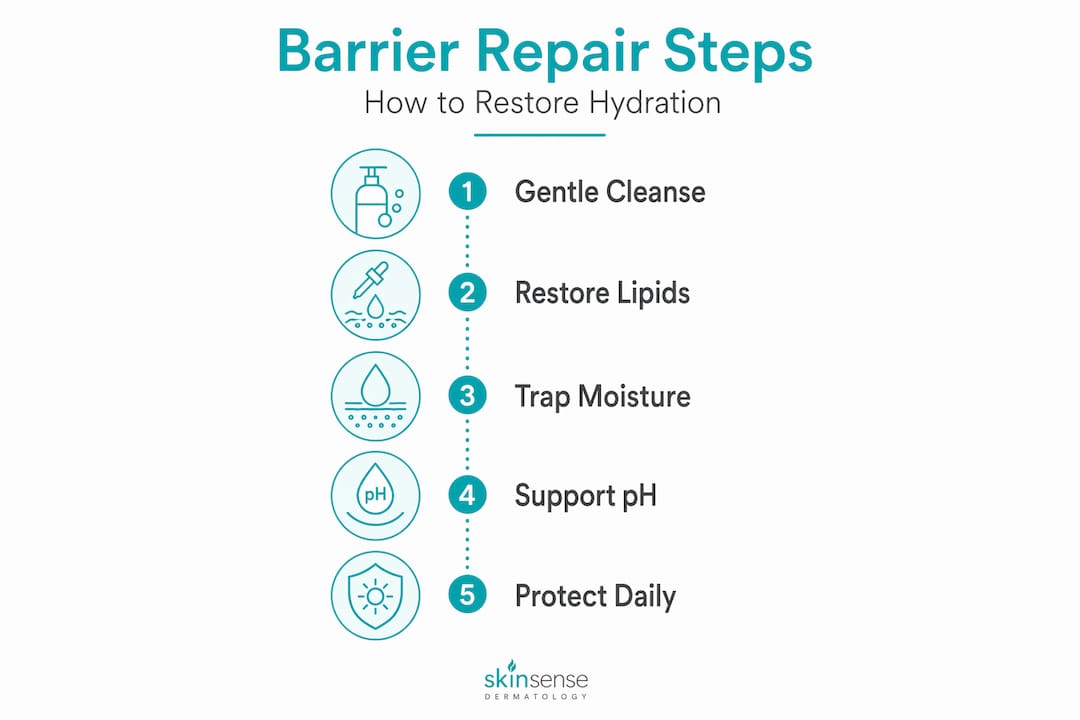
Effective dry skin barrier repair targets three things simultaneously: increasing water content in the stratum corneum, slowing water loss through lipid restoration, and protecting the structural integrity of the lipid-corneocyte matrix. Here is how to do that practically:
Choose ingredients with a purpose:
- Ceramides directly replenish the lipid mortar and support structural repair.
- Humectants like hyaluronic acid draw water into the skin cells. Explore how humectants support hydration as part of a complete routine.
- Occlusives like petrolatum sit on the surface and physically slow TEWL. Occlusives can block almost 99% of water loss when applied correctly.
Simplify your routine:
The more products you layer, the higher the risk of introducing an irritant. A cleanser, a targeted treatment, and a moisturiser with supporting ingredients is often enough. Combining ceramides and humectants in a single moisturiser covers both hydration and barrier support without complexity.
Use pH-appropriate products:
A cleanser with a high pH can disrupt the acid mantle and impair the enzymes your skin uses to produce new lipids. Stick to products with a pH between 4.5 and 5.5 for facial cleansing.
Lifestyle supports the barrier too:
Staying well-hydrated internally, sleeping adequately, and avoiding prolonged hot showers all contribute meaningfully to barrier health and glow. UV exposure also degrades lipids over time, which is why SPF is a barrier care step, not just a cosmetic one.
Pro Tip: Apply your moisturiser while your skin is still slightly damp after cleansing. This traps some surface water in the stratum corneum before your occlusive or moisturiser seals it in, maximising hydration delivery.
My take on the “just moisturise” myth
I have spoken to so many people who have spent months, sometimes years, cycling through moisturiser after moisturiser and getting nowhere. They feel like their skin is “broken” or uniquely difficult. What I have found, consistently, is that the issue is almost never the moisturiser they are using. It is that they are still washing their face twice a day with a cleanser that strips their barrier clean, then trying to rebuild with a single cream.
Here is the uncomfortable truth I have come to accept: most skincare routines are solving a problem they helped create. The sensitisation, the dryness, the reactive skin. A lot of it is self-inflicted through over-cleansing and overcomplicating.
What actually works, in my experience, is ruthless simplicity. Cut the routine back. Protect the barrier first. Stop using anything that stings, tingles, or leaves your skin feeling “tight and clean.” Tight and clean is not a good sign. It means you have washed away your lipid protection.
I am also sceptical of any product promising overnight barrier repair. The science is clear: self-repair takes consistent time. Real improvement over two to four weeks of stable, simple care beats any quick-fix promise. Give your skin a fair environment to do what it is already trying to do.
— Werner
Products that actually support your barrier
At Smplskin, we built our approach around exactly what the science recommends: gentle cleansing, real barrier support, and no unnecessary complexity.
The Gentle Cleanser and SPF 15 Moisturiser Duo is designed to do two things the barrier needs most. The cleanser respects your skin’s pH and lipid structure instead of stripping it. The moisturiser delivers hydration while the SPF protects against UV-driven lipid degradation. Together, they cover the morning routine basics without asking you to manage five different products. If you are working on dry skin barrier repair or simply want to maintain what you have, this duo is where we would tell you to start. Simple. Effective. Built around your barrier, not against it.
FAQ
What is the skin hydration barrier?
The skin hydration barrier is the stratum corneum, your skin’s outermost layer, which regulates water retention and prevents water loss through a lipid matrix of ceramides, cholesterol, and fatty acids.
How do I know if my skin barrier is damaged?
Increased sensitivity, persistent dryness, stinging from products you previously tolerated, and tight skin after cleansing are common signs that your skin moisture barrier is compromised.
What is the difference between skin hydration and barrier function?
Hydration refers to the water content inside skin cells, while barrier function controls how quickly that water escapes through the skin surface via TEWL.
Which ingredients help with dry skin barrier repair?
Ceramides restore the lipid matrix, humectants like hyaluronic acid attract water into the skin, and occlusives like petrolatum physically reduce water loss. Using all three together gives the best results.
How long does it take to repair the skin barrier?
The skin begins self-repair within hours, but full barrier normalisation typically takes several days to weeks of consistent, gentle care without repeated exposure to irritants.
Recommended
- Understanding the skin barrier: why it matters for healthy skin – SMPL SKIN South Africa
- 10 simple ways to boost skin hydration for glowing skin – SMPL SKIN South Africa
- Role of humectants in skincare: a hydration guide – SMPL SKIN South Africa
- Hydration tips for skin: minimalist routines and expert advice – SMPL SKIN South Africa