

TL;DR:
- Skin fasting involves temporarily reducing or pausing non-essential skincare products to reset the skin.
- It mainly benefits barrier health, reduces irritation from ingredient overload, and promotes understanding skin needs.
- Experts recommend short-term fasting, using simple routines with cleanser, moisturizer, and sunscreen.
More products do not always mean better skin. That idea might feel counterintuitive when every brand is launching a new serum or active ingredient, but it is one worth sitting with. Skin fasting is gaining real traction among minimalist skincare enthusiasts, and for good reason. It challenges the assumption that a 10-step routine is the gold standard. In this guide, we break down exactly what skin fasting is, how it works in practice, what experts actually say about it, and how you can decide whether it belongs in your own routine.
Table of Contents
- What is skin fasting? Separating fact from fiction
- How does skin fasting work? The core steps explained
- Does science support skin fasting? What experts really say
- Is skin fasting right for you? Personalisation and pitfalls
- Our take: Why skin fasting matters in a crowded skincare world
- Ready to try skin fasting? Minimalist essentials to support your routine
- Frequently asked questions
Key Takeaways
| Point | Details |
|---|---|
| Skin fasting simplified | Skin fasting means pausing non-essential products to let your skin reset and recover. |
| Evidence is limited | No clinical studies support skin fasting, but less can often be more for skin health. |
| Essentials still matter | Always use gentle cleanser, moisturizer, and sunscreen even during a fast. |
| Personalise your routine | Skin fasting works best when tailored to your skin’s sensitivity and needs. |
What is skin fasting? Separating fact from fiction
Now that you’ve seen how skin fasting is causing a stir, let’s clarify what it really means and what it doesn’t.
Skin fasting is a skincare trend involving a temporary reduction or pause in using non-essential products, particularly active ingredients like retinoids, AHAs, BHAs, and vitamin C, to allow the skin to reset, repair its barrier, and rely on natural processes. It is not about abandoning your routine forever. It is a deliberate, short-term pause.
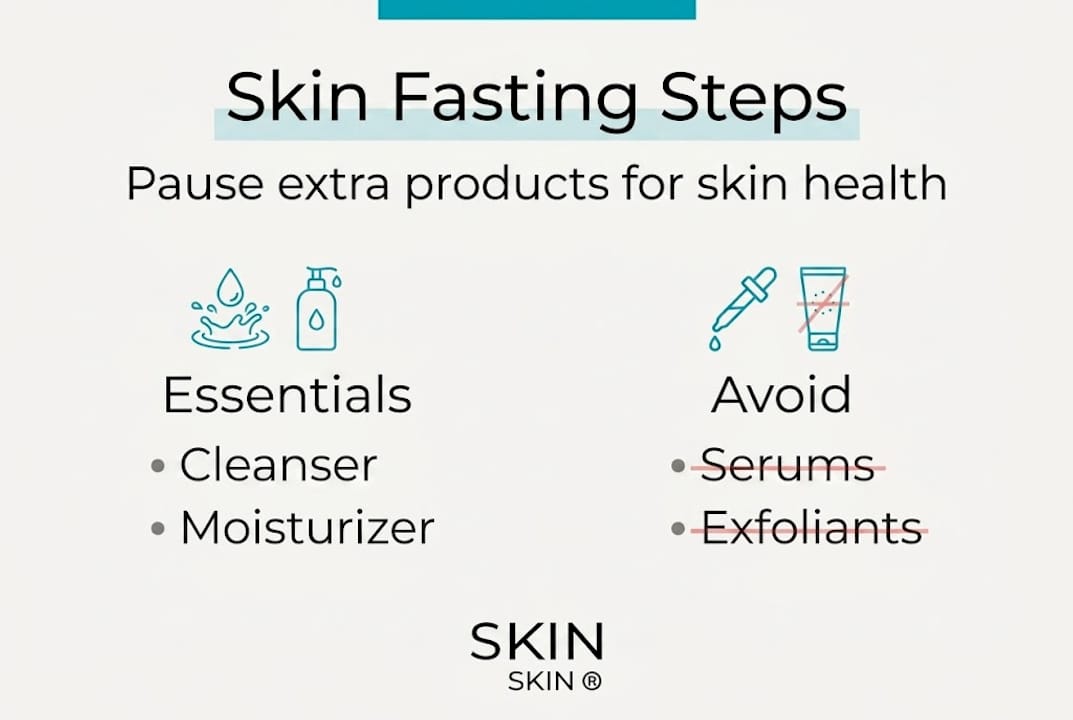
People often confuse skin fasting with a skin detox, but these are not the same thing. A skin detox tends to imply removing toxins, which is not how skin biology works. Skin fasting is more honest. It focuses on simplification, not purification.
Here is a quick comparison to clear things up:
| Concept | What it involves | Goal |
|---|---|---|
| Skin fasting | Pausing actives, keeping essentials | Barrier reset, reduced irritation |
| Skin detox | Cutting all products temporarily | Perceived cleansing of skin |
| Minimalist routine | Using only essential products daily | Long-term simplicity and skin health |
Some common misconceptions are worth addressing directly:
- It is not a cure-all. Skin fasting will not fix chronic conditions or replace medical treatment.
- It is not medically recognized as a formal protocol, but that does not make it useless.
- It is not the same as neglecting your skin. You still cleanse, moisturise, and protect.
- It is not for everyone. Certain skin conditions may require consistent active treatment.
Expert perspectives on skin fasting vary. Some see it as a genuine reset for overworked skin. Others frame it more cautiously as a simplification strategy rather than a biological detox. Both viewpoints agree on one thing: stripping back to essentials can reduce irritation and help you understand what your skin actually needs, versus what marketing has convinced you that it needs.
“The goal is not to starve your skin, but to give it a moment to breathe without the noise of too many ingredients competing for attention.”
How does skin fasting work? The core steps explained
With a clear understanding of what skin fasting is, the next step is to see exactly how you can put it into practice.
The process is refreshingly simple. Here is a straightforward approach to get started:
- Identify your actives. List every product in your routine that contains retinoids, AHAs, BHAs, vitamin C, or exfoliants. These are the products you will pause.
- Keep your essentials. A simple routine for healthy skin during a fast includes only a gentle cleanser, a moisturiser if your skin needs it, and always sunscreen.
- Choose your duration. Methodology typically includes using only a gentle cleanser, moisturiser if needed, and always sunscreen, pausing actives for 24 to 48 hours up to 7 days.
- Observe your skin. Pay attention to how your skin responds without the extra layers. Is it calmer? More balanced? More oily or dry?
- Reintroduce slowly. Once the fast is over, bring products back one at a time. This way you can clearly see which ones your skin loves and which ones it tolerates less well.
Here is a simple reference for timing:
| Fast duration | Frequency | Best suited for |
|---|---|---|
| 24 to 48 hours | Weekly | Mildly overwhelmed skin |
| 3 to 5 days | Monthly | Reactive or irritated skin |
| Up to 7 days | Quarterly | Skin on heavy active routines |
When choosing skincare products simply, fewer ingredients make it easier to understand what is working. The same logic applies here.
Pro Tip: Keep a short daily note during your skin fast. Write down what you notice, any changes in texture, oil levels, or sensitivity. This gives you real data about your skin’s natural state, not just guesswork.
Does science support skin fasting? What experts really say
Understanding the steps is vital, but do these claims hold up when you look at the research?
Honestly, the science is limited. There are no empirical data or benchmarks specifically for topical skin fasting. Current evidence is limited to anecdotal reports and expert opinion. No clinical trials have been published specifically studying skin fasting as a protocol.
That said, the absence of formal research does not mean the practice lacks value. Experts widely agree on several related points:
- Reducing actives benefits barrier health. Overusing exfoliants or retinoids can disrupt the skin barrier. Giving it a break allows recovery.
- Inflammation from product overload is real. Many people experience irritation not from a single ingredient but from the cumulative load of too many actives together.
- SPF is non-negotiable, even during a fast. This is the one essential that never gets paused, regardless of how minimal your routine becomes.
- Moisturisation remains important. Hydrated skin heals and recovers more efficiently.
Contrasting views exist: proponents see it as a reset, while other experts view it as simplification rather than a biological detox, emphasising that essentials like SPF must stay in place throughout.
Think of it this way: skin fasting is not a miracle. It is a recalibration. When you strip away the extra layers, you get a clearer picture of your skin’s baseline. That information is genuinely useful.
Holistic skincare routines and skin cycling concepts both echo this philosophy: your skin benefits from rhythm, rest, and intentional care, not constant stimulation from multiple active ingredients layered together.
The bottom line is that ingredient transparency and simplicity empower better decisions. You learn to listen to your skin instead of defaulting to more products as the automatic answer.
Is skin fasting right for you? Personalisation and pitfalls
Armed with facts and expert views, let’s make this concept practical and decide if and when skin fasting can work for you.
Skin fasting is ideal for minimalist routines and for testing short-term what your skin needs without overcomplicating. It is particularly well-suited for:
- People whose routines have grown too complex over time
- Those experiencing persistent redness, breakouts, or sensitivity
- Anyone whose skin seems to have plateaued and stopped responding to products
- Individuals wanting to understand skin sensitivity better before adding new products
Some clear signs it may be time to try a skin fast:
- Persistent irritation that has no obvious single cause
- Product overload, where you are using five or more actives regularly
- Breakouts that won’t settle, despite following a consistent routine
- Skin that feels tight or reactive after applying products
There are also common mistakes to avoid. These can turn a helpful practice into a frustrating one:
- Skipping SPF. This is the most important mistake. Sun protection must stay, always.
- Dropping your moisturiser completely. If your skin feels dry, keep a gentle, fragrance-free moisturiser in place.
- Being too rigid. If your skin genuinely needs something, give it what it needs. Fasting should not cause suffering.
- Reintroducing everything at once. This defeats the purpose entirely.
Following daily skincare tips alongside your fast helps maintain good habits throughout the process.
Pro Tip: Always patch test any product you plan to reintroduce after a fast. Introduce one new product every 3 to 5 days so you can clearly identify any reaction before adding another.
Our take: Why skin fasting matters in a crowded skincare world
We believe the skincare world has a noise problem. There are more products, more actives, and more steps being marketed as essential than ever before. And most people feel overwhelmed rather than empowered by it.
Skin fasting matters not because it is a revolutionary discovery, but because it asks a question most routines never do: what does your skin actually need, versus what has habit and marketing layered on top?
We have seen, time and again, that the people who discover their healthiest skin are often the ones who stripped back, stayed consistent with fewer ingredients, and paid attention. Minimalism is not just a trend for us. It is a philosophy built on ingredient transparency and honest results.
When you pare down to the essentials, you also rebuild confidence. You stop fearing your own skin and start understanding it. For a simple routine for hydration that supports that kind of relationship with your skin, less truly is more. Complexity hides signals. Simplicity reveals them.
Ready to try skin fasting? Minimalist essentials to support your routine
If you’re curious to try skin fasting, having the right minimalist essentials makes all the difference.
At SMPL SKIN, we have built our entire range around exactly this kind of intentional simplicity. During a skin fast, you need a gentle cleanser that does not strip, a moisturiser that supports barrier recovery, and an SPF that protects without adding unnecessary ingredients to the mix. Our SPF 15 Daily Moisturiser covers two of those needs in one step. If you want to keep it even simpler, the Gentle Cleanser and SPF 15 Duo gives you a complete, no-fuss fasting kit. Transparent ingredients. Simple routine. Real results.
Frequently asked questions
How often should you try skin fasting?
Experts generally recommend skin fasting for 24 to 48 hours once a week or once a month, depending on your skin’s current needs and how many actives you use regularly.
Is there scientific evidence behind skin fasting?
Currently, there are no clinical studies specifically on skin fasting, but experts broadly agree that reducing actives can help prevent irritation and support skin barrier recovery.
What should you use during a skin fast?
Stick to a gentle cleanser, a moisturiser if your skin needs it, and always apply sunscreen. Everything else, especially actives, gets paused for the duration of the fast.
Is skin fasting safe for sensitive skin?
Yes. Skin fasting is ideal for sensitive skin because it removes the risk of stacking irritating actives. Starting with a short 24-hour fast is a gentle, low-risk way to begin.
Recommended
- Simple skin health: skin cycling for minimalists – SMPL SKIN South Africa
- How to achieve healthy skin with a simple routine – SMPL SKIN South Africa
- Detoxify your skin at home: simple routines for results – SMPL SKIN South Africa
- Build a healthy skin regimen: simple routines for hydration – SMPL SKIN South Africa