

TL;DR:
- Knowing your skin type helps select products that support rather than harm your skin.
- Skin type can change over time due to age, hormones, climate, and stress.
- Simplicity and consistency in skincare are more effective than over-complicating routines or chasing trends.
Most people choose skincare products based on what looks appealing or what a friend recommended. The problem? Using the wrong products for your skin type can make your skin worse, not better. A heavy cream on oily skin can block pores. A drying cleanser on sensitive skin can trigger redness and flaking. Skin types are defined by sebum production, hydration levels, and reactivity, and understanding yours is the first step to a routine that actually works. In this article, we break down the five main skin types, how to identify yours, and how to build a simple, hydration-focused routine around it.
Table of Contents
- What are the main skin types?
- How to identify your skin type easily
- Nuances: how your skin type can change over time
- Matching your routine to your skin type
- What most people get wrong about skin types
- Simple products for every skin type
- Frequently asked questions
Key Takeaways
| Point | Details |
|---|---|
| Skin type basics | Normal, oily, dry, combination, and sensitive are the main categories, defined by oil, moisture, and reactivity. |
| Easy identification | The bare-face test helps you observe and determine your skin type at home. |
| Types can change | Your skin type can shift with age, hormones, and environment, so routines should adapt. |
| Hydration matters | Hydrating your skin is vital for every type to maintain a healthy barrier and comfort. |
| Simple routines work | Gentle, targeted routines for your type are more effective than trend-driven approaches. |
What are the main skin types?
Now that you understand why mislabeling your skin type can be harmful, let’s break down the main skin types and what actually defines them.
The five primary skin types recognised in skincare are normal, dry, oily, combination, and sensitive. Each one is shaped by how much oil your skin produces, how well it retains moisture, and how it reacts to products or environmental factors. Knowing which category fits you best helps you choose products that support your skin rather than work against it. You can also explore skin health explained for a deeper look at what healthy skin actually looks like.
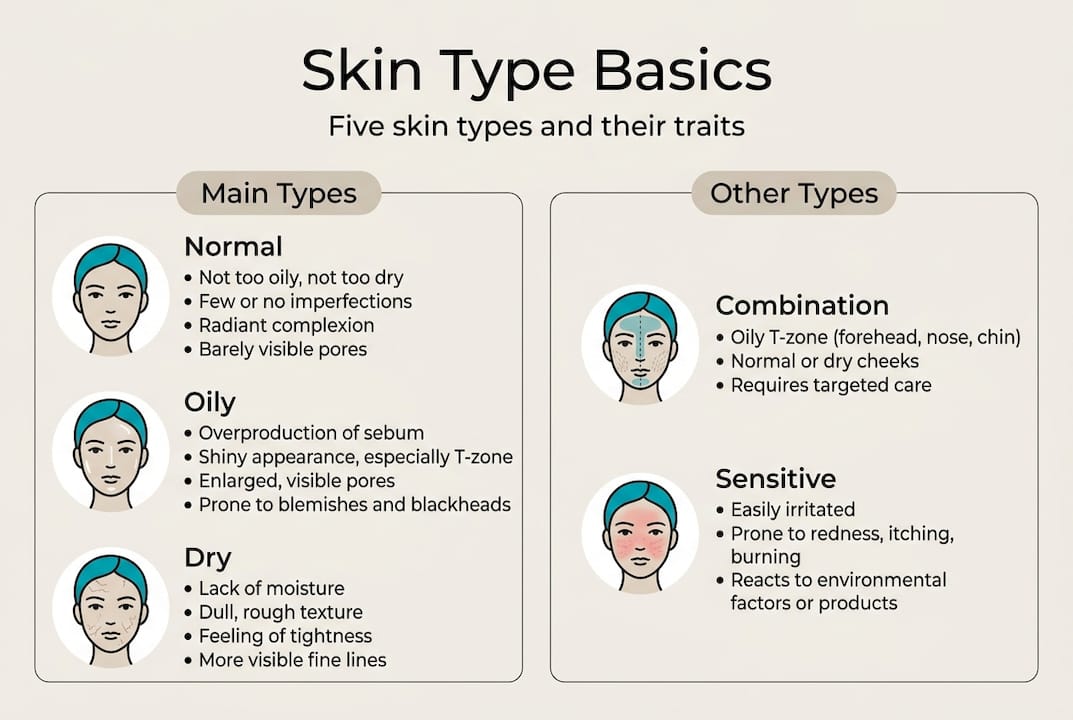
Here is a quick overview of each type:
| Skin type | Key characteristics | Common concerns |
|---|---|---|
| Normal | Balanced oil and moisture | Few blemishes, minimal sensitivity |
| Dry | Low sebum, rough or tight feel | Flaking, dullness, fine lines |
| Oily | Excess sebum, shiny appearance | Enlarged pores, acne, congestion |
| Combination | Oily T-zone, dry cheeks | Managing two zones at once |
| Sensitive | Reactive, easily irritated | Redness, burning, stinging |
One important thing to understand: sensitive skin is not a standalone category in the same way the others are. It is an overlay. You can have oily skin that is also sensitive, or dry skin that is also sensitive. This distinction matters because it changes what products you should and should not use.
Combination skin is the most common type, affecting a large portion of the population. It can feel particularly confusing because different areas of your face have different needs at the same time.
Why does this matter? Because:
- Oily skin needs lightweight, non-comedogenic hydration, not heavy creams
- Dry skin needs richer emollients and gentle cleansers
- Sensitive skin needs fragrance-free, minimal-ingredient formulas
- Normal skin benefits from simple maintenance routines
- Combination skin may need targeted products for different zones
Getting this right from the start saves you time, money, and frustration.
How to identify your skin type easily
With the categories in mind, here is how you can pinpoint your own skin type in just a few steps.
The most reliable DIY method is the bare-face wash test. It requires no special tools and gives you clear, observable results within an hour. Here is how to do it:
- Cleanse your face with a gentle, unfragranced cleanser and pat dry.
- Wait 30 to 60 minutes. Do not apply any products. Let your skin settle naturally.
- Observe your skin. Look for shine, tightness, flaking, or redness.
- Check specific zones. Focus on your forehead, nose, cheeks, and chin.
- Match your observations to the skin type descriptions above.
If your skin feels tight and looks dull, you likely have dry skin. If it is shiny all over, that points to oily skin. Shine only on the T-zone with dryness on the cheeks suggests combination skin. Little to no shine, no tightness, and no irritation indicates normal skin.
For more complex or unclear cases, a questionnaire like the Baumann Skin Type Indicator can offer a more nuanced result. It factors in oiliness, sensitivity, pigmentation, and firmness to give a broader picture.
Remember: if your skin is persistently red, itchy, or reacting to most products, it is worth seeing a dermatologist. Some skin conditions like rosacea or eczema can mimic or overlap with skin types.
Pro Tip: No matter what your skin type is, hydration is non-negotiable. Skipping moisture because you have oily skin can actually trigger more oil production as your skin tries to compensate. When you choose skincare products, always include a hydrating step. You can also check out daily skincare glow tips for practical routine ideas across all skin types.
Nuances: how your skin type can change over time
Identifying your skin type today is helpful, but it is important to understand that skin needs and characteristics can change over time.

Skin type shifts with age, hormonal changes, climate, and even stress levels. The oily skin you had in your twenties may become drier in your forties. The normal skin you maintained through summer can feel dry and tight in winter. These changes are completely normal, and they are a good reason to reassess your skin periodically rather than sticking to a routine you set years ago.
Here is how common life events and factors can shift your skin type:
| Life event or factor | Possible skin change |
|---|---|
| Ageing | Skin becomes drier as oil production slows |
| Pregnancy or hormones | Can trigger oiliness or sensitivity |
| Cold or dry climate | Increases dryness and sensitivity |
| Stress | Can worsen oiliness or trigger breakouts |
| Medication changes | May affect hydration or reactivity |
Sensitive skin deserves a special mention here. It can develop at any age, even if your skin was never reactive before. New sensitivities can appear due to overuse of active ingredients, environmental changes, or health factors. This is why holistic skincare routines that account for your whole lifestyle tend to deliver better long-term results.
Key factors that can shift your skin type include:
- Seasonal changes: Cold, dry winters often dry out even oily skin
- Hormonal fluctuations: Puberty, pregnancy, menopause, and contraceptives all play a role
- Diet and hydration: What you eat and drink affects how your skin functions
- Skincare habits: Over-exfoliating or using harsh products can disrupt your skin barrier
Combination skin is particularly prone to shifting, as the balance between oily and dry zones can change dramatically based on the factors above. For men especially, men’s skincare routines need to adapt as hormone levels and shaving habits evolve over the years.
Matching your routine to your skin type
Knowing your skin type is just the start. Here is how you can use that insight for a routine that truly works for you.
A good routine does not need to be complicated. In fact, keeping it simple is often more effective. The key is choosing the right types of products for your skin type and using them consistently.
| Skin type | Cleanser | Moisturiser | Extra step |
|---|---|---|---|
| Normal | Gentle foam or gel | Lightweight lotion | SPF daily |
| Dry | Cream or oil cleanser | Rich, occlusive cream | Hydrating serum |
| Oily | Foaming gel cleanser | Oil-free gel moisturiser | BHA exfoliant |
| Combination | Balanced gel cleanser | Lightweight, non-greasy | Zone-specific treatment |
| Sensitive | Fragrance-free micellar | Barrier-repair cream | Soothing serum |
If your skin type shifts, here is how to adapt:
- Reassess gradually. Do not overhaul your whole routine at once. Swap one product at a time.
- Start with hydration. Boosting skin hydration is the first fix for most skin concerns.
- Adjust your cleanser. If skin feels tight, switch to something gentler. If it is oilier, try a foaming formula.
- Layer smartly. Learn to layer skincare for hydration to get the most from each product.
The most common mistakes people make? Skipping moisturiser because they have oily skin, or over-cleansing because they feel shiny. Always hydrate regardless of skin type to avoid compensatory oiliness. Stripping your skin of moisture only tells it to produce more oil.
Pro Tip: A balanced, consistent routine beats an elaborate one every time. Start with a cleanser, moisturiser, and SPF. Once that feels right, you can build a healthy skin regimen with targeted additions.
What most people get wrong about skin types
Here is a fresh take on what really matters when understanding and caring for your skin.
We think the skincare industry has over-complicated skin types. Most people do not fit perfectly into a single category. You might be mostly normal with some oiliness in summer. You might have dry skin that becomes sensitive when stressed. Trying to find a rigid label and then buy an entire matching product line for it is often where things go wrong.
What we have seen work, time and again, is this: focus on the fundamentals. Gentle cleansing, consistent hydration, and a simple SPF will serve almost everyone well, regardless of where they fall on the skin type spectrum. Instead of chasing the next trending ingredient or doing a full routine overhaul every few months, invest in understanding your skin’s current needs and respond to those.
The most healthy skin with simple routine success stories we hear are not from people who found the perfect product for their exact skin type. They are from people who stopped over-complicating things and committed to consistency. Skin rewards patience and simplicity far more than it rewards novelty.
Simple products for every skin type
If you are ready to simplify your skincare based on your new understanding, these gentle options are a smart next step.
At SMPL SKIN, we have built our product range around exactly this philosophy: clean, effective formulations that work for real skin, without the overwhelm. Whether your skin is dry, oily, sensitive, or somewhere in between, our barrier-friendly products are designed to hydrate, protect, and support your skin’s natural balance.
For an easy starting point, our gentle cleanser and moisturiser duo is a favourite for those new to a simple routine. If daily sun protection is a priority, the SPF 15 daily moisturiser delivers hydration and protection in one step. For those who prefer a foaming cleanse, the foam and moisturiser duo makes morning routines effortless. Explore what works best for your skin type and take that first simple step.
Frequently asked questions
Can my skin type change with age or weather?
Yes, your skin type often changes due to ageing, hormonal shifts, or climate variations, so it is worth reassessing your routine seasonally or after major life changes.
Is it possible to have sensitive skin and another skin type?
Sensitive skin overlays any other type, meaning you can have oily, dry, or combination skin that is also reactive and easily irritated.
What’s the easiest way to figure out my skin type?
Use the bare-face wash test: cleanse, wait an hour, and observe whether your skin feels tight, looks shiny, or shows redness in specific zones.
Do I need different products if my skin type shifts?
When your skin type changes, adjust gradually by starting with your cleanser and moisturiser, focusing on gentle care and consistent skin type hydration before adding anything new.
Does everyone need to moisturise, even oily skin?
Absolutely. All skin types need hydration to maintain a healthy skin barrier, and skipping it can actually cause your skin to produce more oil to compensate.
Recommended
- 10 simple ways to boost skin hydration for glowing skin – SMPL SKIN South Africa
- Simple men’s skincare: Easy routines for hydrated skin – SMPL SKIN South Africa
- Understand skin sensitivity: simple solutions for hydration – SMPL SKIN South Africa
- Skin health explained: simple science for better results – SMPL SKIN South Africa