

TL;DR:
- The skin barrier is a lipid-rich outer layer that maintains hydration and protects against irritants.
- Damage from over-cleansing, harsh products, and UV exposure compromises barrier function, causing dryness and sensitivity.
- Supporting repair involves gentle cleansing, ceramide-rich moisturizers, sun protection, and avoiding aggressive actives.
Most of us have been there. You switch products, try a new cleanser, add a serum, and your skin still feels tight, dry, or irritated. The frustration is real. But here’s the thing: the problem often isn’t the products. It’s your skin barrier. When this critical layer is compromised, no amount of product-switching will fix it. Understanding what the skin barrier is, how it works, and what harms it gives you the power to make real, lasting changes. This guide breaks it all down in plain language so you can stop guessing and start seeing results.
Table of Contents
- What is the skin barrier? Anatomy and function explained
- How the skin barrier protects you: More than just a shield
- What damages the skin barrier? Common causes and warning signs
- How to support and restore your skin barrier
- The skin barrier: What most guides miss and why a holistic mindset matters
- Discover barrier-supportive skincare with SMPL SKIN
- Frequently asked questions
Key Takeaways
| Point | Details |
|---|---|
| Crucial outer layer | Your skin barrier is the shield that keeps moisture in and irritants out of your skin. |
| Not just one barrier | Multiple layers—physical, chemical, microbial, immune—work together for full protection. |
| Common causes of damage | Over-exfoliation, harsh cleansers, UV exposure, and age can weaken your skin’s barrier. |
| Repair takes time | Using ceramide-rich moisturizers and gentle routines helps restore your barrier, but healing can take weeks. |
| Holistic care works best | A comprehensive approach that supports lipids, pH, and the microbiome is key for lasting skin health. |
What is the skin barrier? Anatomy and function explained
Now that you know there’s more to skin problems than products, let’s break down exactly what your skin barrier is.
Your skin barrier is the outermost layer of your skin, called the stratum corneum. Think of it like a brick wall. The bricks are flattened skin cells called corneocytes. The mortar holding them together is a blend of lipids. This structure is what keeps good things in and bad things out. It’s elegant in its simplicity, and when it works well, you barely notice it. When it doesn’t, your skin tells you loudly.
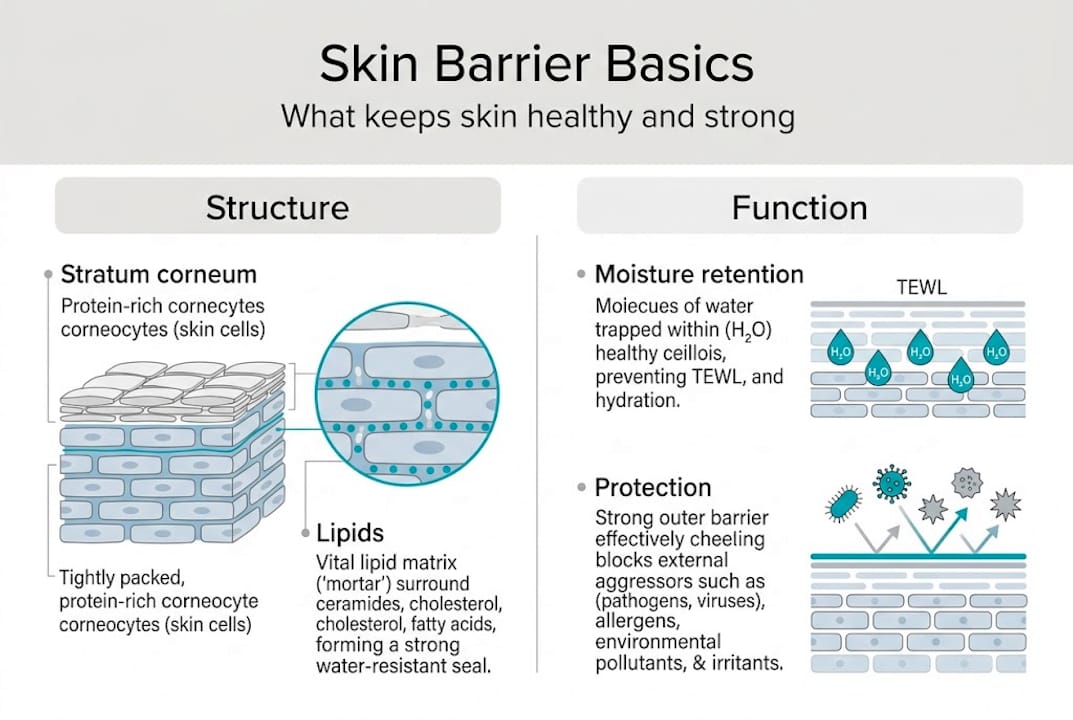
The lipid “mortar” is the real hero here. According to skin barrier structure, the specific mix matters enormously. The skin barrier lipid ratio is a precise 3:1:1 blend of ceramides (40-50%), cholesterol (25%), and free fatty acids (10-15%). Disrupt this ratio and the wall starts to crack.
Key lipid components of the skin barrier:
| Lipid | Proportion | Primary role |
|---|---|---|
| Ceramides | 40-50% | Structural integrity and water retention |
| Cholesterol | 25% | Flexibility and fluidity of the lipid layer |
| Free fatty acids | 10-15% | Maintaining acid pH and antimicrobial defense |
Beyond keeping moisture in, your barrier does several jobs at once. Understanding skin health basics helps frame why each function matters:
- Prevents transepidermal water loss (TEWL): Keeps your skin hydrated from within
- Blocks irritants and allergens: Acts as a filter against environmental aggressors
- Supports skin pH: Maintains a slightly acidic environment that protects you
- Sustains the skin microbiome: Provides the right conditions for beneficial bacteria
When the barrier is intact, all of these functions run quietly in the background. The moment it’s compromised, every single one is affected.
How the skin barrier protects you: More than just a shield
With the basic structure covered, it’s important to recognize that protection goes far beyond a simple “wall.”
Your skin barrier operates on five distinct levels. This is what makes it so remarkable, and why caring for it requires more than just slapping on a moisturizer.
| Defense layer | What it does |
|---|---|
| Physical | Blocks particles and pathogens from entering |
| Chemical | Acid mantle (pH 4.5-5.5) neutralizes harmful microbes |
| Microbial | Supports beneficial bacteria that crowd out harmful ones |
| Immune | Triggers inflammation responses to threats |
| Neuronal | Regulates itch and pain sensations in the skin |
The skin barrier functions confirm that the barrier is multifaceted, involving immune surveillance and microbiome management, not just physical protection. This is why someone with a disrupted barrier often experiences not just dryness, but also sensitivity, redness, and even breakouts.
The acid mantle deserves special attention. This thin, slightly acidic film sits on top of your skin and is your first chemical line of defense. When you use harsh, alkaline cleansers or over-wash your face, you strip this mantle away. Sensitive skin is often just a disrupted acid mantle trying to recover.
TEWL (transepidermal water loss) is the key measurement dermatologists use to assess barrier health. Healthy skin loses a controlled amount of water through the skin surface. Damaged skin loses significantly more, which is why it feels dry and tight no matter how much water you drink.
The skin microbiome is another layer most people overlook. Your skin hosts billions of microorganisms that actively protect you. Disrupt the barrier and you disrupt their habitat too.

Pro Tip: If your skin feels dry even after moisturizing, the issue likely isn’t hydration. It’s barrier integrity. Focus on repairing the barrier first, then layer hydration on top.
What damages the skin barrier? Common causes and warning signs
Knowing how your barrier protects you, it’s vital to recognize what can put it at risk.
Barrier damage is more common than most people realize, and many causes are things we do every day without thinking. The good news is that once you know the triggers, they’re largely avoidable.
Top causes of skin barrier damage:
- Over-washing or over-cleansing: Stripping the skin’s natural oils with frequent washing
- Harsh chemical exfoliants: Overusing acids or physical scrubs that remove the lipid layer
- UV exposure: Sun damage degrades ceramides and disrupts the lipid matrix
- Extreme weather: Cold, wind, and low humidity all accelerate moisture loss
- Aging: Natural ceramide production slows significantly with age
- Fragrance and alcohol in products: Common irritants that compromise barrier integrity
Over-exfoliation and harsh cleansers increase TEWL, leading to dryness, inflammation, and sensitivity. This is a cycle many people fall into: they see dryness, exfoliate more to “refresh” the skin, and make the problem worse.
Warning signs your barrier is compromised:
- Persistent tightness, especially after cleansing
- Stinging or burning when applying products
- Flaking or rough texture that doesn’t respond to moisturizer
- Redness or blotchiness without an obvious cause
- Sudden sensitivity to products you’ve used before
“Ceramide-based repair can reduce the severity of barrier damage by 61%, making ingredient choice one of the most powerful tools in your routine.”
Aging is a particularly important factor. As we get older, our skin’s ability to produce ceramides naturally declines. Reviewing your skincare routine tips and choosing the right products for your age and skin type becomes more important over time. The barrier and aging relationship shows that older skin has measurably higher TEWL than younger skin, meaning prevention is far more effective than repair.
How to support and restore your skin barrier
Once you’ve identified damage, here’s how you can help your skin recover its strength and comfort.
Restoring your skin barrier doesn’t require a complicated 10-step routine. In fact, simplicity is the strategy. The goal is to reduce stress on the skin while giving it the right building blocks to repair itself.
Step-by-step barrier recovery routine:
- Cleanse gently: Use a low-pH, fragrance-free cleanser. Avoid foaming cleansers with sulfates.
- Apply a hydrating serum: Hyaluronic acid or glycerin pulls water into the skin.
- Moisturize with ceramides: This is the critical step. Ceramide-rich moisturizers actively replenish the lipid matrix.
- Protect with SPF: UV damage is one of the fastest ways to undo barrier repair.
- Pause actives: Step away from retinoids, acids, and exfoliants until the barrier recovers.
Ceramide moisturizers and gentle routines reduce TEWL and support barrier repair, with recovery time ranging from 72 hours to four weeks depending on the severity of damage. Minor irritation can resolve quickly. Chronic barrier dysfunction takes longer and requires consistent care.
Pro Tip: Immediately after barrier damage, apply a ceramide moisturizer to damp skin and seal with a thin layer of an occlusive like petroleum jelly overnight. This dramatically speeds up recovery.
Understanding how to layer your products correctly also makes a real difference. The guide on layering for hydration walks you through the correct order, and building a barrier-supportive regimen gives you a sustainable framework for long-term skin health.
Patience is genuinely part of the process. Skin doesn’t repair overnight. Commit to a simple, consistent routine and give it time to work.
The skin barrier: What most guides miss and why a holistic mindset matters
Even with practical repairs in place, there’s a broader perspective worth considering for sustainable skin health.
Most skincare content treats the barrier as a single problem with a single fix: add ceramides, done. We think that misses the point entirely. The barrier is a living system, and it responds to everything, including your stress levels, sleep, diet, and the consistency of your routine.
Dermatology research increasingly emphasizes all functional layers, not just permeability. Aging and chronic conditions favour preventive corneotherapy over aggressive actives. In plain terms: being reactive never beats being consistent.
We’ve seen it repeatedly. Someone repairs their barrier, feels great, then reintroduces a strong acid too soon and ends up back at square one. The real shift happens when you move from fixing damage to preventing it. That means treating your barrier like the dynamic, multi-layered system it is, not just a wall that needs patching.
A holistic skincare approach that addresses moisture, immune health, microbiome balance, and routine stability will always outperform any single ingredient. Simple, gentle, and consistent beats complicated and aggressive every time.
Discover barrier-supportive skincare with SMPL SKIN
Ready to apply what you’ve learned about barrier health? Explore science-backed, gentle routines built to help your skin thrive.
At SMPL SKIN, every product is formulated with the skin barrier in mind. We keep things simple so your skin gets exactly what it needs without unnecessary complexity. Our barrier-friendly daily moisturiser is designed to reduce TEWL, support hydration, and protect with SPF15, making it a practical daily essential.
If you’re starting fresh or rebuilding a damaged barrier, our gentle cleanser and moisturiser duo gives you a complete, paired routine without the guesswork. Browse the SMPL SKIN full range and find the right products to support your skin’s natural defences, simply and effectively.
Frequently asked questions
What are the main components of the skin barrier?
The skin barrier consists mainly of ceramides, cholesterol, and fatty acids arranged in a 3:1:1 ratio, with ceramides making up the largest portion at 40-50%.
How do I know if my skin barrier is damaged?
Signs of barrier impairment include persistent dryness, stinging when applying products, redness, and increased sensitivity to products you’ve previously tolerated well.
How long does it take to repair the skin barrier?
Minor barrier repair can take 3-7 days, while more significant damage may require up to four weeks. Barrier repair time depends on the severity of damage and how consistently you follow a gentle, ceramide-focused routine.
Can I use exfoliants if my skin barrier is damaged?
It’s best to avoid exfoliants entirely while recovering. Over-exfoliation impairs barrier function and increases TEWL, which slows healing. Reintroduce actives slowly once the barrier feels comfortable and stable.
Why does aging affect the skin barrier?
Aged skin has higher TEWL than younger skin and repairs more slowly, because natural ceramide production declines with age, making consistent preventive care increasingly important over time.
Recommended
- Skin health explained: simple science for better results – SMPL SKIN South Africa
- Detoxify your skin at home: simple routines for results – SMPL SKIN South Africa
- Postbiotic skincare: 5 key benefits for healthy skin – SMPL SKIN South Africa
- Understand skin sensitivity: simple solutions for hydration – SMPL SKIN South Africa
- Sensitive skin: Why natural solutions matter for purity – ZenChemy Lab