

TL;DR:
- Proper face cleansing involves gentle techniques, brief massage, and thorough rinsing.
- Using skin-type appropriate, fragrance-free cleansers with lukewarm water preserves the skin barrier.
- Over- or under-cleansing harms skin health; twice daily is generally recommended for most skin types.
Most people spend less than 30 seconds washing their face, rushing through a routine that genuinely shapes how their skin looks and feels every single day. Splashing water and rubbing in whatever soap is nearby might feel sufficient, but this approach quietly causes irritation, dullness, and a compromised skin barrier over time. A structured cleansing method that includes washing your hands, using lukewarm water, massaging gently for 30 to 60 seconds, rinsing properly, and following up with moisturizer changes everything. This guide breaks down exactly what to do, step by step, so your skin gets the care it actually deserves.
Table of Contents
- What you need before you start
- Step-by-step facial cleansing routine
- How often should you cleanse?
- Troubleshooting and mistakes to avoid
- Why gentleness, not intensity, wins for skin health
- Enhance your results with gentle skincare solutions
- Frequently asked questions
Key Takeaways
| Point | Details |
|---|---|
| Gentle cleansers work best | Choose a non-irritating cleanser matched to your skin type for daily use. |
| Consistent steps matter | Follow a set routine twice daily to maximize skin health and avoid common mistakes. |
| Protect your skin barrier | Avoid harsh scrubbing and hot water to prevent irritation and long-term issues. |
| Double cleanse only when needed | Reserve double cleansing for makeup, sunscreen, or heavy pollution; otherwise, keep it simple. |
What you need before you start
Now that you know why a proper routine matters, let’s make sure you have everything you need to get started. Jumping straight into cleansing without the right materials is one of the most common mistakes we see. A little preparation goes a long way.
The single most important thing to get right is your cleanser. You need one that actually suits your skin type, because using the wrong product is just as harmful as using no product at all. Skin-type matched cleansers work as follows: gel or foaming cleansers are best for oily or acne-prone skin, while cream or hydrating cleansers work better for dry or sensitive skin. Fragrance-free formulas are a safe bet for almost everyone, especially if your skin reacts easily. When you’re unsure, lean toward gentle over aggressive, every time. For more guidance on this, our article on choosing skincare products gives you a simple framework to follow.
Here’s everything you need before you begin:
- A gentle, skin-type-appropriate cleanser (fragrance-free if possible)
- Lukewarm water (not cold, definitely not hot)
- A clean, soft towel dedicated only to your face
- A moisturizer to apply immediately after patting dry
- Micellar water or an oil-based cleanser for evenings when you’ve worn makeup or sunscreen
| Item | Why it matters |
|---|---|
| Skin-type cleanser | Removes impurities without stripping natural oils |
| Lukewarm water | Cleanses effectively without causing irritation or dryness |
| Clean face towel | Prevents bacteria transfer that leads to breakouts |
| Moisturizer | Locks in hydration and restores the skin barrier post-cleanse |
| Oil-based cleanser (optional) | Dissolves oil-soluble debris before a water-based cleanse |
Towels are often overlooked. A towel that’s been sitting in a damp bathroom for three days carries bacteria, and pressing that against freshly cleansed skin defeats the entire purpose. Use a fresh towel at least every two to three days, or keep a dedicated stack of small face cloths. You can find more ideas about building out your full kit in our guide on skincare essentials.
Pro Tip: If your skin is sensitive or reactive, avoid non-bar cleansers that contain alcohol, artificial fragrance, or sulfates. These ingredients strip your skin faster than any physical scrubbing ever could.
Step-by-step facial cleansing routine
With your materials ready, here’s the exact routine to follow. This process is rooted in dermatologist-backed guidance and takes no longer than two to three minutes from start to finish. Consistency matters far more than complexity.
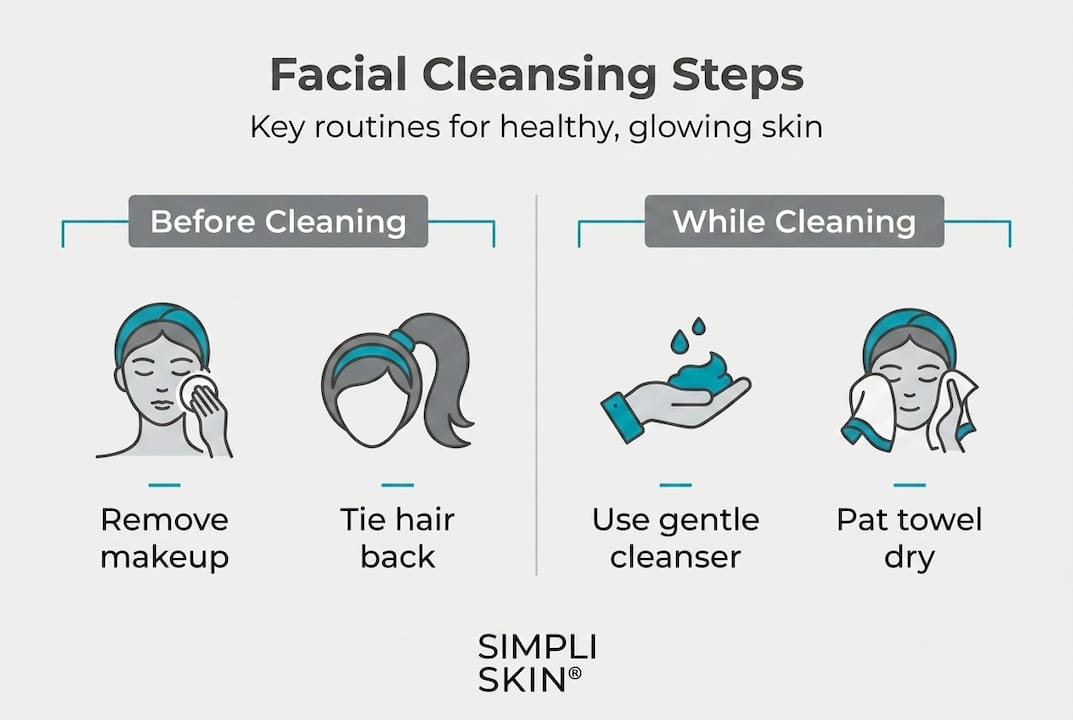
- Wash your hands thoroughly. Before touching your face, clean your hands with soap and water. Your hands carry oils, bacteria, and environmental debris that you don’t want near freshly rinsed skin.
- Wet your face with lukewarm water. Splash your face gently or rinse it under a running tap. The goal is to open up the pores slightly and soften the skin surface without shocking it with temperature extremes.
- Apply your cleanser and massage gently. Dispense a small amount, about the size of a five-rand coin, and work it into your skin using slow, circular motions. According to Cleveland Clinic guidance, massaging for 30 to 60 seconds is the sweet spot for effective cleansing without causing micro-irritation. Focus on your T-zone, jawline, and the sides of your nose.
- Rinse thoroughly with lukewarm water. Make sure no cleanser residue is left behind. Leftover product buildup can clog pores and cause the very breakouts you’re trying to prevent. Check your hairline and jawline, where residue often hides.
- Pat dry with a clean, soft towel. Never rub. Patting is gentler on the skin barrier and reduces friction-induced irritation. A few soft presses are all it takes.
- Apply your moisturizer immediately. Within 60 seconds of patting dry, apply your moisturizer to damp skin. This step seals in hydration and supports barrier recovery. We break this down further in our guide on building a healthy skin routine.
For evenings when you’ve worn makeup, sunscreen, or been exposed to heavy urban pollution, double cleansing is the smarter approach. Cleveland Clinic recommends double cleansing by starting with an oil-based or micellar cleanser on dry skin to dissolve oil-soluble impurities, then following up with your regular water-based cleanser. Here’s how the two methods compare:
| Method | Best for | Steps | When to use |
|---|---|---|---|
| Single cleanse | No makeup, low pollution days | Steps 1 to 6 above | Morning and low-exposure evenings |
| Double cleanse | Makeup, sunscreen, city pollution | Oil/micellar first, then water-based | Evenings after heavy product use |
Pro Tip: Less is genuinely more here. Scrubbing harder or using more cleanser does not mean cleaner skin. It means a more damaged skin barrier. Gentleness is the actual skill to develop.
For your morning routine specifically, our article on morning skincare steps walks you through how to sequence your cleanser, serum, and moisturizer for maximum hydration benefits.
How often should you cleanse?
Now that you know the steps, it’s important to understand how frequently to use this routine for your unique skin type. Frequency is where a lot of people quietly go wrong, either overcleansing out of habit or undercleansing because they think it’s fine to skip.

For most people, twice-daily cleansing is the dermatologist-recommended standard. Once in the morning to remove overnight oils and products, and once at night to clear the day’s pollution, sweat, and sunscreen. This rhythm supports a healthy skin barrier without tipping into over-cleansing territory.
If you have dry or sensitive skin, you may need to adjust. Dermatologists often suggest that dry or sensitive skin types simply rinse with water in the morning and reserve actual cleansing for the evening only. This avoids stripping the limited natural oils that dry skin relies on for comfort and resilience.
Here’s what goes wrong at both extremes:
- Overcleansing: Strips natural oils, disrupts the skin microbiome (the natural community of beneficial bacteria on your skin), triggers excess oil production as the skin tries to compensate, and increases sensitivity to other products.
- Undercleansing: Allows dead skin cells, pollutants, and sebum to accumulate, which leads to clogged pores, a dull complexion, and potential breakouts or congestion.
- Cleansing with the wrong product too often: Even a twice-daily routine causes damage if the cleanser is too harsh. Frequency and product choice work together.
- Skipping nighttime cleansing: This is one of the most damaging habits. Your skin does most of its repair work while you sleep, and it cannot do that effectively if it’s coated in sunscreen, makeup residue, or city grime.
There is a widely held belief that the more often you cleanse, the cleaner and healthier your skin will be. This is simply not true. More is not better. The goal is to remove impurities without disturbing your skin’s natural balance. Our article on skincare routine tips explores how to build a sustainable daily rhythm that works with your lifestyle, not against it.
Hydration also plays a role in how your skin tolerates cleansing frequency. If your barrier is well-supported with moisture, it handles twice-daily cleansing more comfortably. Read our breakdown of hydration in morning routine to understand how these pieces connect.
Troubleshooting and mistakes to avoid
Even with the best routine, mistakes are common. Here’s what to watch out for and how to troubleshoot when things don’t feel quite right.
The most frequent cleansing mistakes we see share a common thread: they all involve too much intensity and not enough care. Hot water, harsh scrubbing, dirty towels, and bar soaps are the usual culprits. Each one strips the skin barrier (the outermost protective layer of your skin), leading to dryness, inflammation, compensatory oil production, and long-term sensitivity.
Here are the most common mistakes and their quick fixes:
- Using hot water: Switch to lukewarm immediately. Hot water dilates blood vessels aggressively and accelerates moisture loss after cleansing.
- Scrubbing with a rough cloth or fingers: Use only your fingertips in slow, circular motions. Physical over-exfoliation disrupts the barrier faster than almost anything else.
- Using a dirty towel: Keep a dedicated set of clean face cloths and rotate them every two to three days at a minimum.
- Using bar soap on your face: Bar soaps typically have a high pH that strips your acid mantle (the skin’s protective film). Switch to a properly formulated facial cleanser.
- Skipping moisturizer: Going without moisturizer after cleansing leaves the skin vulnerable. Apply within 60 seconds of patting dry.
- Rinsing too quickly: Leftover cleanser residue is a genuine problem. Spend an extra 15 seconds ensuring everything is rinsed clean, especially around the hairline.
Your skin will tell you when something is wrong. Watch for these warning signs:
“If your skin feels tight, starts flaking, looks red, or begins producing more oil than usual shortly after cleansing, your routine needs adjustment. These are not minor inconveniences. They are your skin’s way of saying its barrier is compromised. Protecting that barrier is not optional. It is the foundation of everything else you do in your skincare routine.”
Skin barrier preservation is the core principle behind every recommendation in this guide. When your barrier is healthy, your skin is resilient, balanced, and better able to absorb the serums and treatments you apply afterwards. Our article on understanding the skin barrier is worth reading alongside this guide. And if your skin has been through a rough patch and needs a reset, explore how detoxifying skin at home can support recovery.
Why gentleness, not intensity, wins for skin health
Here’s an angle most skincare advice avoids: the instinct to scrub harder, cleanse more frequently, or use stronger products when skin isn’t performing is usually what makes things worse. We’ve seen this pattern repeatedly. Someone experiences dullness or breakouts, they intensify their routine, and their skin deteriorates further. They weren’t being lazy. They were being too aggressive.
The skin barrier science is clear on this. Consistent, gentle cleansing outperforms aggressive regimens in the long run, every time. Simplicity is not a compromise. It is the strategy.
We genuinely believe that minimal, considered routines produce more lasting radiance than complex, intense ones. Your skin is resilient by design. It does not need to be fought. It needs to be supported. When you cleanse gently, moisturize consistently, and respect your skin’s natural rhythm, you work with it rather than against it. That is how real, sustainable results happen. Less complexity, more commitment to the basics. That is the smpl approach.
Enhance your results with gentle skincare solutions
For those who want seamlessly effective results with minimal guesswork, here’s an easy way to tie everything together.
Following a proper cleansing routine is only as effective as the products you use to support it. A dermatologist-approved gentle cleanser paired with a quality moisturizer makes the six-step routine significantly more impactful. You’re not adding complexity. You’re completing the loop.

We’ve made it simple. Our gentle cleanser and moisturiser duo is formulated with German Chamomile and Cucumber Extract to cleanse effectively without stripping your barrier, and to hydrate without heaviness. It’s designed for exactly the kind of routine this guide describes. Clean ingredients, straightforward results, no unnecessary steps. Shop the duo and give your routine the foundation it deserves.
Frequently asked questions
Can I use the same cleanser both morning and night?
Yes, a gentle cleanser suited to your skin type is generally safe for twice-daily use, as long as it’s formulated to cleanse without stripping natural oils.
Should I double cleanse if I don’t wear makeup?
Double cleansing is not necessary for most people who skip makeup. Unless you’ve worn heavy sunscreen or spent time in a polluted environment, one thorough cleanse is typically sufficient.
What temperature water is best for washing my face?
Lukewarm water is the ideal choice. Hot water strips the skin barrier and accelerates moisture loss, leaving skin more prone to dryness and irritation.
How can I tell if my cleanser is too harsh?
Tightness, flaking, or prolonged redness after cleansing are clear signals that your product may be disrupting your skin barrier health and needs replacing with something gentler.
Recommended
- How to achieve healthy skin with a simple routine – SMPL SKIN South Africa
- Detoxify your skin at home: simple routines for results – SMPL SKIN South Africa
- Skincare routine tips: 4 steps to a daily glow – SMPL SKIN South Africa
- Everyday skincare essentials list for simple, healthy routines – SMPL SKIN South Africa