

TL;DR:
- Your skin’s health depends largely on maintaining its natural acidic pH balance, typically between 4.5 and 5.5. Disruptions to this balance can lead to dryness, breakouts, sensitivity, and worsening skin conditions. Using pH-balanced products and gentle routines supports the acid mantle, ensuring barrier integrity, microbiome health, and overall skin resilience.
Your skincare shelf might be full of products labelled “natural,” “gentle,” or “sensitive-friendly,” and you might still be dealing with redness, dryness, or breakouts. Here’s the thing: the label doesn’t tell the full story. What truly determines whether a product helps or harms your skin often comes down to one overlooked factor: skin pH balance. Understanding this single concept can completely change how you approach your routine, the products you choose, and the results you actually get.
Table of Contents
- What does skin pH balance mean?
- Why does skin pH balance matter?
- How to know if your skin pH is balanced
- Simple ways to support healthy skin pH
- Why you shouldn’t obsess over pH (and what truly matters)
- Discover products that respect your skin’s pH
- Frequently asked questions
Key Takeaways
| Point | Details |
|---|---|
| Acid mantle matters | A healthy skin barrier relies on the acid mantle’s lower pH for moisture and defense. |
| Balance prevents problems | Staying in the optimal pH range supports strong, clear, resilient skin. |
| Gentle routines win | Using mild, pH-balanced products keeps your natural defenses working at their best. |
| Don’t overthink it | Consistent, gentle care is more important than chasing the perfect pH daily. |
What does skin pH balance mean?
pH stands for “potential of hydrogen” and it measures how acidic or alkaline a substance is on a scale from 0 to 14. Zero is the most acidic, 14 is the most alkaline, and 7 is neutral. Your skin is not neutral. It sits comfortably on the acidic side of the scale, and that’s exactly how it should be.
The key player here is your acid mantle. Think of it as a thin, protective film sitting on the surface of your skin. It’s made up of sebum, sweat, and natural skin secretions that combine to create a slightly acidic environment. This film is your skin’s first line of defense against bacteria, pollutants, and moisture loss. You can read more about how this works in our guide to skin barrier basics.
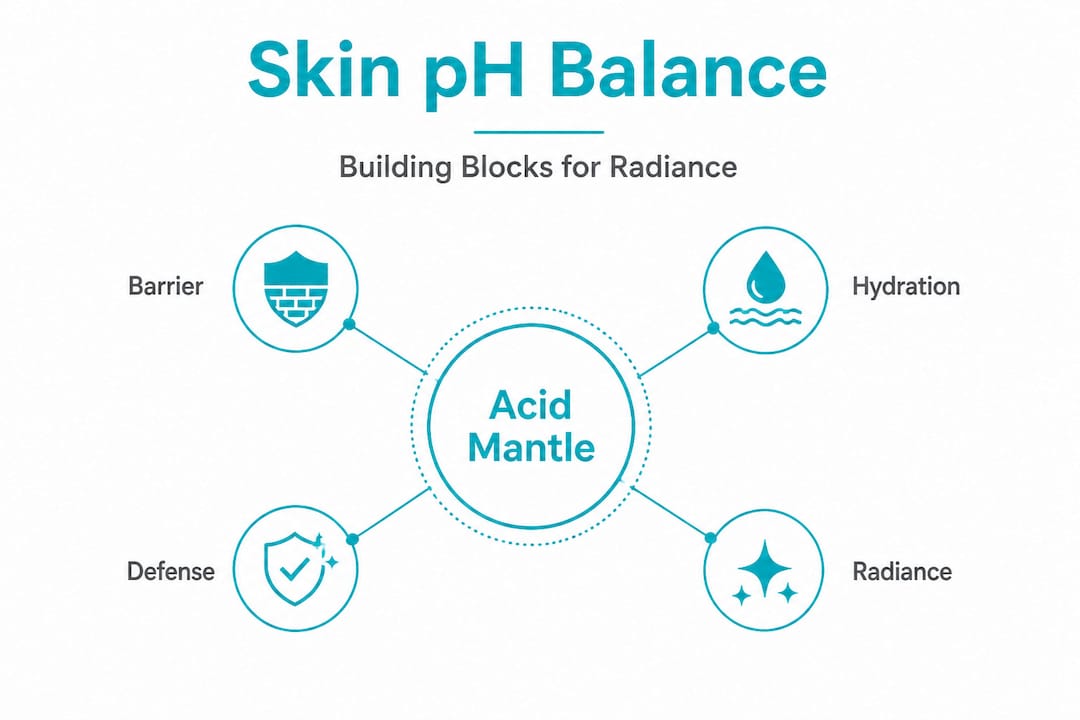
So what’s the sweet spot? Healthy skin typically has a pH between 4.5 and 5.5. This narrow range keeps everything working as it should. Here’s a quick look at how different pH levels affect the skin:
| pH range | Category | Effect on skin |
|---|---|---|
| 0 to 3 | Highly acidic | Chemical burns, severe irritation |
| 4.5 to 5.5 | Optimal skin range | Balanced barrier, healthy microbiome |
| 6 to 7 | Slightly alkaline | Mild dryness, possible sensitivity |
| 8 to 10 | Alkaline | Compromised barrier, increased bacteria risk |
| 11 to 14 | Highly alkaline | Severe damage, chemical irritation |
Key stat: Research shows that the acid mantle pH averages 4.7, protecting against bacteria, retaining moisture, supporting the skin microbiome, and enabling the optimal enzyme and lipid activity that keeps your barrier intact and functional.
That 4.7 average is not just a number. It represents a finely tuned biological environment that your skin works hard to maintain. When that environment is disrupted, you feel and see the consequences.
Why does skin pH balance matter?
Now that you know what skin pH balance is, here’s why it’s a true foundation for great skin and why disruptions matter more than you might think.
Your acid mantle does a lot of heavy lifting. When your skin’s pH sits in the healthy range, it naturally inhibits the growth of harmful bacteria like Staphylococcus aureus, which is linked to acne and eczema flare-ups. It also supports a thriving community of beneficial microorganisms that form part of your skin’s natural microbiome. The acid mantle’s pH of 4.7 is not just protective; it actively creates conditions where good microbes thrive and bad ones struggle.
When pH is disrupted, real problems follow. Here’s what can happen:
- Increased water loss: An alkaline skin environment compromises the lipid structures in your barrier, leading to higher transepidermal water loss (TEWL). Your skin dries out faster, feels tight, and looks dull.
- Breakouts and inflammation: Bacteria that cause acne thrive in more alkaline conditions. A disrupted pH can quickly shift the balance toward more breakouts.
- Sensitivity and irritation: When the barrier is weak, external irritants penetrate more easily. Fragrances, pollution, and even water can trigger reactions.
- Worsening of skin conditions: Conditions like atopic dermatitis (eczema) are closely tied to pH imbalance.
The research here is clear. In people with atopic dermatitis, lesional skin pH averages 5.2 compared to 4.6 on unaffected skin, and this higher pH correlates directly with increased water loss and greater disease severity. That’s not a small difference. It shows how even a shift of less than one pH unit can have measurable effects on how your skin looks and feels.
Keeping your pH balanced also supports the hydrating skin routines that make a real difference in your skin’s appearance over time. If your barrier is constantly disrupted, even the best hydrating serum won’t perform the way it should. And when it comes to better results through skin science, pH balance is genuinely foundational.
Pro Tip: Don’t panic if your skin feels off one day. Healthy skin is remarkably good at rebalancing itself after minor disruptions. A gentle routine is usually all it takes to help your skin recover quickly.
How to know if your skin pH is balanced
If you’re wondering how to tell if your routine is working, here’s how you can check your own skin’s pH status confidently.
Your skin often gives you signals before you even reach for a testing strip. Common signs of pH imbalance include:
- Redness or persistent flushing
- Tight, dry, or flaky skin after cleansing
- Oily skin that still feels dehydrated
- Frequent breakouts despite a careful routine
- Unusual sensitivity to products that used to work well
If any of these sound familiar, it’s worth taking a closer look. Here’s a straightforward way to test your skin’s pH at home:
- Cleanse your skin gently using a mild, fragrance-free cleanser and rinse thoroughly with lukewarm water.
- Wait 30 minutes without applying any products. This allows your skin to settle and show its natural pH reading without interference from skincare products.
- Press a pH testing strip lightly against your cheek or forehead for the time indicated on the packaging (usually a few seconds).
- Compare the colour of the strip to the chart provided. Most skin-safe strips have a range of 4 to 8, which covers the zone you need.
- Note the reading. If your result falls between 4.5 and 5.5, your skin is in a healthy range. A reading above 6 suggests your barrier may need more support.
Research supports a simple testing approach: use pH strips after 30 minutes without products to get an accurate picture of your skin’s natural state, and focus your routine on pH-balanced cleansers and moisturisers in the 4.5 to 6.5 range.
It’s worth noting that home pH strips are not lab-grade instruments. They give you a useful general indication, not a precise scientific measurement. The goal is to spot patterns over time, not to obsess over a single reading. Your skin can self-correct small pH shifts, especially when your overall routine is gentle and consistent.
Simple ways to support healthy skin pH
Ready to put this into action? These practical tips will help reinforce your skin’s natural defenses every day.
The most impactful change you can make is choosing the right cleanser. Many traditional bar soaps have a pH between 9 and 11, which is highly alkaline relative to your skin. Using them regularly can strip your acid mantle and push your skin into a cycle of dryness, irritation, and overproduction of oil. Look for cleansers specifically formulated in the 4.5 to 6.5 range.
Here’s a practical comparison of harsh versus pH-balanced routines:
| Routine type | Cleanser pH | Likely outcomes |
|---|---|---|
| Harsh routine | 9 to 11 | Stripped barrier, dryness, breakouts |
| Over-exfoliating | Varies | Chronic irritation, sensitivity |
| pH-balanced routine | 4.5 to 6.5 | Supported barrier, hydration, calm skin |
| Consistent gentle routine | 4.5 to 5.5 | Optimal microbiome, resilient skin |
Evidence-based guidance recommends that you use pH-balanced products and incorporate emollients like ceramides and squalane to reinforce the skin barrier alongside a pH-supportive routine.
Beyond product choice, here are the habits that make the biggest difference:
- Cleanse gently and only when necessary. Over-cleansing is one of the most common ways to disrupt skin pH.
- Apply your moisturiser while your skin is still slightly damp. This locks in hydration and supports barrier repair.
- Avoid physical scrubs with harsh particles. They create micro-tears and pH disruption at the same time.
- Rinse with lukewarm water, not hot. Hot water strips natural oils and raises the skin’s surface pH temporarily.
- Simplify your routine. Fewer products means fewer opportunities for incompatible formulas to clash and disrupt your skin.
Looking for daily skincare tips that align with what the science actually says? Keep it simple, keep it consistent, and let your skin do the rest. If you want a full list of what to stock, our skincare essentials list is a great place to start.
Pro Tip: When layering products, go from lowest to highest pH. Apply your vitamin C serums or toners first (they tend to be more acidic), then follow with your moisturiser. This approach supports how your skin naturally processes each formula and reduces the chance of ingredient interference.
Why you shouldn’t obsess over pH (and what truly matters)
Having covered all the science, it’s time for some candid perspective on what really counts for your skin’s long-term health.
We talk about pH a lot in skincare, and for good reason. But here’s the honest truth: it’s one piece of a much larger picture. We’ve seen people track their skin pH daily, switch products every two weeks, and end up with more irritation than they started with. The pursuit of “perfect” numbers can actually work against you.
Dermatologists tend to take a nuanced view on this. While pH is genuinely important, skin reverts quickly from mild disruptions when your overall barrier health is good. That means your daily habits matter far more than any single product’s pH reading. A consistent, gentle routine does more for your skin than a perfectly curated, highly analytical approach.
It’s also worth knowing that pH changes with age. As we get older, skin tends to become more alkaline, which can make it more prone to dryness and slower to heal. This is a natural part of ageing, not a failure of your routine. Chasing a 4.7 pH reading in your 50s the same way you would in your 20s misses the point. Adapting your routine to support your skin at each life stage is far more valuable.
The bigger picture includes hydration, barrier support, sun protection, a good night’s sleep, and stress management. pH plays its role, but it plays it as part of a team. Incorporating postbiotic skincare benefits into your routine is a good example of how supporting the microbiome and barrier health together gives you a more complete approach than focusing on pH alone.
We believe the best skincare philosophy is one built on simplicity and trust in your skin’s natural intelligence. Give it the right tools, stay consistent, and it will do the rest.
Discover products that respect your skin’s pH
If you’re ready to put a pH-friendly routine into action, take the next step with skincare designed for real results.
At SMPL SKIN, we’ve formulated every product with your skin’s natural balance in mind. We know that the best routine is one that supports your barrier without disrupting it. That’s why our SMPL SKIN Gentle Cleanser is built to cleanse effectively while keeping your acid mantle intact. No harsh stripping, no unnecessary ingredients.
Want a complete starting point? The Gentle Cleanser & SPF 15 Moisturiser Duo gives you a cleanser and moisturiser that work together to keep your skin balanced, hydrated, and protected all day. Simple, effective, and formulated with care. Explore more skincare products designed for your simplest, healthiest routine yet.
Frequently asked questions
How do I restore my skin’s pH if it’s off balance?
Switch to pH-balanced cleansers and moisturisers in the 4.5 to 6.5 range, stop using harsh soaps, and give your skin a few consistent days to recover before evaluating the change.
Is it necessary to test my skin pH regularly?
Routine pH testing isn’t necessary for most people because skin reverts quickly from mild disruptions, and a well-chosen gentle routine will usually maintain good balance on its own.
What’s the ideal pH for skin products?
Look for products formulated in the 4.5 to 6.5 pH range to match your skin’s natural acid mantle and support long-term barrier health.
Does aging change your skin’s pH?
Yes. As you age, skin trends more alkaline, which can increase dryness, slow healing, and make the barrier more vulnerable to irritation and environmental stressors.
Recommended
- Why skin hydration matters: glow and barrier health – SMPL SKIN South Africa
- Skin health explained: simple science for better results – SMPL SKIN South Africa
- Discover the skin microbiome for healthier, simpler skincare – SMPL SKIN South Africa
- 7 proven signs your skin is healthy: How to recognize them – SMPL SKIN South Africa
- How to enhance skin radiance naturally for women 40+