

TL;DR:
- The skin microbiome is a diverse, active community essential for skin health and barrier function.
- Maintaining microbiome balance involves gentle skincare, pH-appropriate products, and avoiding over-disruption.
- Research methods like sequencing reveal complex functions and caution against oversimplified “good versus bad” microbe claims.
Your skin is home to trillions of microorganisms, and most of them are doing you a favour. The skin microbiome is the community of bacteria, fungi, viruses, and even mites that live on your skin and work alongside your immune system and skin barrier every single day. Far from being something to scrub away, this invisible ecosystem is one of your skin’s most powerful allies. In this guide, we break down what the skin microbiome is, why its balance matters, how science actually studies it, and what all of this means for building a routine that genuinely works.
Table of Contents
- What is the skin microbiome?
- How skin microbiome varies by site and age
- Why microbiome balance matters for skin health
- Microbiome-targeted skincare: Insights and evidence
- How research studies reveal the microbiome: Methods and meaning
- Why the skin microbiome isn’t a simple ‘good vs bad’ story
- Support your skin microbiome with simple routines
- Frequently asked questions
Key Takeaways
| Point | Details |
|---|---|
| Microbiome diversity matters | Healthy skin relies on a balanced mix of microbes across different body sites and ages. |
| Balance prevents skin issues | Maintaining microbiome equilibrium protects against inflammation and barrier damage. |
| Evidence-based routines work | Gentle cleansers and microbiome-supportive products offer practical, science-backed support. |
| Context is key | Not all microbes are strictly good or bad—what helps one person may not help another. |
| Interpreting claims needs caution | Product evidence and research methods matter when choosing microbiome-supportive skincare. |
What is the skin microbiome?
Think of your skin as a living landscape. It has dry deserts on your forearms, humid valleys behind your knees, and oil-rich terrain across your forehead. Each zone supports a unique community of microorganisms, and together they form what scientists call the skin microbiome, the collection of bacteria, fungi, viruses, and microscopic mites that share your skin every moment of every day.
This ecosystem is not a threat. It is a partnership. These microorganisms perform critical roles:
- Barrier defence: They occupy space and produce compounds that stop harmful pathogens from taking hold.
- Immune education: They train your skin’s immune cells to respond appropriately, neither over-reacting nor under-reacting.
- pH regulation: Many commensal (friendly) bacteria help keep your skin’s surface mildly acidic, around pH 4.5 to 5.5, which is the sweet spot for healthy skin function.
- Competing with harmful microbes: Friendly bacteria produce antimicrobial substances that crowd out pathogens naturally.
“The skin microbiome is not simply ‘good bacteria’ versus ‘bad bacteria.’ It is a dynamic, context-dependent community where diversity and function matter more than any single microbe.”
One of the most persistent myths in skincare is that thorough cleansing eliminates microbes entirely. It does not. Within hours of washing, your microbiome begins to repopulate, largely from your own skin’s sebaceous glands, hair follicles, and the environment around you. The real question is not whether microbes exist on your skin. It is whether the community is balanced. Understanding skin barrier basics is closely tied to understanding the microbiome, because the two systems support each other constantly.
How skin microbiome varies by site and age
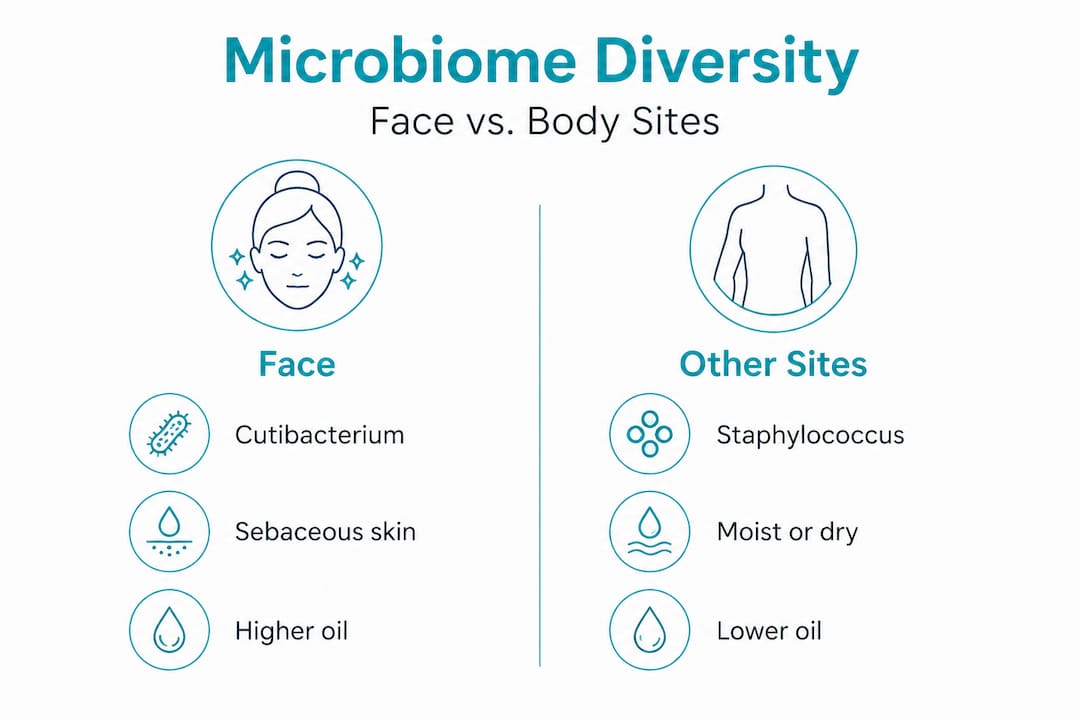
Your microbiome is not the same across your entire body, and it is not fixed over time. Scientists studying the skin microbiome have found that microbial communities differ dramatically by body site and shift meaningfully as we age.
Here is a simplified look at how microbiome composition changes across common skin sites:
| Body site | Dominant microbe type | Key characteristics |
|---|---|---|
| Face (forehead, nose) | Cutibacterium acnes, Malassezia | Sebum-rich, lipophilic species thrive |
| Forearm | Staphylococcus, Corynebacterium | Drier zones, lower microbial density |
| Behind the knee | Staphylococcus epidermidis | Moist environment supports stable colonies |
| Feet (between toes) | Tinea fungi, mixed bacteria | High humidity, prone to fungal overgrowth |
| Scalp | Malassezia species | Sebum-rich scalp supports yeast dominance |
What changes with age? Quite a lot. Infant skin carries a microbiome shaped by birth method, breastfeeding, and early environment. Adolescent skin shifts dramatically with the surge in sebum production during puberty, which is why acne often peaks in teenage years. Mature skin tends to have lower microbial diversity, which partly explains why skin becomes more vulnerable to irritation, dryness, and slow healing as we age.
Key factors that influence your microbiome across life include:
- Hormone levels (shifts in puberty, pregnancy, and menopause alter sebum, which feeds certain microbes)
- Climate and humidity (local environment shapes which species thrive)
- Skincare habits (product chemistry, cleansing frequency, and ingredients all leave marks)
- Diet and lifestyle (gut health and stress levels have indirect effects on skin)
The practical takeaway is significant. Because your microbiome is site-specific and age-dependent, a single product or routine cannot be a blanket solution for every skin concern. Simple skin routines built around your skin type and life stage will always outperform generic approaches that ignore this biological reality. This is exactly why we believe in personalised simplicity, not complexity for its own sake.
Why microbiome balance matters for skin health
When your skin microbiome is in balance, you may not notice it at all. Your skin just feels comfortable, looks even, and responds well to its environment. But when something disrupts that balance, a condition scientists call dysbiosis, the effects can be hard to ignore.
Research confirms that microbiota contribute to skin barrier integrity and provide colonisation resistance against harmful organisms. When dysbiosis occurs, inflammation and skin disorders often follow. Two of the most studied examples are:
- Atopic dermatitis (eczema): In eczema-prone skin, Staphylococcus aureus can overgrow and displace more protective species. This shifts the immune response and worsens the skin barrier, creating a frustrating cycle of flares and sensitivity.
- Acne: Cutibacterium acnes is naturally present in almost everyone’s skin. But certain strains, combined with excess sebum and a disrupted follicular environment, trigger the inflammatory response we call acne. It is not simply about having this bacterium; it is about the conditions that allow it to behave aggressively.
Here is a quick comparison of balanced versus dysbiotic microbiome states:
| Microbiome state | Skin experience | What it looks like |
|---|---|---|
| Balanced (eubiosis) | Comfortable, resilient skin | Even tone, calm, good moisture retention |
| Dysbiotic | Reactive, compromised skin | Redness, breakouts, flaking, sensitivity |
How do you support balance? A few practical steps make a real difference:
- Use gentle, pH-appropriate cleansers. Harsh soaps shift the skin’s pH upward, which creates conditions where harmful microbes thrive.
- Avoid over-exfoliating. Removing too much surface skin too frequently disrupts the physical habitat that friendly microbes rely on.
- Moisturise consistently. Hydrated skin supports a healthy barrier, which in turn creates a stable environment for commensal species.
- Limit unnecessary antibiotics and strong antimicrobial products unless genuinely needed, because they affect the entire microbial community, not just targeted pathogens.
- Consider skin-supportive ingredients. Research into postbiotic benefits shows that certain byproducts of beneficial bacteria can calm inflammation and strengthen the barrier without introducing live organisms.
Pro Tip: If your skin becomes reactive after changing a product, give it at least two to four weeks before switching again. The microbiome needs time to resettle after any disruption, and a too-fast product rotation can mask the real issue.
Understanding the relationship between the skin barrier and microbiome gives you a real advantage when making product decisions.
Microbiome-targeted skincare: Insights and evidence
Walk into any pharmacy or beauty store and you will see products claiming to be “probiotic,” “prebiotic,” or “microbiome-friendly.” The terms sound compelling. But what do they actually mean, and does the science back them up?
Let us break down the three key terms:
- Probiotics in skincare: Live or inactivated microorganisms applied topically. The idea is that they reinforce the beneficial microbial population on your skin. Challenges include keeping live bacteria stable in a product formula and ensuring they actually colonise the skin rather than simply wash off.
- Prebiotics in skincare: Ingredients that feed beneficial bacteria already on your skin. Think of them as fertiliser for your existing good microbes. Common examples include certain sugars and plant-derived fibres.
- Postbiotics in skincare: The metabolic byproducts of bacterial fermentation, such as lactic acid, short-chain fatty acids, and peptides. These do not require live bacteria to be effective, making them far more stable in formulations and easier to study. Explore what postbiotic claims actually mean before trusting marketing language.
The honest truth is that microbiome-supportive efficacy is still an evolving evidence base, and results can vary dramatically by strain and formulation. This does not mean the category is worthless. It means you need to be selective.
Practical advice for choosing products with microbiome claims:
- Ask for specifics. Does the brand name the specific strain or ingredient? Vague terms like “probiotic complex” mean very little without details.
- Look for clinical data. Peer-reviewed studies on the actual formula carry more weight than general research on a category of ingredients.
- Prioritise stability. Postbiotics and prebiotics are generally more stable than live probiotic formulations and have a stronger track record in topical applications.
- Check the cleanser. If a brand sells a microbiome-friendly serum but their cleanser strips the skin and disrupts pH, the benefit is largely cancelled out before you even start.
- Simpler is often smarter. Piling on too many actives at once creates unpredictable interactions that can disturb rather than support your skin ecosystem.
Pro Tip: Fermented ingredients like galactomyces or bifida ferment lysate are postbiotic in nature and have solid real-world evidence behind them. They are worth prioritising over vague “probiotic” claims with no supporting data.
How research studies reveal the microbiome: Methods and meaning
When a headline announces that scientists have “discovered the secret to healthy skin microbiome,” it is worth pausing to ask: how did they find this, and what does it really mean?
Scientists use two main approaches to study the skin microbiome:
- Shotgun metagenomics: Scientists extract all the DNA from a skin swab and sequence it all at once. This gives a broad picture of which organisms are present and what genes they carry. However, shotgun metagenomics requires careful protocol choices because skin samples contain very low amounts of microbial DNA compared to gut samples, making contamination a real risk.
- Metatranscriptomics: This approach sequences RNA rather than DNA, which reveals which genes are actually active at a given moment. Crucially, DNA-based metagenomics estimates genetic potential, while metatranscriptomics measures what microbes are actually doing. An organism can be present without being active, and confusing the two leads to misleading conclusions.
“Knowing a microbe is present tells you it could do something. Knowing it is transcriptionally active tells you it is doing something. These are very different things, and conflating them has led to a lot of overblown headlines.”
Key research pitfalls to be aware of when reading microbiome science:
- Low biomass contamination: Skin has far fewer microbes per square centimetre than the gut. Lab reagents themselves can introduce contaminant DNA, skewing results.
- Sampling inconsistency: A swab taken after showering gives different results than one taken after 24 hours without washing. Protocol matters enormously.
- Correlation versus causation: Many studies identify associations between certain microbes and skin conditions without proving that those microbes caused the condition.
Understanding these limitations helps you evaluate skincare actives and product claims with a clear head. When a brand says “clinically proven to support the microbiome,” the next question is always: what method, what sample size, and what outcome were they measuring?
Why the skin microbiome isn’t a simple ‘good vs bad’ story
Here is something the marketing world does not want to admit: there is no such thing as a universally “good” or “bad” skin microbe. Context is everything.
Take Staphylococcus epidermidis. In most people, it is a quiet resident that helps suppress inflammation and crowds out more harmful bacteria. But in immunocompromised individuals or on damaged skin, the same species can become a source of infection. Or consider Cutibacterium acnes, which is present on virtually all adult skin. In the right conditions and at the right population levels, it actually supports skin health by producing fatty acids that maintain a protective pH. In the wrong conditions, certain strains trigger severe inflammatory acne. The same taxa can be commensal in one context but participate in disease in another, which is why interpreting microbiome shifts requires functional understanding, not just a headcount of species.
This is where we feel strongly that the skincare industry does its customers a disservice. Too many brands promise to “rebalance your microbiome” with a single serum, treating a deeply complex, living system as if it were a simple dial to turn. The real path forward is not to chase every microbiome trend. It is to build holistic routines that are gentle, consistent, and grounded in real skin science. Support your barrier. Avoid harsh disruptions. Choose ingredients with evidence behind them. The microbiome responds well to the same things your skin does: stability, gentleness, and simplicity.
Support your skin microbiome with simple routines
The science is clear: a balanced microbiome thrives when you keep things simple and consistent. Stripping your skin with harsh products or chasing every new trend does more harm than good.
At SMPL SKIN, we have built our range around exactly this philosophy. Our gentle cleansers are formulated to clean without disrupting your skin’s natural pH, and our hydrogels and serums focus on supporting the barrier that your microbiome depends on. With key ingredients like German Chamomile and Cucumber Extract, our products calm rather than stress the skin. If you are ready to take a more science-backed, simplified approach to skincare, explore our full range and find the routine that respects your skin’s biology from the inside out.
Frequently asked questions
Can you improve your skin microbiome with diet or supplements?
Diet and supplements may influence the skin microbiome indirectly through gut-skin connections, but the evidence remains mixed and personalised recommendations require more research before firm conclusions can be made.
How does cleansing affect the skin microbiome?
Cleansing with harsh, high-pH products can disrupt both the skin barrier and the microbiome, which is why cleansing practices and product chemistry matter. Gentle, pH-balanced cleansers are consistently the safer choice.
Are all probiotics in skincare equally effective?
No. Efficacy is strain-specific and formulation-dependent, meaning a probiotic claim on a label tells you very little without knowing the specific strain and supporting clinical evidence.
How do scientists test the skin microbiome?
Researchers primarily use metagenomic and metatranscriptomic sequencing, but DNA yields depend on sampling technique and extraction method, meaning results can vary significantly between studies and labs.
Recommended
- Skin health explained: simple science for better results – SMPL SKIN South Africa
- Postbiotic skincare: 5 key benefits for healthy skin – SMPL SKIN South Africa
- How to achieve healthy skin with a simple routine – SMPL SKIN South Africa
- Detoxify your skin at home: simple routines for results – SMPL SKIN South Africa
- Βασικά βήματα skincare για υγιή και λαμπερή επιδερμίδα | B Woman