

TL;DR:
- Clean beauty is a broad, unregulated movement centered on ingredient transparency, safety, and minimalism, but its meaning varies among brands. Consumers must verify ingredients and standards independently, as labels alone do not guarantee safety or consistency. Ultimately, informed beauty involves understanding ingredients and making intentional, confident choices beyond marketing buzzwords.
You keep seeing the words “clean beauty” everywhere. On product packaging, in beauty aisles, across social media. But when you try to pin down what clean beauty actually means, things get murky fast. There is no single agreed-upon definition, no government stamp of approval, and no master list of banned ingredients that every brand follows. What one company calls “clean” might include ingredients another brand specifically excludes. We wrote this guide to cut through that confusion and give you a clear, honest understanding of what clean beauty is and how to use it as a practical tool in your skincare routine.
Table of Contents
- What does clean beauty mean and why does it matter?
- Why is clean beauty confusing? Understanding the lack of regulation and variation
- Common ingredient exclusions and what they mean for your skin
- How to build a simple and effective clean beauty skincare routine
- The real story behind clean beauty: clarity beyond marketing buzz
- Discover simple, effective clean beauty products at SMPL SKIN
- Frequently asked questions
Key Takeaways
| Point | Details |
|---|---|
| No legal definition | Clean beauty is a marketing term without standardized regulation, so its meaning varies between brands. |
| Ingredient transparency | Examining full ingredient lists is essential because clean labels alone don’t guarantee safety or quality. |
| Avoid common irritants | Clean beauty typically excludes potential allergens, endocrine disruptors, and carcinogens for safer skin routines. |
| Personal criteria matter | Defining your own clean standards and skincare goals leads to simpler, more effective product choices. |
| Balance clean with effectiveness | Filtering for clean ingredients should complement selecting products that perform well for your skin needs. |
What does clean beauty mean and why does it matter?
At its core, clean beauty is a consumer and industry movement focused on products made without ingredients considered potentially harmful. The clean beauty definition also covers ingredient transparency, non-toxic positioning, minimalism, and often ethical and sustainable sourcing. That is a broad set of values, which is part of why the term means different things to different people.
Think of clean beauty less as a certification and more as a philosophy. It asks: what is actually in this product, and do we need all of it? For people who want simple, effective routines without unnecessary fillers or concerning chemicals, that question matters a great deal.
Here is what clean beauty generally stands for:
- Ingredient avoidance: Leaving out substances linked to irritation, hormone disruption, or other health concerns
- Transparency: Publishing full ingredient lists and being open about what goes into formulations
- Minimalism: Using fewer, purposeful ingredients rather than loading products with additives
- Ethical sourcing: Many clean beauty brands also consider where ingredients come from and how they are produced
Clean beauty is not automatically the same as sustainable beauty, though the two often overlap. Sustainability focuses on environmental impact, things like packaging waste and carbon footprint, while clean beauty focuses on what touches your skin. Our sustainable skincare guide covers that distinction in more depth if you want to explore both sides of the conversation.
Why is clean beauty confusing? Understanding the lack of regulation and variation
Here is the uncomfortable truth: clean is not regulated in major markets like the United States. No government body controls which products can legally carry the “clean beauty” label. Any brand can put those words on their packaging tomorrow, regardless of what is inside.
This creates a real problem for consumers. Two products sitting side by side on a shelf, both labelled “clean,” might have completely different formulations. One might exclude parabens but use synthetic fragrances. Another might avoid fragrance but contain preservatives the first brand flags as problematic.
Because there is no standardised definition, two “clean” products may differ substantially in which specific ingredients they exclude. Consumers should verify via full ingredient lists and brand criteria rather than relying on the label alone.
What this means in practice:
- The label is a starting point, not a guarantee. It signals a brand’s intention, but you still need to verify.
- Brand criteria vary widely. Some brands maintain public “banned ingredient” lists. Others do not.
- Greenwashing exists. Some brands use “clean” purely as a marketing term with no meaningful formulation changes behind it.
- Third-party certifications help. Organisations that independently verify ingredient safety claims offer more reliable reassurance than a brand’s self-applied label.
Knowing how to choose skincare products beyond their marketing is a skill worth developing, and it starts with reading ingredient lists rather than front-of-pack claims. For a useful reference on recognising clean beauty signals beyond just labelling, third-party resources can be a helpful companion.
Common ingredient exclusions and what they mean for your skin
Clean beauty frameworks typically target a recognisable group of ingredients. A common practical goal within these frameworks is avoiding ingredient classes associated with irritation, allergy potential, possible endocrine disruption, or carcinogenicity concerns. Here is what that looks like in a real ingredient list:
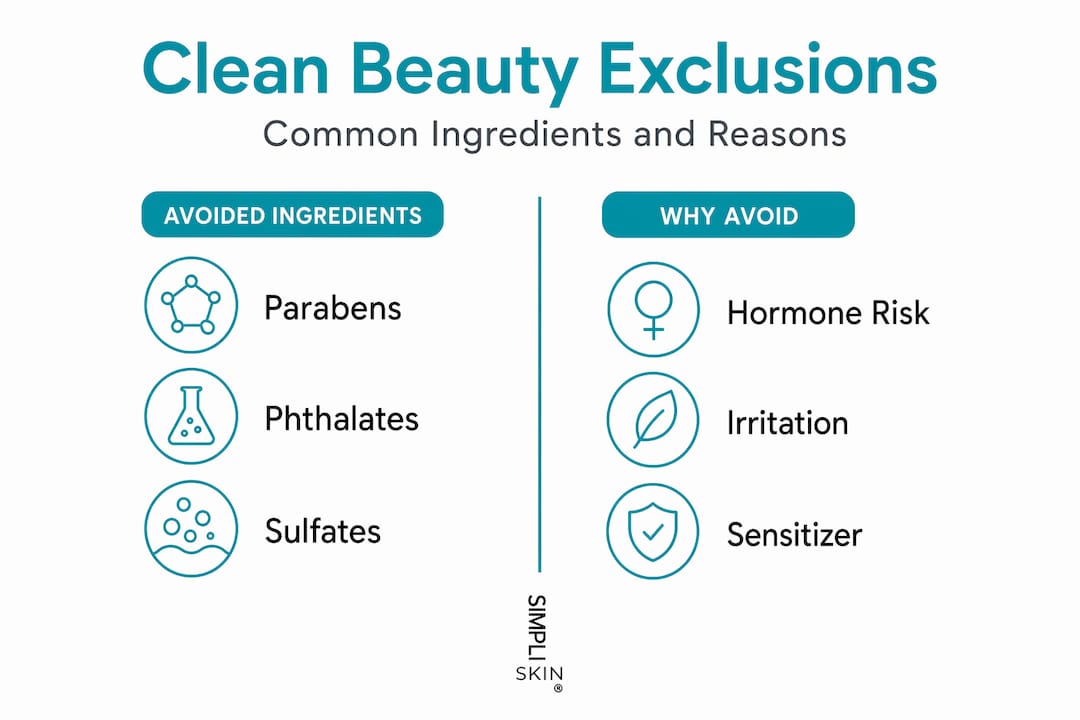
| Ingredient class | Why it’s often avoided | Commonly found in |
|---|---|---|
| Parabens | Potential hormone disruption | Moisturisers, conditioners |
| Phthalates | Linked to endocrine effects | Fragranced products |
| Synthetic fragrances | Common irritant and allergen | Almost any leave-on product |
| Formaldehyde releasers | Possible carcinogen | Some preservative systems |
| Sulphates (SLS/SLES) | Can strip skin barrier | Cleansers, shampoos |
| Oxybenzone | Hormone disruption concerns | Chemical sunscreens |
One of the most important nuances in the clean beauty conversation is this: “natural” does not mean automatically safe for everyone. Poison ivy is natural. So is lanolin, which many people are allergic to. The “natural vs. synthetic” split is a much weaker framework than “does this specific ingredient cause problems for my specific skin.”
This is where individual tolerance matters. Someone with sensitive skin might react to essential oils found in many natural products. Someone else might have no issue with a carefully tested synthetic preservative. Clean beauty is most useful when it centres ingredient-by-ingredient evidence and personal sensitivity rather than blanket assumptions about natural being safe.
Pro Tip: If you have sensitive or reactive skin, the most useful thing you can do is keep a short list of ingredients that you know personally cause problems. Use that list as your actual filter when reading labels, regardless of what the product calls itself.
If you are exploring cleaner options for reactive skin, our guide on sensitive skin solutions gives practical steps for building a gentle routine. And if ingredient origin matters to you, we also break down vegan skincare benefits and what that distinction actually means in formulation terms.
How to build a simple and effective clean beauty skincare routine
Here is where clean beauty principles become genuinely useful rather than just theoretical. The most effective strategy for building a minimalist clean beauty routine is to define your personal clean criteria first, then select one to three multifunctional products that meet those criteria. That approach keeps you focused on what matters to your skin rather than getting lost in marketing claims.
Follow these steps:
-
Write down your ingredient concerns. Start with any ingredients you know cause problems for you. If you do not have reactions, research the ingredient classes most associated with irritation or systemic concerns and decide which ones you want to avoid.
-
Set your non-negotiables. Maybe synthetic fragrance is a firm no for you. Maybe you are comfortable with certain synthetic preservatives if the rest of the formula is clean. Be specific rather than vague.
-
Choose multifunction products. A moisturiser with SPF built in. A cleanser that also balances pH. Fewer products mean fewer potential problem ingredients, and it simplifies your routine significantly. Our tips on building a step-by-step facial cleansing routine are a good place to start.
-
Read the full ingredient list, not the front label. INCI (International Nomenclature of Cosmetic Ingredients) names can look intimidating, but apps and online databases make it easy to check flagged ingredients in seconds.
-
Balance clean with effective. This is the part many people skip. Clean-ness and performance are separate things. A product can be free from every ingredient on your exclusion list and still not deliver results if its active ingredients are underdosed or poorly formulated. Look for evidence of efficacy, not just absence of problematic ingredients.
Pro Tip: Before you commit to a full-size product, check whether the brand publishes its “clean standard” or banned ingredient list on its website. Brands that are genuinely committed to transparency will make this easy to find. If you cannot locate it, that tells you something.
For more help selecting products that actually work for your goals, our guide on how to choose skincare products walks through the decision-making process step by step.
The real story behind clean beauty: clarity beyond marketing buzz
We are going to be honest about something that most clean beauty content skips. The term “clean beauty” is, at its current state, primarily a marketing construct. That does not make it useless. It means you have to use it differently than you might expect.
According to Healthline, consumer confusion around clean beauty stems directly from its broad, unregulated nature. The word “clean” on a product is best treated as a starting point for investigation, not a safety guarantee. That framing is more empowering than it sounds.
When you stop expecting the label to do the work for you, you become a sharper consumer. You start reading ingredient lists. You start asking what a brand’s actual standards are. You stop paying a premium for packaging that says “clean” without any substance behind it. Clean beauty as a framework works best when it centres ingredient transparency and safety-focused decision-making, regardless of whether the word “clean” appears on the label at all.
Our honest view is this: the best version of clean beauty is simply informed beauty. It is choosing products where you know what is in them, you understand why those ingredients are there, and you have confidence that the formulation is both safe for your skin and effective for your goals. No buzzwords required.
That connects directly to what we believe at SMPL SKIN. Simplicity is not about doing less. It is about doing the right things intentionally. For a broader look at that approach, our piece on holistic skincare insights explores how a thoughtful, minimal routine delivers better results than a complicated one ever could.
Discover simple, effective clean beauty products at SMPL SKIN
Now that you understand clean beauty’s essence and how to apply it, you deserve products that actually live up to the promise.
At SMPL SKIN, we build every product around ingredient transparency, minimal formulations, and real results. No unnecessary fillers. No ingredients added just to bulk up a formula. Our gentle cleanser and SPF 15 duo is a perfect example of clean beauty in practice. Two purposeful products that cover your daily cleansing and protection needs without overcomplicating your routine. The SMPL SKIN Gentle Cleanser is formulated with German Chamomile and Cucumber Extract to soothe and cleanse without stripping your skin barrier. Pair it with the SPF 15 daily moisturiser for hydration and daily sun protection in one step. Simple. Effective. Exactly what clean beauty should look like.
Frequently asked questions
Is there a legal definition of clean beauty products?
No, “clean beauty” is not legally regulated in major markets like the United States, so its meaning varies widely by brand and no government body enforces a standard definition.
Does clean beauty mean all natural ingredients?
Not necessarily. “Natural” is not automatically safe for everyone, and clean beauty includes both natural and carefully selected synthetic ingredients, with the focus on avoiding potentially harmful substances regardless of origin.
How can I identify truly clean beauty products?
Check full ingredient lists against your personal exclusion criteria and look for brands that publish their own standards because, as two products labelled “clean” can differ substantially, the label alone is not a reliable guide.
Can clean beauty products help sensitive or allergy-prone skin?
Yes, clean beauty frameworks frequently exclude common irritants and allergens, which can benefit sensitive skin, particularly when you cross-reference product formulations against your known sensitivities.
Is clean beauty the same as sustainable beauty?
No. Clean and sustainable beauty address different priorities: clean beauty focuses on ingredient safety for the consumer, while sustainable beauty focuses on environmental impact, and a product can be one without being the other.
Recommended
- Sustainable skincare: A simple guide to eco-friendly routines – SMPL SKIN South Africa
- Holistic skincare: Simple routines, real results in 2026 – SMPL SKIN South Africa
- Everyday skincare essentials list for simple, healthy routines – SMPL SKIN South Africa
- How to choose skincare products for a simple routine – SMPL SKIN South Africa