

TL;DR:
- The vegan cosmetics market is growing rapidly, driven by consumer demand for ethical and effective skincare options. Vegan skincare contains no animal ingredients, often backed by certification, and provides proven benefits through plant-based actives. Choosing simple, well-formulated vegan products supports both skin health and environmental sustainability.
The vegan cosmetics market was valued at $16.6 billion in 2021 and is projected to exceed $28.5 billion by 2031, growing at 5.9% annually. That kind of growth does not happen because consumers are settling for less. It happens because they are finding something better. The biggest misconception about vegan skincare is that going plant-based means giving up performance, but the science, the results, and the millions of loyal users tell a completely different story. This article breaks down exactly what vegan skincare is, why it works, and how it fits into a genuinely simple and sustainable routine.
Table of Contents
- What makes skincare ‘vegan’?
- Key benefits: how vegan skincare supports healthy, effective routines
- Sustainability and environmental impact of vegan ingredients
- Aligning values: why conscious consumers choose vegan skincare
- A realistic perspective: what most guides miss about vegan skincare
- Experience the benefits with a simple vegan skincare routine
- Frequently asked questions
Key Takeaways
| Point | Details |
|---|---|
| Effective plant benefits | Vegan skincare leverages plant actives proven to hydrate and improve skin quality. |
| Lower environmental impact | Choosing vegan ingredients can significantly reduce your skincare’s carbon footprint and resource use. |
| Aligned with values | Vegan routines let you support animal welfare and ethical consumerism without sacrificing results. |
| Look beyond labels | Check for certifications and sourcing practices, as not all vegan products are created equally. |
What makes skincare ‘vegan’?
Vegan skincare is not just a trend label. It is a clearly defined category with specific standards attached to it. At its core, a product is vegan if it contains no animal-derived ingredients and has not been tested on animals at any stage of production. That means every ingredient, every supplier, and every formulation step must meet that standard.
Vegan Society Trademark certification verifies that a product contains no animal ingredients or animal testing at any stage, making it one of the most trusted markers you can look for on a label. It is not self-declared. It is independently verified.
“Vegan skincare is not just about what is left out. It is about making an active choice to support formulations that respect both animal welfare and consumer health.”
Common animal-derived ingredients to watch for
Many traditional skincare products include animal-derived ingredients that are not always obvious on labels. Here are the most common ones to be aware of:
- Lanolin — a wax secreted by the skin of wool-bearing animals, often found in lip balms and moisturisers
- Beeswax — used as an emollient and thickener in balms and creams
- Collagen — typically sourced from bovine or marine animals, used in anti-ageing products
- Carmine — a red pigment derived from crushed beetles, found in blushes and lip products
- Keratin — a protein sourced from animal horns, hooves, or feathers, often used in hair and skin treatments
- Squalane — traditionally sourced from shark liver oil, though plant-based alternatives from sugarcane or olives are now widely available
- Hyaluronic acid — historically derived from rooster combs, now frequently produced through vegan fermentation processes
Understanding what to look for gives you real power as a consumer. Certification logos simplify this process, but knowing the ingredient names means you are never caught off guard.
It is also worth noting the distinction between vegan and cruelty-free. A product can be cruelty-free (not tested on animals) but still contain animal-derived ingredients. Truly vegan products meet both standards simultaneously. That alignment is what makes vegan skincare both an ethical and a practical choice.
Key benefits: how vegan skincare supports healthy, effective routines
Once you understand what vegan skincare is, the next question is simple: does it actually work? The answer, backed by solid research, is yes.
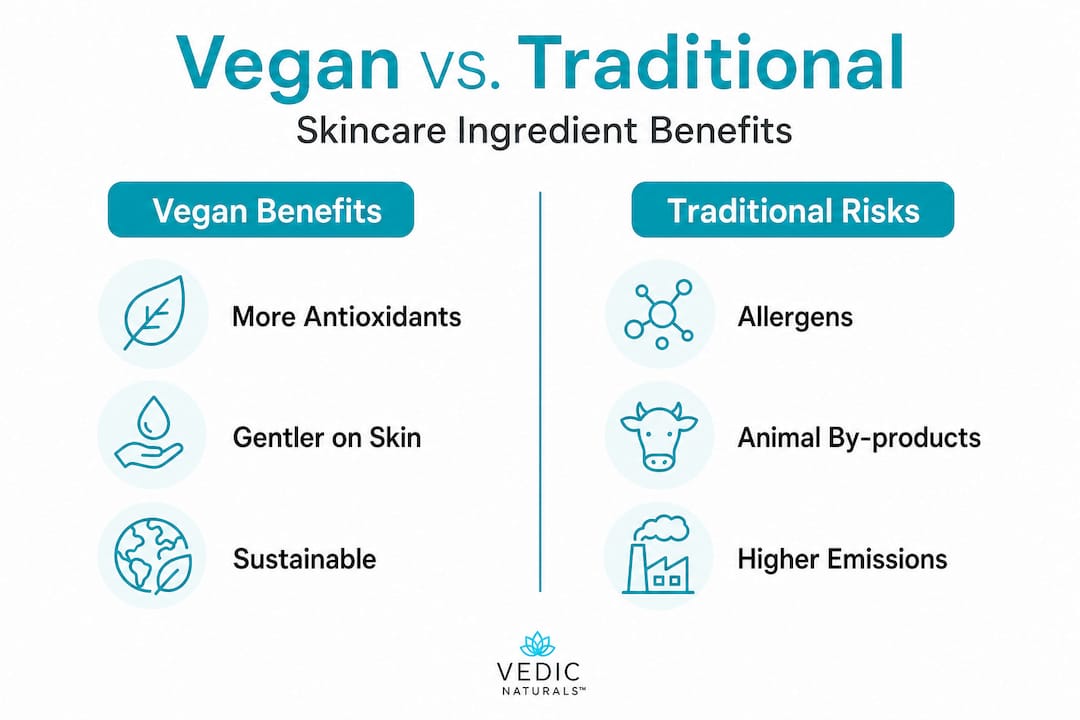
Plant-based ingredients in vegan skincare provide antioxidants, vitamins, and anti-inflammatory compounds, with clinical studies showing measurable results including a 21.1% reduction in sebum, visible wrinkle reduction, and enhanced hydration. These are not soft claims. These are the kinds of outcomes that traditional skincare promises and vegan formulations are now demonstrably delivering.
Why plant actives perform so well
Plants have evolved sophisticated biochemical systems to protect themselves from UV exposure, oxidative stress, and environmental damage. When we harness those protective compounds in skincare, we get ingredients that are naturally rich in antioxidants, polyphenols, and phytoestrogens. These work directly on the skin’s surface and deeper layers to repair, protect, and hydrate.
Here is a quick comparison of popular plant-based actives versus their traditional counterparts:
| Ingredient | Plant-based version | Traditional source | Key benefit |
|---|---|---|---|
| Squalane | Sugarcane or olive | Shark liver oil | Deep hydration, barrier repair |
| Hyaluronic acid | Fermented vegan sources | Rooster combs | Moisture retention, plumping |
| Collagen support | Vitamin C, peptides | Bovine/marine collagen | Stimulates natural collagen synthesis |
| Exfoliation | Fruit-derived AHAs | Lactic acid (dairy) | Resurfacing, brightening |
The plant-based versions are not inferior substitutes. In several cases, they are more bioavailable and better tolerated by sensitive skin types.
Simplicity as a skincare strategy
One overlooked benefit of vegan skincare is how well it supports a minimalist routine. Many plant actives multitask. A good skin microbiome friendly serum containing fermented hyaluronic acid, for example, can hydrate, support the skin’s natural flora, and reduce inflammation all at once.
Postbiotic skincare is another area where vegan formulations shine. Postbiotics are the beneficial compounds produced during fermentation, and vegan fermentation processes make them accessible without any animal involvement. They support barrier function, calm reactive skin, and work synergistically with the microbiome.
This is exactly the kind of formulation philosophy that makes it possible to build a simple, healthy routine without layering ten products on top of each other. Fewer, more functional products. Better results with less effort.
Pro Tip: When evaluating a vegan skincare product, check whether the brand publishes clinical or consumer study results. A formulation is only as good as its testing. Certifications matter, but evidence-backed results matter more.
Sustainability and environmental impact of vegan ingredients
Beyond your skin, your skincare choices affect the planet. This is where many conscious consumers feel most strongly, and it is where the environmental case for vegan skincare becomes very compelling.

Plant-based production generates significantly lower greenhouse gas emissions, uses less water, and occupies less land than animal-derived ingredient production. Research indicates vegan analogs can have up to 50% lower climate impact and require approximately 30% less land compared to animal-based alternatives.
That is a meaningful difference at scale. When millions of consumers switch to plant-based formulations, the cumulative effect on emissions, land use, and water systems is substantial.
Sustainability comparison
| Environmental factor | Plant-based ingredients | Animal-derived ingredients |
|---|---|---|
| GHG emissions | Significantly lower | Higher due to livestock farming |
| Water use | Lower on average | Higher, especially for dairy |
| Land occupation | Up to 30% less | More due to feed crop production |
| Biodiversity risk | Depends on sourcing | Higher due to habitat conversion |
“Choosing vegan skincare is one of the most direct ways consumers can reduce the environmental footprint of their personal care choices without sacrificing the quality of their results.”
The nuance you need to know
Here is something most vegan skincare guides skip over. Not all plant-based ingredients are automatically eco-friendly. Palm oil, for example, is plant-derived but linked to significant deforestation and habitat destruction. Some essential oils require enormous quantities of raw plant material to produce a tiny yield. Certain tropical botanicals are harvested in ways that are not sustainable or fairly traded.
The lesson here is that vegan is a necessary starting point, not a guarantee. When choosing products, look for brands that go further. Regenerative sourcing, local ingredient supply chains, and transparent environmental reporting all signal a brand that is genuinely committed to sustainability, not just wearing the label.
Check out our eco-friendly skincare guide for a more detailed breakdown of how to evaluate sustainability claims in your skincare.
Aligning values: why conscious consumers choose vegan skincare
With the science and sustainability covered, it is worth stepping back and looking at the bigger picture. Why are so many people making this switch, and what does it mean for how we think about skincare?
The vegan cosmetics market growing from $16.6 billion to a projected $28.5 billion is not just a commercial trend. It reflects a genuine shift in consumer values. People want their everyday choices, including what they put on their skin, to align with their ethics. That is a powerful motivator.
Here is a straightforward framework for thinking about your own vegan skincare choices:
- Start with certification. Look for verified logos like the Vegan Society Trademark. Do not rely on marketing language alone.
- Read the ingredient list. Even certified vegan products can contain ingredients that are not ideal for sensitive skin or the environment. Knowledge is your best filter.
- Prioritise proven actives. Choose formulations that feature evidence-backed plant actives rather than exotic ingredients with vague benefits.
- Evaluate the brand’s sourcing. Does the brand disclose where its plant ingredients come from? Transparency is a good sign.
- Simplify your routine. Vegan skincare works best when it is part of a simple, consistent routine rather than a complex layering system. Fewer, better products always win.
Not all vegan skincare is automatically allergen-free. Some plant extracts are potent allergens for certain skin types. If you have reactive skin, patch testing is still essential regardless of whether a product is vegan or not. The goal is skin that works well for you, and knowing how to choose the right products for your specific needs is a key part of that.
Pro Tip: When vegan skincare also incorporates regenerative or locally sourced ingredients, the environmental benefit multiplies. Ask your brand where its hero ingredients originate.
A realistic perspective: what most guides miss about vegan skincare
We have supported many people through the shift to vegan skincare, and we want to share something that most guides gloss over. Vegan is not a magic solution. It is a starting point.
We have seen people swap out their entire routine for certified vegan products and still struggle with their skin, because they chose formulations that were not right for their skin type, or they overcomplicated their routine with too many active ingredients at once. The vegan label did not solve that. Simplicity and formulation quality did.
Here is the truth we have learned: the most important question to ask about any skincare product is not “is it vegan?” It is “is it well formulated, tested, and appropriate for my skin?” Vegan certification tells you something important about ethics and ingredients, but it does not automatically guarantee that a product will give you results. A poorly formulated vegan product is still a poorly formulated product.
That said, we genuinely believe that vegan skincare represents the right direction for both skin health and the planet. Plant actives are powerful, diverse, and increasingly well understood by science. Formulations built around ingredients like German Chamomile, Cucumber Extract, and fermented plant compounds are not compromises. They are upgrades.
The shift we encourage is to move away from collecting products and toward building a coherent, intentional routine. Holistic, simple routines built around a few high-quality vegan products consistently outperform complicated multi-step systems built around dozens of mediocre ones. Healthy, radiant skin is less about volume and more about consistency, compatibility, and quality. Vegan skincare, when chosen thoughtfully, delivers all three.
Experience the benefits with a simple vegan skincare routine
If this article has sparked something for you, and you are ready to see what a genuinely simple vegan routine can do for your skin, we want to make that easy. You do not need a shelf full of products. You need the right ones.
Our Gentle Cleanser and SPF 15 Moisturiser Duo is a great place to start. It pairs a skin-calming cleanser with a lightweight moisturiser that protects and hydrates in one step. Both products are formulated with clean, plant-based ingredients and are designed to work together as the foundation of a routine that is easy to stick to. Simple, effective, and kind to your skin. That is what we stand for at SMPL SKIN, and it is what every product we make is built around. Start your routine, feel the difference, and keep it simple.
Frequently asked questions
Does vegan skincare work as well as traditional options?
Yes. Clinical studies show that plant-based ingredients deliver measurable benefits including reduced oiliness, improved hydration, and visible wrinkle reduction, making them fully competitive with animal-derived alternatives.
Is all vegan skincare also cruelty-free?
Not always. Always check for independent certifications like the Vegan Society Trademark, which confirms no animal testing or animal-derived ingredients at any stage of production.
Are vegan skincare products automatically sustainable?
They generally have a lower environmental impact than animal-derived alternatives, but individual ingredients like palm oil can still carry significant eco risks, so always evaluate beyond the label.
What are some common animal-derived ingredients to avoid in skincare?
The key ones to watch for are lanolin, beeswax, collagen (unless labelled vegan), carmine, and keratin. These appear in more products than most consumers realise.
How do I start a simple vegan skincare routine?
Choose a certified vegan gentle cleanser, add a good moisturiser with SPF, and keep the rest minimal. Consistency with a few quality products will always outperform a complicated routine with many average ones.
Recommended
- Holistic skincare: Simple routines, real results in 2026 – SMPL SKIN South Africa
- Sustainable skincare: A simple guide to eco-friendly routines – SMPL SKIN South Africa
- How to choose skincare products for a simple routine – SMPL SKIN South Africa
- Skin health explained: simple science for better results – SMPL SKIN South Africa